Michael McKelvy remembers looking through binoculars at a chapel ceiling. His father, an architect, wanted him to inspect the woodwork. Nails were poking through where they should not have been. The lesson arrived with an excellent view: a drawing could specify one thing, and a building could contain another.
It is a small incident to carry into a career that now encompasses offshore construction and liquefied natural gas. It also offers a useful way into that career. The Houston-based chairman and chief executive of McDermott International began on the design side of the business. He later became responsible for getting things built. Between those jobs lies a familiar argument about whose idea was right and whose detail was practical.
A nail is an admirably concise critic. It has no interest in the elegance of the presentation. For anyone responsible for a finished structure, the uncomfortable question is how the mistake travelled from an intention on paper to something visible overhead. That question grows more expensive as the structure grows larger.
McKelvy’s professional life has taken him through architectural practice, industrial engineering and construction, a family-owned building company and an international energy contractor. The changes in subject matter are conspicuous. The connecting work is less glamorous: coordinating expertise, accepting responsibility and making sure a promise survives contact with the job.
An architect takes the delivery job
His formal education included environmental design at the University of Oklahoma and architecture at Louisiana Tech University. Early work at C.H. Guernsey & Company and Lockwood Greene put architecture alongside project management. Lockwood Greene subsequently became part of CH2M. A profession concerned with the design of individual places opened into a business concerned with delivering projects across markets.
At CH2M, McKelvy rose to chief delivery officer. The remit included project execution across domestic and international regions, with oversight extending to procurement, quality and risk. It is an instructive title. Delivery sounds like the final step, something that happens after the clever work is done. In a construction business, it gathers up the consequences of nearly every earlier decision.
The wrong purchase, an unresolved design question or a badly understood obligation can all arrive at the same destination: the project team expected to finish the work. An architect moving into that responsibility has to look at a drawing differently. The line on the page still matters. So does the person who has to obtain the material, understand the connection and arrange its installation.
His subsequent executive education ranged across Chicago Booth, Michigan Ross, Thunderbird, Stanford and Babson. Those programs supplemented two design degrees with management study. The sequence suggests a career in which the job kept widening. A chief executive does not replace the specialist’s knowledge; the task is to create the conditions in which several kinds of specialist can use what they know.
- DesignArchitecture & project management
- ExecutionCH2M chief delivery officer
- BuildingGilbane COO, then CEO
- EnergyMcDermott CEO, then chair
The outsider at the family firm
In 2014, McKelvy joined Gilbane Building Company as president and chief operating officer. In 2016 he became chief executive, the first person outside the Gilbane family to hold those leadership roles. That distinction brings a particular management problem: how to accept authority in an institution whose continuity predates your arrival.
He spoke about the family’s support and the autonomy given to its leadership. Growth was possible, but he also identified the availability of qualified people as a constraint. Expanding faster than the team could responsibly manage would introduce its own risk. The attraction of a bigger number had to share the room with the question of who would actually do the work.
“We have to stay nimble,” he said in 2017. It is a modest sentence for a chief executive discussing growth. It leaves room for refusal, timing and judgment. A contractor can win more work than it can comfortably deliver; success at the bidding stage does not settle the rest of the story.
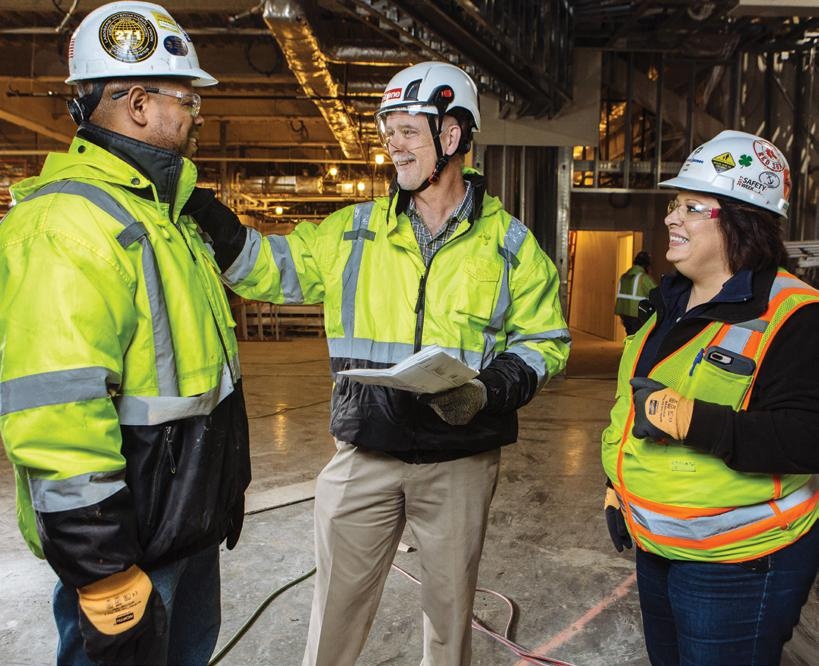
Gilbane’s 2017 annual report carried a photograph of McKelvy listening to colleagues at the Twin River Casino and Hotel project in Tiverton, Rhode Island. In his accompanying letter, he emphasized employee development, internal collaboration and applying lessons from one project elsewhere in the business. The photograph supplies a welcome change of scale. Before a company becomes a set of annual results, it is people comparing notes in an unfinished room.
The letter also discussed using scans of existing spaces to reduce rework. That is a practical ambition for technology: helping the next decision become more accurate. The building industry has plenty of opportunities for a sophisticated tool to encounter a very ordinary obstruction. An accurate record of what is already there can be worth a good deal of enthusiasm about what might be possible.
The shortage with a human face
By 2021, McKelvy was discussing another constraint on construction: the shortage of qualified people. Gilbane was expanding its corporate presence in Boston, where he had relocated, while keeping its headquarters in Providence. Access to universities, emerging talent and customers formed part of the attraction.
He linked recruitment to inclusion and retention. He also distinguished between material prices already locked into existing work and the higher prices affecting new bids. A project’s economics depend on when commitments were made. The headline price of a commodity cannot explain every contract sitting on a contractor’s desk.
These are connected management questions. A company can have prospective customers and still need the right team to serve them. It can have a full schedule and still face a difficult decision about the next bid. People, purchases and timing put limits around ambition. A growth plan that leaves them in the footnotes is asking the footnotes to perform rather heavy lifting.
“We have to stay nimble.”Michael McKelvy, 2017
Houston, with a different set of structures
McDermott appointed McKelvy president and CEO on February 1, 2022. He also joined the board, succeeding interim chief executive Lee McIntire in the operating role. The assignment brought him into a company whose work includes engineering, fabrication and offshore installation as well as construction on land.
The move changed the assets and customers around him. A marine construction vessel and an office-building project belong to different technical worlds. Each still depends on a series of commitments fitting together: what the client needs, what the engineers design, what suppliers provide and what the execution team can complete.
In 2025, McDermott announced that he would also chair its board. The announcement named Neil Bruce as lead independent director and added investors Michael Martino and Farhad Nanji to the board. McKelvy thanked departing directors Nils Larsen and Tom Burke, describing a period that had included reorganization, refinancing and a strategic divestment.
Those are consequential words in a builder’s biography. Financing helps determine whether an organization has the room to carry out its operating plans. Governance sets responsibilities around the executive making those plans. The boardroom and the project site may use different vocabularies, but both have to deal with commitments made before the final result is visible.
McKelvy also serves on Amrize’s board, bringing his construction experience into building materials and solutions. Shareholders confirmed his re-election in April 2026. His other board service includes Meeting Street, a children’s learning community. Earlier directorships included RPS Group. These appointments extend a working life spent around institutions that design, build, advise and teach.
The work now has dates attached
On March 31, 2026, McDermott and joint-venture partner Chiyoda announced substantial completion of construction and commissioning for Train 1 at Golden Pass LNG in Sabine Pass, Texas. Golden Pass led the start-up operations that achieved first LNG. Work continued on Trains 2 and 3. The distinction matters: a completed stage is a specific achievement within a project that still has work ahead.
Offshore assignments added another set of commitments. In August, ADNOC awarded McDermott and its consortium an Umm Shaif contract covering a new pressure-boosting facility, including a jacket and topside. Engineering and project management were assigned to the United Arab Emirates, with fabrication at the QMW joint-venture yard in Qingdao, China. Geography becomes part of the construction problem.
In September, Eni Cyprus awarded McDermott a subsea contract for the Cronos development. The planned delivery team drew on Houston, Perth, London and Kuala Lumpur, supported by marine construction vessels. An organization chart can put those places into tidy boxes. The actual work requires the boxes to communicate.
The financial picture supplied another measure. For the second quarter of 2026, McDermott reported revenue of $2.3 billion and net income of $41 million. It also reported $76 million of cash used in operating activities and a quarter-end backlog of $15.8 billion. Profit, cash flow and future contracted work answer different questions. Reading them together gives the operating challenge some texture.
On September 21, the company announced completion of a refinancing that included $500 million of equity financing, $550 million of senior secured Nordic bonds and a new long-term letter-of-credit and guarantee facility. Those arrangements concern the capacity behind the projects. A contract award opens a story; the resources to execute it help determine the ending.
McKelvy’s advice about design and construction returns to early conversation between the two. It is an unshowy idea with a demanding implication: people need to expose questions while there is still time to answer them. The distance between a drawing and a building is full of decisions. His career has been spent moving closer to the people responsible for making them.
Company figures, not personal financial measures. Operating cash flow was negative $76 million.