The awkward part of a construction boom is having to explain why you cannot take all of it. In April 2026, Brian Lane was doing just that. Comfort Systems USA had customers, projects and a swelling book of future work. Asked about demand, its chief executive talked about restraint. There was plenty to build. His concern was whether the company could build it properly.
It is a revealing answer from someone whose business had just reported a strong start to the year. An order can look splendid on a spreadsheet long before anybody has to find the electricians. Lane kept the discussion close to delivery: choose familiar work, stay within the company's capabilities, and avoid committing people to more than they can execute. The invitation to grow came with a practical question. Who, exactly, would do the work?
Lane has been CEO since December 2011. He runs a Houston-based contractor whose work includes the mechanical and electrical systems that make buildings function. A finished building gives its architect a handsome photograph. A functioning building owes rather more to the people behind the walls. Lane's career has developed on that less photogenic side of the business, where a promise eventually has to become pipe, duct or wire.
A chemistry degree, then a wider map
His route began with a science education: a bachelor's degree in chemistry from the University of Notre Dame, followed by an MBA from Boston College. The pairing puts technical study and commercial training beside each other on his résumé. Neither degree, by itself, explains the eventual chief executive. The intervening jobs supply the industrial context.
Lane spent fifteen years at Halliburton, working in business development, strategy and project initiatives, and left as regional director for Europe and Africa. He also held a vice presidency at Kvaerner focused on the chemical industry, and a regional directorship at Capstone Turbine, a distributed power manufacturer. Before Comfort Systems, his working world already included engineering, construction, energy equipment and customers across borders.
He joined Comfort Systems in October 2003. The ascent was gradual: regional vice president, senior vice president, then executive vice president and chief operating officer in January 2009. He became president and COO in March 2010 and joined the board that November. By the time the chief executive job arrived, he had spent eight years inside the business. This was a promotion with a long inspection period.
- 2003Joins Comfort Systems
- 2009Chief operating officer
- 2011Chief executive officer
Buying a company without erasing it
The handover from William Murdy was announced in December 2011. Murdy remained non-executive chairman, and lead independent director Franklin Myers credited him with preparing Lane for the transition. Comfort Systems then had 86 locations in 72 cities. Lane inherited an established national organization, along with the delicate task of leading businesses whose value depended on what they knew locally.
Acquisitions make that task particularly personal. Buying a contractor means acquiring relationships, habits and experienced leaders as well as equipment and contracts. In an earlier discussion of integration, while he was president and COO, Lane described detailed diligence and early conversations about what would change under public ownership. The difficult work began before a deal closed: getting to know the people and testing whether the cultures fitted.
Comfort's approach allowed local identities to survive. A shared business model could bring purchasing strength, expertise and resources without requiring every operating company to become indistinguishable. For Lane, the significance is practical. A local team's knowledge cannot simply be packed into a box and dispatched to Houston. The people who understand a market remain part of what the buyer has paid for.
That philosophy also takes time. When Ivey joined Comfort Systems in 2021, Ivey's CEO Denny Terrell described a positive dialogue lasting more than twenty years. Lane welcomed the company's workforce, leadership and service capabilities. The episode gives a more patient picture of acquisition than the usual procession of announcements: a relationship can precede the transaction by a considerable distance.
A seat at the lunch table
The local emphasis has a visible counterpart in Lane's visits. In November 2020, he and Trent McKenna went to BCH Mechanical in Largo, Florida. They toured a new sheet metal shop and met field employees. It is an ordinary item in an operating company's life, which is precisely its interest. The parent company's chief executive was looking at the place where work happened.
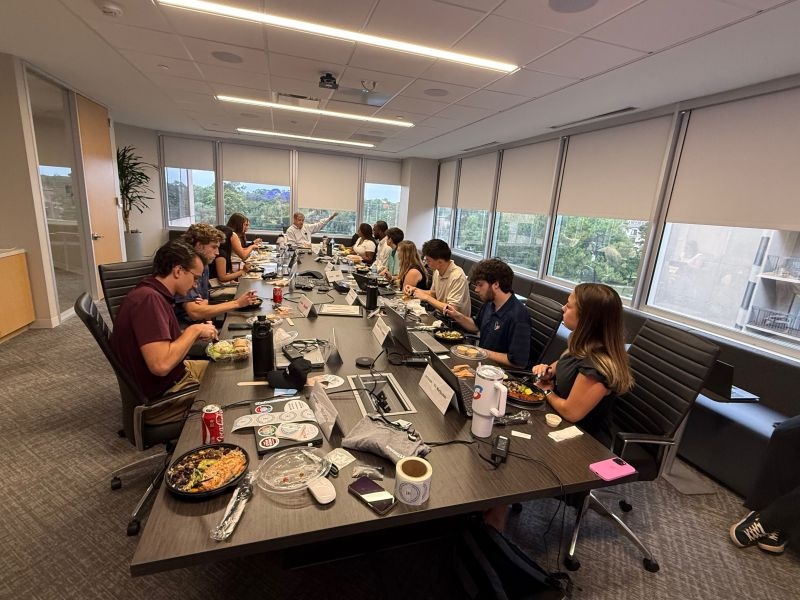
A later employee lunch offers another small scene. Kate Fruehauf posted a photograph of a long conference table and described a conversation with Lane about the company's direction and leadership. She highlighted his interest in connecting with employees at different levels. The picture contains meals, laptops and a CEO at the far end of the table. Corporate culture, for once, has somewhere to sit.
One lunch cannot stand in for an entire organization. It does, however, fit a recurring emphasis in Lane's public remarks: results belong to operating teams. He returns to field leadership, training and the people carrying out the installation. The emphasis matters in a trade business because growth depends on skills that take time to acquire. Signing another contract cannot instantly create another experienced crew.
The factory behind the building
Lane's interest in the work extends to changing how it is done. In October 2021, discussing off-site construction, he singled out local leadership, the workforce and advances in welding. “I love going there,” he said. It was a brief, unusually direct expression of pleasure in the middle of an earnings discussion. The attraction was the improvement happening on the production floor.
Off-site construction moves parts of the building process into a manufacturing setting before delivery to the project. For a mechanical contractor, that changes where assembly takes place and how work can be organized. The building site still matters. So does the factory preparing systems for it. Lane's organization has been investing in both.
By the first quarter of 2026, Comfort was buying modular assembly space and investing in automation. McKenna described a goal of four million square feet of modular capacity by year-end. That was a target, rather than a completed milestone. The distinction matters: space, machinery and people must become usable capacity before an expansion can serve customers.
The investment sits alongside a less glamorous management job: deciding which technologies actually help a crew. In a 2024 discussion, Lane praised McKenna's team for filtering construction technologies and finding applications in the field. A useful innovation earns its place through the work it improves. For a company selling installation and service, that is a more demanding test than whether a demonstration looks impressive.
“I love going there.”
Brian Lane, on off-site operations · October 2021
Big numbers, finite crews
The scale has changed. Comfort Systems reported $9.10 billion in revenue for 2025, compared with $7.03 billion in 2024. Operating cash flow rose from $849.1 million to $1.19 billion. Those are company results achieved during Lane's tenure, with the work of many operating businesses and a wider management team behind them.
The second quarter of 2026 brought revenue of $3.27 billion, against $2.17 billion a year earlier. Backlog reached $14.06 billion at June 30. Backlog represents work ahead; it still has to be performed. The numbers therefore describe both commercial success and a substantial obligation to deliver. A contractor's future is full of things that have yet to be installed.
Technology customers and data centers have become a significant part of the opportunity. Their buildings require physical systems, whatever ambitions the computing inside them serves. On the July earnings call, Lane again pointed to the tradespeople carrying out the work. His contribution to the conversation kept returning from financial outcomes to the people responsible for making them possible.
He also allows a little levity into these exchanges. On the April 2026 call, CFO Bill George teased him about complaining despite favorable conditions. Lane replied, “I want to keep crying, Bill.” The joke works because it follows a discussion of real constraints. He could enjoy a good quarter and still worry about the next promise. An earnings call briefly acquired the rhythm of colleagues who know one another well.
Revenue, year by year
Making room at the top
Lane's own responsibilities have changed as the business has grown. He served as president through December 2025, then continued as CEO and director while McKenna became president. In July 2026, Craig Sasser became chief operating officer and Briston Blair became chief strategy and innovation officer. Lane publicly welcomed Sasser's operating experience and industry knowledge.
There is a symmetry here with Lane's arrival in the chief executive job. His own succession followed years of operating responsibility. The current leadership changes again put experienced colleagues in broader roles. That does not settle every question about future growth, but it shows the management structure changing alongside the workload.
His connections also reach beyond Comfort. Lane is an independent director of Main Street Capital, which announced his appointment in 2015. The role places an operating executive on the board of a business that finances other companies. His construction and industrial-services experience is part of the qualification Main Street identifies for that seat.
As of October 21, 2026, the next public checkpoint is close: third-quarter results are scheduled for October 22, followed by an October 23 call. Comfort's latest announcement puts its network at 211 locations in 155 cities. The footprint is larger than the one Lane inherited. The underlying question remains stubbornly human: can the people in those places keep delivering what the organization promises?
Lane has expressed optimism about the remainder of 2026 and into 2027. His more interesting contribution is the condition attached to expansion in his operating remarks: keep selecting work the company can do well. A business can accumulate contracts faster than it develops judgment. Leaving room for that judgment may be a consequential part of the chief executive's job.