At the Dallas County Mesquite Government Center, a $32 million building project, Suffolk Construction faced a familiar predicament: the schedule was tight, and an error on the floor could become an argument between trades. Rugged Robotics’ account of the job gives the proposed layout allowance as seven to eight days per floor. The delivered layout took three. That is a pleasing number. The more revealing detail is that Rugged’s team attended coordination meetings before its machines arrived.
- The job: print construction instructions directly onto unfinished floors.
- The offer: prepared files, robots, and experienced operators, purchased per project.
- The wager: clearer instructions make the installation after layout easier.
The company prints a building’s plans at life size, right where people will build. Wall positions, mechanical openings, symbols, and labels become marks on concrete. A floor acquires the detail of a drawing without requiring every installer to keep translating between the drawing and the room. The charm is practical: the instruction is under your boots.
A printer with a construction problem
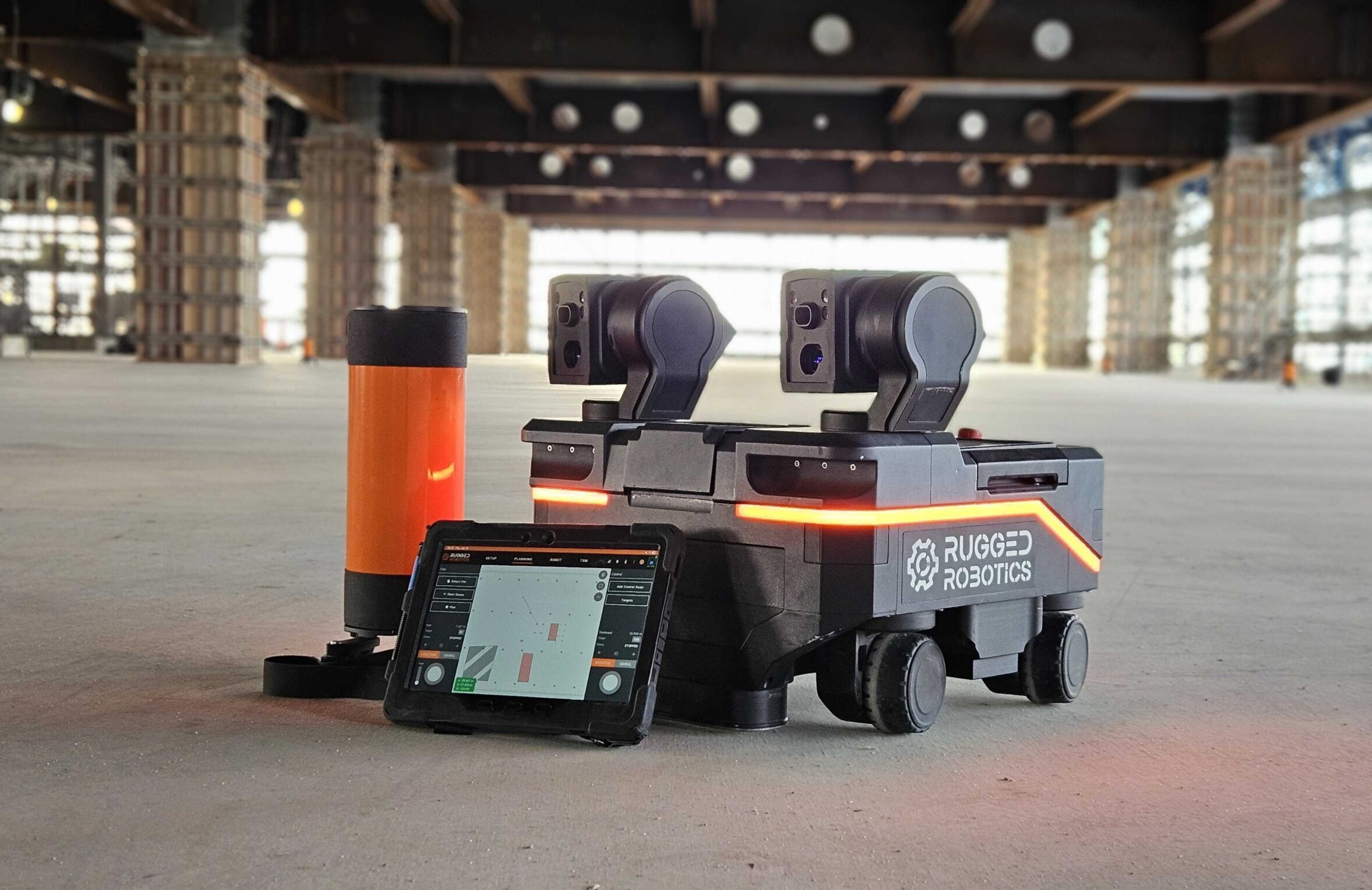
Rugged’s Mark1 is a mobile layout robot. It does not pour concrete. It writes on it. The company describes a holonomic drive system for intricate geometry, a 5½-inch printhead for detailed markings, and navigation using a network of passive targets. Curves and awkward angles are part of the intended job, along with multi-line text. Rugged advertises accuracy of less than one-eighth of an inch.
The two founders brought complementary experience. Derrick Morse is a professional engineer with a commercial-construction background. Logan Farrell worked in NASA’s robotics research and development team. They founded Rugged in 2018. Their stated aim was to tackle the inaccuracies of manual field layout while freeing crews to concentrate on their craft.
A $2.5 million seed round in 2019 preceded a $9.4 million Series A in March 2022. BOLD Capital Partners and Brick & Mortar Ventures led that later round; Consigli Construction and Suffolk Technologies also participated. Builders were helping finance a tool meant for builders.
For printing, Rugged collaborated with industrial inkjet supplier REA JET US. The supplier’s account describes engineers adapting a large-character drop-on-demand printhead to the robot. That division of expertise is telling: Rugged could concentrate on getting the machine around a jobsite while working with a company already accustomed to putting durable marks on materials.
The work before the wheels turn
Rugged accepts design information from tools including Revit and AutoCAD, as well as CSV files. Its service reviews and prepares those assets, coordinates deployment with the project team, checks reference coordinates, and establishes targets before printing. The machine’s movement is the visible performance. Much of the useful work concerns what it has been asked to print.
In Mesquite, Suffolk worked with BIM specialist VIATechnik and Rugged to coordinate the model. Two robots and two operators then printed instructions for several trades. Rugged reports more than 75% less rework on that project. The sequence matters: coordination came first, printing second. Treating the result as a robot-speed contest would miss the information work that made the robot useful.
Company-reported case study. Bar lengths compare 8 days with 3; outcomes vary by project.
Buy the layout, bring the people
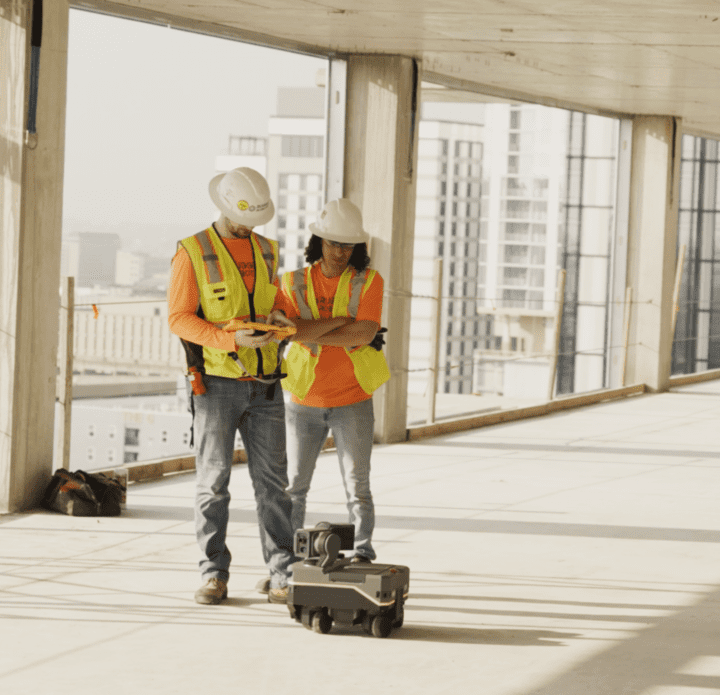
A contractor buying a robot also acquires responsibilities: operating it, preparing its files, arranging its movements between projects, and finding enough work to keep it occupied. Rugged sells an alternative allocation of those responsibilities. Its own team brings and operates the machines. The customer buys the completed layout as a project service.
The distinction is commercially useful. Dusty Robotics’ FieldPrinter and HP SitePrint also address automated construction layout. Rugged’s positioning rests on the people and preparation bundled with its hardware. Its passive-target approach is another distinction; Dusty’s current FieldPrinter 2 specifications describe a laser tracker. Those are different implementations, not grounds for declaring a winner without knowing the job.
Rugged quotes according to project size, schedule and location, the trades involved, the density of information, and unusual conditions or logistics. That makes procurement a discussion about a particular slab. A sensible comparison includes staff time and installation consequences as well as the price of producing the marks.
“Our end goal was to automate the things that make sense to automate in commercial construction.”
Logan Farrell / co-founder / REA JET case study
The labels travel further than the robot
At a 44,000-square-foot manufacturing facility in Kilgore, Texas, Brogoitti Construction needed to position equipment supplied by Selmers. Rugged helped enrich the CAD data with dimensions and part numbers. Two Mark1 robots printed more than 3,000 marks in four days. Crews could unload and pre-stage equipment according to those numbers. The floor was serving as an assembly guide.
Rugged’s case study says the projected layout-and-installation period fell from eight weeks to under two, with approximately 50% hard-dollar savings. These are reported results from one job, rather than a universal discount. They suggest a useful measurement: count the work that clearer layout removes later, not merely how quickly the printer moves.
The data-center example makes the same point through different details. On a Hensel Phelps project covering more than 250,000 square feet, Rugged supplied operators and robots across five deployments. Printed door IDs, swings, frames, and ceiling heights helped framers. The company reports more than 750 layout hours freed up and framing installation more than 15% faster.
Settle the instructions first
In 2025, Rugged received IEEE’s Robotics and Automation Award for Product Innovation. Recognition aside, its approach offers a copyable habit: settle the shared instructions before work reaches the floor. Ask which labels an installer needs, check the reference coordinates, and involve the layout team during coordination.
The inference is straightforward. A fast printer given incorrect geometry can distribute an error efficiently. The value depends on reliable design information and control, alongside a site and schedule suited to deployment. Rugged offers pilot projects, giving contractors a way to examine the process on their own work. The useful question is whether the next person can build with fewer stops to decipher what the last person meant.