A construction project has an awkward way of rewarding competence. The electrician does the work, the building gets finished, and the job disappears. Success contains its own dismissal notice. For a contractor, meanwhile, the next project can require people who were available last month and have since gone elsewhere. Buildforce has made a business out of this badly timed exchange.
- Vetted electricians, W-2 employment, and software for the people hiring them.
- Work records that carry hours, attendance, and skills into the next assignment.
- A published staffing markup starting at 40%, with lower rates at volume.
The Houston company sits between electrical subcontractors and electricians working on commercial and industrial construction. Workers use a mobile app; contractors use a web platform. Buildforce recruits and screens the labor, handles payroll, and supplies tools for managing assignments. The customer buys access to a workforce and an operation capable of administering it.
01 / The job ends. The record travels.
Moody Heard, Vu Brown, and Michael Orcutt founded Buildforce in 2019. Its worker app launched in Texas in 2020; the contractor marketplace followed in 2022. Heard’s description of tradespeople “working themselves out of a job” captures the founding problem neatly. A trade can provide valuable expertise without providing a dependable bridge between one employer’s project and another’s.
Buildforce’s current focus is electrical work. That specificity matters. “Skilled labor” is an enormous category; a contractor needs someone suited to a particular installation. Serving one trade lets the company organize screening, project requirements, and work histories around a vocabulary its customers actually use. Generality looks impressive in a pitch. Specificity helps assemble a crew.

02 / The résumé acquires a memory
The screening described on Buildforce’s site includes a 15-question assessment and a 30-minute recruiter interview, followed by background, eligibility, and credential checks. Once electricians work through the platform, their profiles accumulate hours, attendance information, and contractor reviews. These “Player Cards” give a hiring manager something more substantial to inspect than a promise made over the telephone.
The upgraded applicant view described in 2026 goes further: it displays skill-specific hours from completed Buildforce jobs, project details, and work history. New workers have interview notes and recent employers shown instead. Buildforce says contractor feedback shaped the changes. The distinction is useful: an interview describes what someone says they can do; a work record documents experience acquired on assignments.
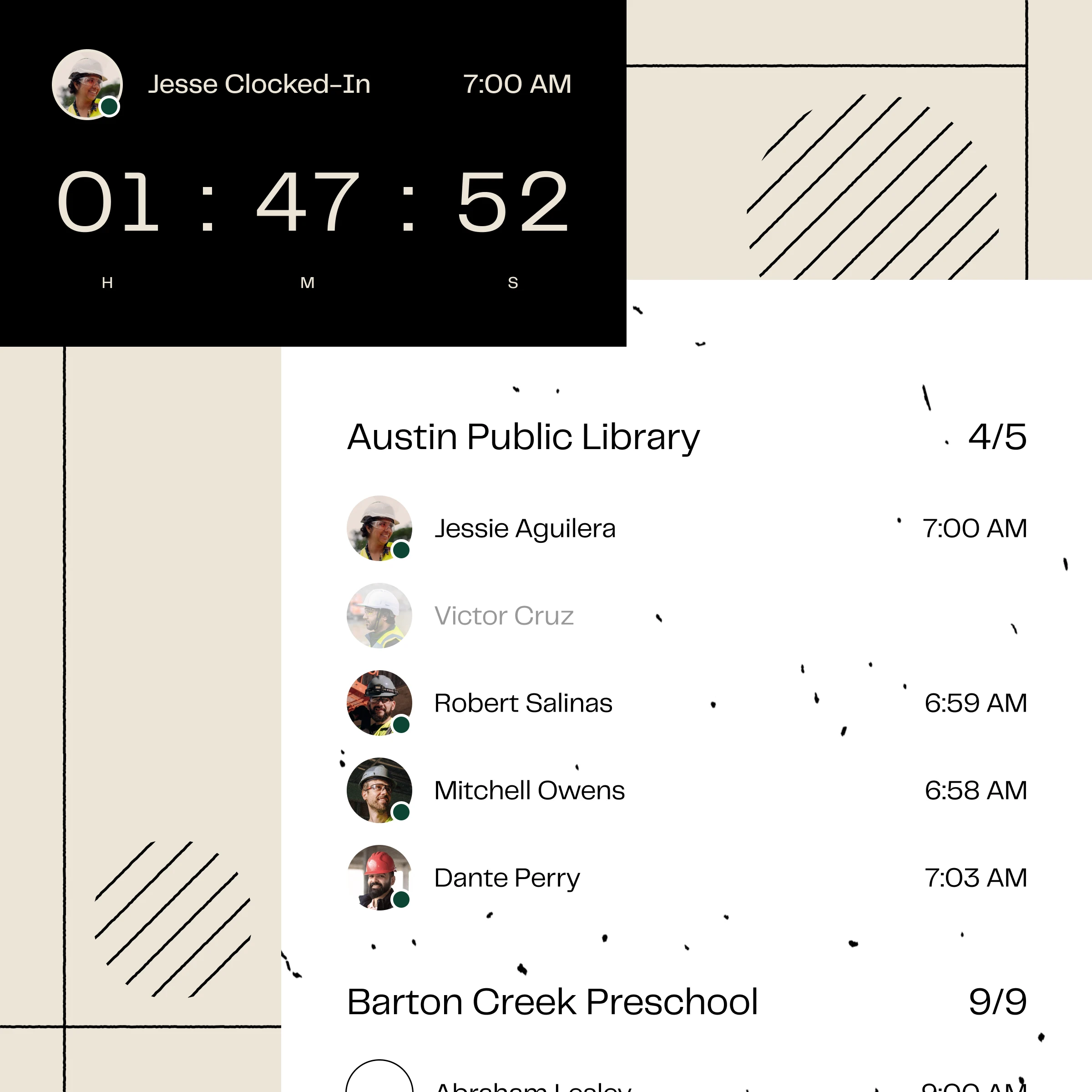
Reliability also earns a small, wonderfully concrete reward. The published All-Star program requires 500 hours and a 95% on-site rate. Perks include a $100 bonus, a $25 monthly gas stipend, and access to jobs 30 minutes early. A badge may flatter the ego. Gas money has other uses.
03 / A faster crew, with a real bill
Consider Dailey Company. In Buildforce’s customer account, project manager Agustin Pacheco describes rising labor demand and the unwelcome time required to recruit internally. The company needed workers sooner. Buildforce supplied 15 of the 19 electricians at the peak of Dailey’s Lone Star project; the account reports more than 14,000 hours worked in 2023.
“Buildforce offered a faster solution which was an immediate value-add.”
Agustin Pacheco / Dailey Company
In Buildforce’s published customer account
The price is explicit. Buildforce’s published standard staffing markup starts at 40% for up to ten workers and declines as low as 32.5% for an average of 100 or more. At the starting markup, an illustrative $30 hourly wage becomes a $42 contractor bill. The extra $12 is a staffing charge; it should never be mistaken for pure profit.
Example calculation, not a wage quote. Actual prices vary by worker and market.
Software for hiring and managing Buildforce temporary electricians is included. Contractors managing their own W-2 workforce pay a published $99 monthly base plus $9 per user. That gives the business both a labor markup and a separate software subscription. Its practical alternatives are direct recruiting, existing crews, and conventional staffing agencies. The useful comparison is the total cost of getting suitable people onto a site.
04 / The electrician who will travel
A worker can be qualified and still be in the wrong place. Sapphire Companies’ Buildforce case study describes that problem after Hurricane Helene damaged North Carolina Walmart stores. Local availability, licensing, and willingness to travel complicated recruitment. Buildforce reports first placements at the Asheville project on October 25, 2024, 28 days after the hurricane struck.
The same account reports 122 electrician positions filled across 38 Sapphire projects in 14 states over six months. Those are company-published customer results, rather than a universal service promise. They illustrate why geography belongs inside the product. Buildforce’s Travel Jobs feature lets workers register willingness to travel and shows per diem and lodging information in listings. Moving a person requires considerably more detail than moving a pin on a map.
05 / Buying the next set of relationships
In December 2024, Buildforce acquired Atlanta-based Ladder, whose announced network included more than 10,000 pre-screened electricians and over 200 customers across six states. Founder Alex Stewart joined Buildforce. The acquisition brought regional relationships as well as a platform. In July 2026, a $10 million Series A led by Saepio Capital supplied expansion funding; Buildforce reported over two million hours across more than 2,000 commercial projects.

Its published values include “Make music,” a metaphor for collaboration, experimentation, and order. That is an unusually apt ambition for a business coordinating crews. The lesson others can copy is practical: let completed work improve the next match, and make the terms visible. The conditions still matter. Records cannot manufacture scarce skills, travel requires willing workers, and a suitable electrician must meet the project’s requirements. The next job needs evidence, people, and someone answering the phone.
Follow the next assignment
Explore the platform, customer accounts, and product updates.