A lumberyard without inventory or trucks is a peculiar thing to ask a building materials executive to imagine. Customers tend to be fond of the materials. They are also attached to the materials turning up. Yet LT Gibson put precisely that challenge to his team, according to his colleague Randy Aardema, who recalled it during a 2014 industry panel.
“I want you to envision a lumberyard that has no inventory and no trucks.” That was the assignment. Aardema’s recollection included the team’s understandable first task: working out what their chief executive meant. Gibson was stretching the frame around a familiar business, making its people consider possibilities beyond the yard they already knew.
Gibson’s career contains a persistent tension. He has built a business by acquiring established local companies, then asked the people inside them to keep improving. History has value in his world. Habit still has to earn its keep.
Sixteen locations, and a different bargain
Gibson founded US LBM in 2009, after working at Stock Building Supply. His experience there included managing its New Jersey market and directing its Roofing and Siding Business Group. This was an entrepreneur coming out of the operating business, already acquainted with the particular complications of supplying construction professionals.
Building Industry Partners principals and BlackEagle Partners backed the venture. The initial management buyout involved divisions of Stock. US LBM began with 16 locations, a modest starting footprint for the national organization it would become. The investment idea placed considerable weight on what those local operations already possessed: their brands, leadership and customer relationships.
That choice gave Gibson a specific job. Buying a business would bring it into a larger organization without erasing the reasons customers used it. A local name could remain on the door. Local managers could retain authority. National resources would have to make those arrangements more useful.
There is a small, human recollection behind the corporate origin. A Wisconsin Building Supply employee later remembered Gibson and Bill Imig joining together to save the division from closing. For someone working there, the founding of US LBM was an event involving a workplace and a future, rather than a new entry in a deal database.
Operating locations at founding, the tenth anniversary and the fifteenth anniversary. Bars use 460 as the 2024 lower bound.
The customer belongs to a place
By October 2019, US LBM had 256 locations in 32 states. The footprint was national; the commercial approach still depended on local expertise. Gibson’s enterprise had grown large enough to offer the resources of a substantial distributor while continuing to trade through businesses rooted in particular markets.
His explanation of that arrangement was unusually attentive to age. In a 2018 letter to prospective stockholders, Gibson pointed out that US LBM was less than nine years old, while its partner companies had been operating for an average of 70 years. The young parent company was buying into histories considerably longer than its own.
That observation changes how an acquisition looks. The acquired company brings accumulated knowledge as well as sales. The parent brings resources a smaller business may struggle to justify on its own. Gibson’s case for combining them rested on respecting both contributions. A national spreadsheet is helpful, though it rarely knows a customer by voice.
“US LBM is and will always be a company that is about our people.”
L.T. Gibson / 2018 letter to prospective stockholders
The lumberyard with nothing in it
The empty-yard challenge adds another dimension to that respect for established businesses. Aardema, then an executive responsible for supply chain, described Gibson as someone who pushed colleagues to think beyond their current position. Imagining the absence of inventory and trucks forced attention onto the supply chain itself.
The remark invited speculative thinking about how materials reach customers. Its value lay in asking a team to reconsider the physical arrangements it took for granted. Once the familiar furniture is removed, even mentally, the work has to be described again: what does the customer need, and how should it reach them?
Gibson’s interest in new ideas also appeared in how he discussed investors. After the Kelso partnership, he described capital as only part of the benefit. New partners brought experience and knowledge. His team could absorb what helped it improve. For a founder overseeing acquisitions, that is a consequential admission: useful ideas can arrive with the other side.
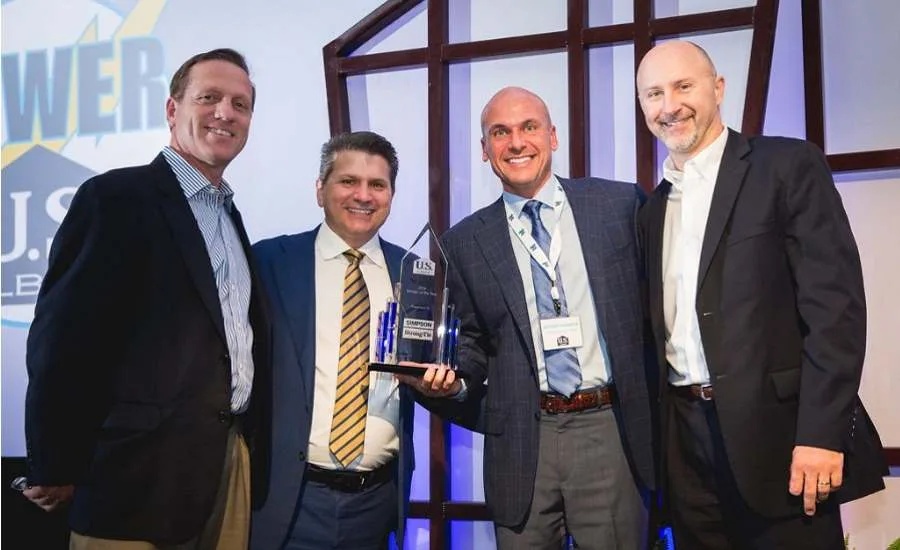
A photograph from an Amelia Island gathering supplies a quieter picture of that network. Gibson stands second from the left beside a trophy presented to Simpson Strong-Tie, US LBM’s 2016 Vendor of the Year. Suppliers have their own sales, shipping and manufacturing teams. Recognizing their contribution puts faces around the otherwise bloodless word “partnership.”
Putting the culture between covers
In 2016, Gibson published The Story of Us: How the Culture at U.S. LBM is Changing the Distribution Industry. It is a telling choice of subject for a distributor’s chief executive. The book puts the organization’s working culture at the center of its account of the business.
Released by Advantage Media Group, the book also connected his management argument to the company’s charitable work. Its publisher specified that all proceeds would benefit the US LBM Foundation. Readers were being offered a description of how the company wanted to work, with the proceeds directed toward organizations outside it.
Gibson’s stated sequence begins with employees: care for them and help them develop, so they can better serve customers. His own education includes a business administration degree from Morehead State University and executive leadership programs at Duke’s Fuqua School, Virginia’s Darden School and IMD. Formal learning remained part of his preparation beyond his undergraduate years.
Empowerment also appears in US LBM’s written operating principles, alongside accountability, integrity and respect. Local autonomy comes with obligations to colleagues and partners. The combination matters. A business can grant someone discretion and still expect them to explain the decision. Without that second part, empowerment becomes a rather expensive way to avoid a conversation.
The employee accounts give that philosophy an everyday setting. At Shelly’s Supply, a production leader described coming to the business as a logistics coordinator after finding little room for advancement elsewhere. The attraction was the chance to keep learning and take on a larger role. The story belongs to that employee, but it illustrates the opportunity Gibson says he wants the organization to provide. A national network can offer somewhere to go, as well as somewhere to report.
New owners, a familiar promise
As the business expanded, Gibson continued leading through changes in its financial backing. Kelso’s investment arrived in 2015. In November 2020, Bain Capital announced an agreement to acquire a majority stake, with Gibson and the management team continuing in place. The company then had more than 250 locations.
Expansion also meant opening locations from scratch. By the 2020 Bain announcement, US LBM had opened more than 30 such sites since its founding, including six that year. That detail complicates a story told entirely through acquisitions. Gibson’s organization was also creating operations of its own, putting the national company’s resources behind new local starting points. An inherited customer relationship and a newly earned one both needed a place in the business.
In October 2023, Bain and Platinum Equity announced an agreement for equal ownership stakes and joint board governance. Again, the announcement specified continuity under Gibson. It described growth supported by acquisitions, data and analytics, supply-chain work and investment in the customer experience.
Those transactions gave his local operating argument an increasingly substantial national setting. They also required the founder to work with successive capital partners while retaining responsibility for the organization beneath them. Across the ownership announcements, local market focus remained a recurring element of the case he made for US LBM.
That same year, Gibson won an EY Entrepreneur Of The Year Southeast award. An independent panel evaluated candidates on growth, purpose, impact and the creation of lasting value. His public response credited the associates whose work earned customers’ and suppliers’ trust. The recognition went to an individual; his account of it returned to the organization.
The business beyond the bill of materials
Technology offers a practical test of Gibson’s appetite for change. US LBM introduced a customer mobile application in 2014, giving users access to order and delivery tracking, invoices and offers. In March 2025, Jonathan Greene took the expanded role of Chief Digital and Technology Officer, reporting directly to Gibson.
“Technology and Digital are critical to our future success,” Gibson said. Greene’s responsibilities combined platforms and systems with digital strategy. The appointment connected the founder’s interest in better ways of operating to a defined leadership role. The lumberyard could retain its local identity while the tools behind the counter changed.
Environmental work reaches into equally physical decisions. US LBM describes efforts involving route planning, structural component manufacturing and products that can reduce waste or energy use. Gibson has framed the company’s responsibility in terms of the communities it helps build. For a distributor, those ambitions meet the everyday mechanics of material sourcing, production and delivery.
The foundation extends that community connection. Established in 2013, it reported more than $3 million raised at its October 2025 golf tournament. The event also introduced the L.T. and Lina Gibson Partnership Award. Business relationships had become a means of assembling resources for work beyond the company’s locations.
Gibson’s story keeps returning to the same difficult act: bringing people into a larger undertaking while preserving their reason to care about it. The locations multiply. The tools change. The work still reaches a particular customer through particular people. His imagined empty lumberyard clears away almost everything familiar. Those relationships are what remain to build around.
Follow the story
Explore Gibson’s work and the milestones behind this profile.