Michael Waterbury arrived at the University of Richmond with a baseball scholarship and a plan. The plan ran into a familiar sporting inconvenience: other people were good at baseball, too. Playing time was scarce. He pitched batting practice and helped maintain the field. When another talented class arrived, he turned more of his attention to the classroom.
He had captained three teams at Newtown High School: baseball, basketball and soccer. Richmond required a change of direction. He studied business, concentrating on finance and marketing, and graduated in 1995. The young athlete who had expected to compete for a place in the lineup began looking for a different kind of work.
There is a temptation to make every early disappointment into a prophecy. Waterbury’s later career does not need that treatment. The baseball scholarship is interesting because it leaves the uncertainty intact. A person can be capable, ambitious and prepared, and still have to reconsider the plan. The next chapter takes some finding.
A different kind of starting lineup
Waterbury found his professional footing at Oxford Health Plans. Over the following years, he advanced from financial analyst to executive, then continued his career at Magellan and ICORE. Those jobs gave him experience inside large organizations, where individual expertise comes with an extensive supporting apparatus. Someone handles the accounts. Someone understands the contracts. Someone keeps the technology working.
In 2015, he founded RemedyOne. Five years later, he founded Goodroot as a parent company that could help other entrepreneurs launch businesses. The sequence matters. He had built a company before building an organization intended to support company builders. His second venture could draw on the difficulties of his first.
Goodroot brought finance, legal, sales and marketing services within reach of affiliated businesses. A founder could pursue a particular commercial idea while drawing on capabilities usually associated with a much larger employer. Waterbury had moved from working inside that kind of structure to trying to make it available to others.
The business arrangement carries a human question: what happens to a promising person’s time? A founder can have the experience to identify an opportunity and the persistence to pursue it, yet spend the day on obligations that require an entirely different set of skills. The calendar becomes crowded before the company does.
The work around the work
Waterbury has been candid about his own introduction to those obligations. Email, a website, taxes and legal structure absorbed attention after he became an entrepreneur. In corporate life, other people had handled much of that work. On his own, he discovered how much of the day it could claim, and how little some of it suited his strengths.
That experience sits close to the center of Goodroot’s proposition. The company supplies business support so a founder can concentrate on the idea that brought them there. Waterbury’s instruction is brisk enough to fit on a small piece of paper:
“Just worry about your idea.”
Michael Waterbury
Of course, an idea still has to survive contact with customers, colleagues and a bank balance. Shared services cannot settle every question. They can give those questions to people equipped to answer them. A capable accountant has something to contribute to entrepreneurship, even if nobody asks the accountant to deliver the launch speech.
Waterbury’s business writing treats early failure as something leaders should examine closely. In an August 2022 essay, he identified five hazards: poor hiring, weak selling, excessive attention to fundraising, incompatible investor incentives and an ill-chosen name. It is a list with very little romance. It also gives a founder useful places to look.
His advice includes taking care with the first hires and evaluating what an investor can contribute beyond money. He is alert to the possibility that raising capital can consume the very person a young business depends on. A crowded fundraising calendar has an opportunity cost, even when the eventual announcement looks impressive.
The point reaches beyond any particular startup. Money, attention and expertise are separate resources. A business can acquire one while running short of another. Waterbury’s emphasis on practical support asks a prospective founder to consider all three before deciding what kind of help to seek.
Goodroot’s shared capabilities give affiliated teams access to specialist support.
Let the people write it down
The same attention to working conditions appears in Waterbury’s account of hiring. He has described creating positions around talented people, including people known through earlier professional relationships. That approach leaves room for a conversation about what someone could contribute before every detail of the job has been fixed.
He has also described an annual culture book, assembled with contributions from employees. Each person puts thoughts and experiences into writing. A company’s account of itself becomes something colleagues can read, compare and discuss. The practice gives the word “culture” a little more substance than it has on a recruitment poster.
“Language and the words we use matter,” Waterbury wrote. An employee’s account gives management something specific to consider: what the work feels like to the person doing it. An annual book also creates a record. The description has to live on a page, where others can recognize it or ask questions.
In 2024, Goodroot appeared on Inc.’s Best Workplaces list. The company reported a rounded survey score of 94 out of 100, with 90 percent of employees describing themselves as highly engaged. Employees used “collaborative” to describe the environment. The recognition involved an employee survey conducted by Quantum Workplace.
HIGHLY ENGAGED
Employees in Goodroot’s 2024 workplace survey.
A dated survey result, rather than a current workforce count.Those figures give a dated measure of the workplace Waterbury was trying to build. They sit alongside the quieter practice of asking people to write about it. One produces a number; the other produces sentences. A leader interested in the quality of working life has reasons to pay attention to both.
When the supporting cast gets its own stage
In June 2025, Goodroot launched Sixfold, a creative agency led by CEO and founder Liz Chasse. The team had already worked on branding, design and market positioning for businesses within Goodroot. Its services included brand development, content, websites and campaigns. Work done for an internal community became available to outside clients.
For Waterbury, the agency’s development offered a close test of his approach to talent. An organization needs support functions to operate. A support function can also contain the beginnings of a business. Recognizing that possibility requires looking closely at colleagues whose work may otherwise be treated as part of the background.
By August 2026, he was reflecting on Sixfold’s first year. He described a decision based on accumulated experience with the team and confidence in Chasse’s leadership. Outside businesses had asked for its help. The opportunity became clearer over time, through completed work and repeated requests, rather than a single revelatory meeting.
The transition brought an ordinary commercial concern: existing Goodroot businesses might receive less attention as the agency took on external clients. Waterbury said the team maintained its service to those businesses. That detail matters because it puts an operating question inside the growth story. An expanding client list still requires someone to manage the calendar.
A separate example arrived in September 2025, when Goodroot announced the sale of ClearFile to Lumelight. Founder Joe Boyle had developed a software business addressing regulatory filing complexity. Goodroot provided capital and support across legal, technology, product and commercial strategy. Boyle remained president following the transaction.
ClearFile gives the shared-services model a concrete sequence: a specialist brings an idea, a supporting organization helps build the business, and an acquisition opens another chapter. Waterbury’s role in that sequence includes backing someone else’s expertise. The result depends on what that person knows and what the surrounding team makes possible.
Room to keep growing
Public recognition has followed Waterbury’s entrepreneurial work. He was an EY Entrepreneur Of The Year New York finalist in 2020. The distinction belongs to a career that had already crossed from executive employment into founding. Goodroot subsequently received recognition for its workplace and its broader business mission.
The founder’s launch in October 2020 gave that mission a local setting. Goodroot marked the occasion by planting 19 crab apple trees at a park in Canton, Connecticut. The trees formed a barrier between a road and a baseball field. A business with national ambitions had chosen a place close to home for its beginning.
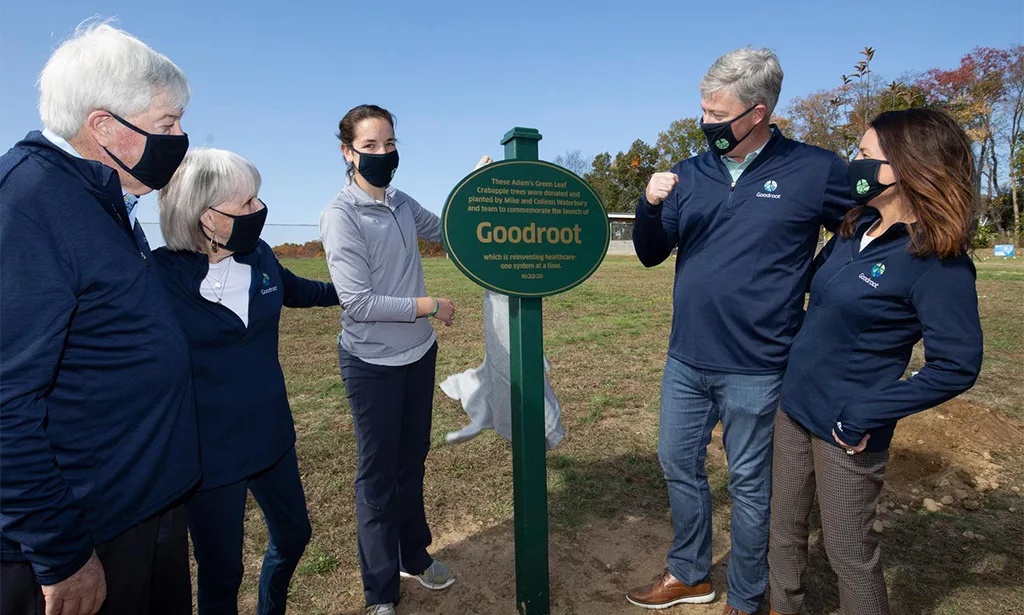
The image from the event shows Waterbury beside a green plaque, with other participants gathered around it. It is a modest piece of business theater, and a rather durable one. Trees keep their own schedule. A press announcement can be finished in an afternoon; a planted tree asks for a longer relationship with the place.
There is a pleasing coincidence in the baseball field beside the launch trees. Waterbury’s first plan involved finding a place on a team. His later business involved helping people assemble teams and companies of their own. The connection does not explain his career. It gives the story a recognizable setting, with room for ambition, disappointment and another attempt.
His work now turns repeatedly toward that next attempt: the person with expertise who needs a business around it, the colleague whose abilities could reach a wider audience, the founder who needs time to work. Michael Waterbury has made those practical questions part of his own enterprise. The interesting part is watching whom he makes room for next.