A machine-learning model has two lives. In the first, it is young, adored and surrounded by compute. It performs for benchmarks. It stretches out in memory. Nobody asks it to live for a year on a battery. Then comes the second life: the model is packed onto an actual device, where memory has walls, latency has a stopwatch, and energy arrives with a bill. This is the life Evan Petridis cares about.
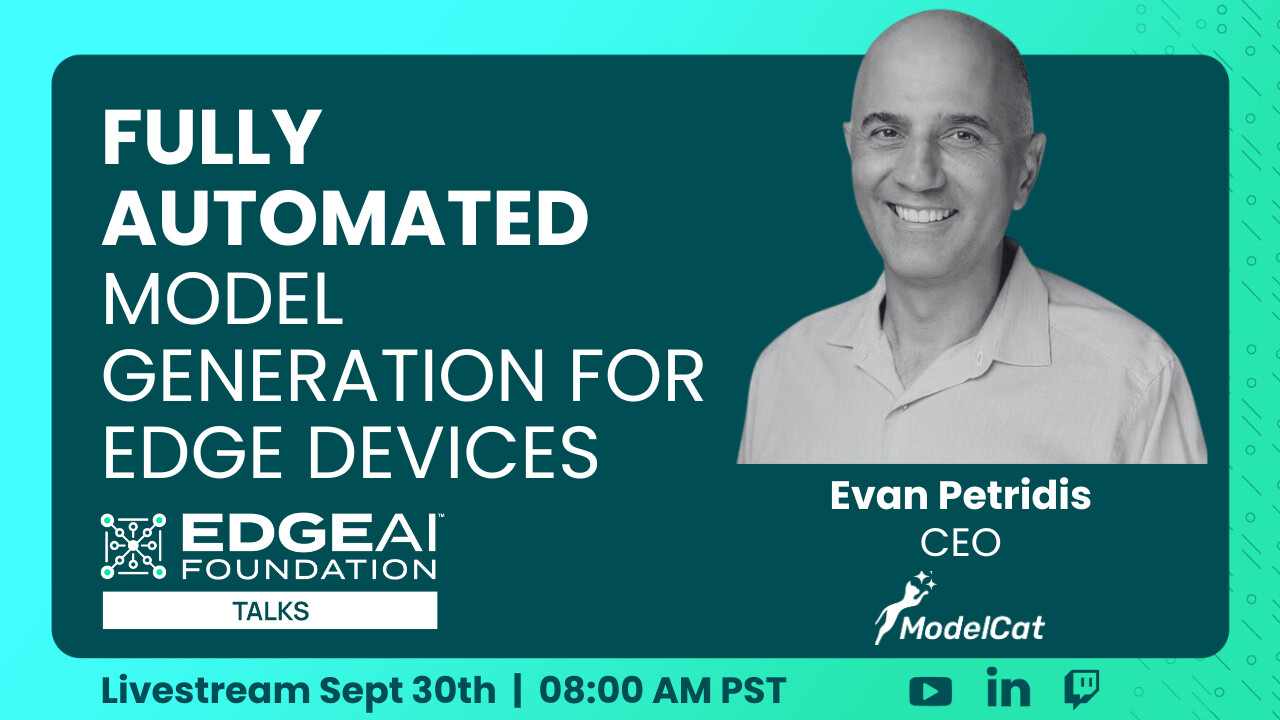
Petridis is the CEO and founder of ModelCat, the Sunnyvale company previously called Eta Compute. Its premise sounds recursive enough to belong on a whiteboard after midnight: use AI to build AI. The practical version is less mystical. A user supplies data, target hardware and performance requirements. ModelCat’s software explores model architectures, trains candidates, runs them on physical chips, measures what happens, and keeps going. The chip, not a hopeful estimate, settles the argument.
That concern with physical consequences did not arrive with the current AI cycle. Petridis has spent more than three decades around systems that have to work when the demo ends. His record moves from hardware development at Cisco in the 1990s to a networking startup, then to millions of building sensors, and finally to the awkward border between machine learning and embedded engineering. ModelCat is a new company identity, but the underlying obsession is familiar.
Perth, packets and the discipline of limits
Petridis earned a bachelor’s degree with First Class Honours from the University of Western Australia. By March 1993, he was managing hardware development at Cisco Systems. This was Cisco before the internet became household plumbing, when networking products were helping determine what the connected world could become. ModelCat’s account of his career says he played a major role in developing some of Cisco’s successful products. The useful biographical point is not the brand name. It is the starting material: hardware, systems and the habit of engineering within fixed boundaries.
In 1997 he co-founded Atmosphere Networks and became its vice president of engineering. Ditech Communications acquired the company in 2000, and Petridis continued at Ditech as vice president of engineering. It was his first documented startup exit and an early lesson in carrying an engineering idea through a company rather than merely through a lab.
After a period running Petridis Consulting, he joined Enlighted in 2015 as chief system architect. Enlighted put connected sensors into commercial buildings, gathering the signals used to manage lighting and other building operations. Petridis later became executive vice president of engineering and oversaw development and production for an end-to-end IoT system with millions of deployed sensors and supporting cloud infrastructure. Siemens acquired Enlighted in 2018.
“Years back I was building a sensor network. Millions of nodes. All that data going to the cloud.”Evan Petridis, reflecting on the origin of ModelCat’s idea
He has described the thought that followed: if AI could move more processing to the edge, the economics would change. It was tempting and technically inconvenient. The people who built machine-learning models and the people who wrote software for small devices were usually not the same people. Each group knew a difficult domain. The handoff between them was where time disappeared.
The gap between two expert tribes
This gap became Petridis’s working problem at Eta Compute, which he joined in February 2021 as chief product officer and executive vice president of systems engineering. The company then focused on energy-efficient endpoint AI. By November, he was CEO. Under his leadership, its Aptos software evolved into a no-code toolchain for creating and optimizing machine-learning models for constrained devices.
The hard part of edge AI is not simply making a model smaller. A product team may care about accuracy, but it also has to fit a memory footprint, meet a latency target, consume acceptable power and work with the accelerators and software supported by a particular chip. Improving one variable can bruise another. The search space becomes a many-sided negotiation conducted through compilers, libraries, kernels and hardware.
Illustrative only. ModelCat measures each candidate against requirements for the selected hardware.
Traditional AutoML did not fully remove this burden. “The promise of AutoML was that it would generate a model for you, but it was really just a bunch of libraries,” Petridis told EE Times. Experts could go further with those libraries, he said, but people still had to remain inside the loops.
ModelCat’s answer is orchestration. The system can choose an initial architecture, build a candidate, compile it for the target, run inference on real hardware, inspect accuracy and device-level measurements, then prune the network or try another design. Petridis calls the grounding essential. The agent may hypothesize; the hardware gets to disagree.
A rebrand with an engineering confession
In August 2025, Eta Compute changed its name to ModelCat. The explanation involved a playful feline metaphor, but the meaningful part was strategic. The company no longer wanted to be read mainly as a low-power edge specialist. It was presenting itself as a model-building layer for any environment where hardware constraints matter.
“We started with the hardest challenge, AI at the edge, and built technology that can deliver the right model every time,” Petridis said in the rebrand announcement. His stated aspiration was broader: a universal build layer that makes AI development more accessible. The ambition is considerable. The method remains stubbornly physical.
A partnership with NXP gave the strategy a concrete route into a large chip ecosystem. In September 2025, the companies launched eIQ Model Creator powered by ModelCat for NXP microcontrollers and application processors. The pitch was to move from prepared data to a hardware-tailored model in days, with memory, execution speed, acceleration features and power considered before deployment. ModelCat has also worked with hardware from Silicon Labs, Qualcomm, STMicroelectronics, Synaptics and Alif Semiconductor.
At Embedded World in Nuremberg in 2025, Petridis stood at a Silicon Labs booth beside a demonstration running object detection and tracking on an MG26 microcontroller. The device had 512 kilobytes of RAM. The scene is a compact version of his argument: not a model admired in isolation, but a model behaving in real time on a small machine.
The chip gets the last word
In March 2026, ModelCat announced Model Retargeting, a limited-beta capability for moving an existing trained model to different silicon. Portability sounds like a file conversion problem until the new processor introduces different memory, acceleration, software and performance characteristics. Teams can end up rebuilding much of the model pipeline. ModelCat’s proposal is to let its agent adapt a trained model while respecting declared constraints and then validate the result on its hardware farm.
“The key is it remains grounded.”Evan Petridis on testing the agent’s ideas against actual hardware
Grounded is a revealing choice of word. The AI industry often rewards scale, abstraction and impressive generality. Petridis’s career has run in the other direction, toward narrower machines with finite resources and an obligation to work. His products have lived in network infrastructure, commercial buildings and embedded devices. Even ModelCat’s more expansive mission depends on benches of physical chips.
Hardware development leadership at Cisco begins.
Atmosphere Networks is co-founded; Ditech acquires it three years later.
Petridis joins Enlighted and works on systems spanning millions of sensors.
He joins Eta Compute, then becomes CEO.
Eta becomes ModelCat; NXP tooling and model retargeting widen the platform.
There is a practical lesson in the sequence. Petridis did not arrive at AI model automation through model research alone. He arrived through the recurring cost of integration: smart software on constrained hardware, specialized teams separated by language, and measurements that arrive too late. ModelCat turns those frictions into inputs. Tell the system what the device can tolerate. Let the agent explore. Put the answer on the chip.
His work outside the CEO seat fits the same pattern. Public career records list advisory roles with checkout technology company Zippin, lighting company Filamento and supply-chain sensing business QuayChain. The products differ, but each lives where software must interpret or change the physical world. Petridis has also served as an advisor or board member to technology companies, a continuation of the operator’s view visible in his own ventures: systems are judged by what survives contact with customers, infrastructure and manufacturing.
The language he uses is tellingly procedural. He talks about loops, constraints, measurements and the divide between technical disciplines. Even his critique of earlier AutoML is about unfinished work rather than failed theory: libraries helped, but still left experts inside the process. ModelCat’s aim is to remove more of that manual choreography while keeping the result inspectable through familiar metrics. It is automation framed as a sequence of engineering decisions, not a disappearing act.
Whether that becomes a universal build layer will be decided by adoption, supported hardware and the quality of the resulting models. For now, Petridis has made a clear wager about where useful automation begins. It begins after the grand promise, at the little machine on the desk, when the memory is fixed, the power is finite and the stopwatch is already running.