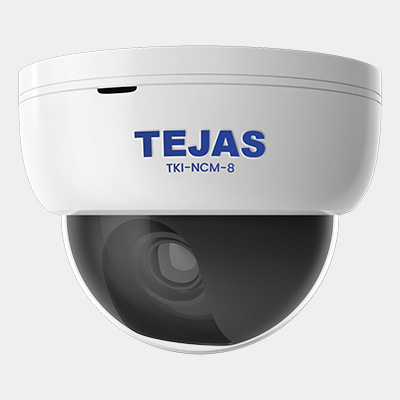
A camera can have very good eyesight and still be a troublesome product. It needs power. It needs a network. It needs somewhere to put its observations, and a way to distinguish an ordinary afternoon from an event worth reporting. Look at Teksun’s Tejas 625 Edge AI Camera and the modest arithmetic comes into view: a nine-watt solar panel, a 3,500 mAh battery, LTE and Wi-Fi, a processor running algorithms near the lens. Intelligence has quite a shopping list.
- The job: engineer connected products, from circuit boards and firmware to apps and manufacturing.
- The shortcut: reusable Tejas hardware and Telep AI algorithms provide starting points for custom devices.
- The buyer: a product company that needs several engineering disciplines to agree before shipment.
That camera is a useful entrance to Teksun. The company’s proposition is easiest to understand through the dependencies inside a physical object. A software demonstration can leave some of those dependencies offstage. A device eventually brings them all into the room. The enclosure and circuit board have opinions about each other. The battery has opinions about everything.
The second act has a component list
Teksun Inc describes a business spanning product design, embedded hardware and software, systems integration, and electronics manufacturing. Its advertised work stretches from mechanical engineering to cloud architecture and mobile applications. Customers can engage it for a new project, a dedicated team, or continuing support. This is a proposal-driven relationship with a business buying engineering capacity and delivery responsibility.
Its manufacturing menu is unusually instructive reading. Alongside PCB fabrication and assembly sit component procurement, test-jig development, mold and enclosure manufacturing, packaging and logistics. These are the jobs that make a product repeatable. A test jig, for example, gives an assembled unit a defined examination before it leaves production. Glamour is scarce here; consequences are abundant.
- 01DefineRequirements & feasibility
- 02EngineerBoard, firmware & apps
- 03ValidateTesting & certification
- 04RepeatManufacturing & support
Editorial map of Teksun’s advertised services. Stages can overlap.
The company says its in-house engineering team exceeds 300, covering hardware, firmware, cloud, software and manufacturing. Its blended onshore and offshore model offers another part of the pitch: access to this range of skills through one relationship. The practical attraction is fewer organizational seams for a customer to manage. Whether that saves money depends on the project and the terms.
A head start, measured in boards
There is a second business idea underneath the services list: reuse. The Tejas 625 system-on-module packages computing and connectivity into a building block. Its published specification describes a Qualcomm 625 processor, Android 9, LTE, Wi-Fi and Bluetooth Low Energy. Teksun’s gateway explanation separates the computing module from a carrier board, whose connections can be adapted to an industry’s needs.
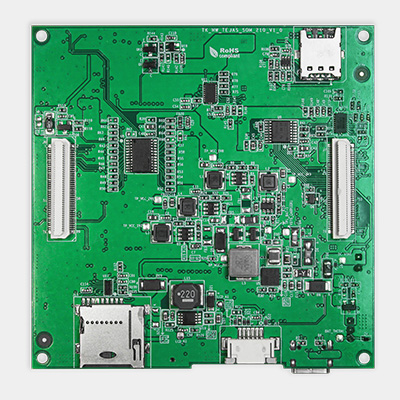
The distinction matters. A customer developing an industrial interface and one developing a health device may need different connections and software while sharing some underlying computing requirements. Reusing a module offers a plausible way to spend engineering effort on those differences. It still calls for an assessment of interfaces, operating-system support, component availability and the intended production life.
Telep supplies another set of building blocks: AI models and algorithms for applications including fall detection, driver monitoring, fire and smoke detection, and occupancy. The Tejas Edge AI Box describes processing device data locally and sending critical information to cloud servers. That architecture can reduce the need to move every observation across a network. Local processing also makes power and computing resources part of the design brief.
The partner who makes the chip useful
BrainChip’s March 2023 announcement gives Teksun’s market position a useful outside description. Teksun joined its Essential AI Ecosystem to bring Akida neuromorphic technology into AI-enabled devices. By May, the companies had announced a prototype for the Embedded Vision Summit. Their initial work covered driver monitoring, face and occupancy detection, and gesture gamification.
In that May announcement, founder and CEO Brijesh Kamani singled out ease of adoption alongside low-power performance. A chip company needs routes into finished applications. An engineering company needs technologies it can turn into something a customer can use. Their interests meet at the workbench.
“it is the ease of adoption that enables them to move rapidly from concept to solution.”
Brijesh Kamani, in BrainChip’s May 2023 announcement
Vivoka’s own May 2023 partnership announcement makes a similar point about voice interfaces. It supplies speech recognition, voice biometrics and natural-language understanding; Teksun develops voice-enabled products for clients. Vivoka’s embedded, cloud-independent technology adds a specialist capability to the integrator’s toolbox. Teksun’s expertise lies partly in bringing such pieces into a working device.
A fall, an alert, a manufacturing plan
The July 2023 Welldercare announcement offers a named application. The Mumbai company’s IKSANA platform was to use unified fall-detection hardware combining Tejas SoM 625 technology and Telep algorithms. Teksun’s release described $66 million worth of planned manufacturing. That number describes the announcement’s ambition; it should not be read as money already earned.
The application exposes why integration matters. A detection algorithm must connect to a device and an alerting workflow before it can serve a caregiver. A convincing model is one piece of that system. Buyers of any safety-related product also need to establish performance in their intended environment and the obligations attached to its use.

Borrow the sequence before buying the service
Teksun serves startups, smaller businesses and enterprises across healthcare, automotive, security, consumer electronics and industrial automation. It fits between an idea-owning product company and the finished device. Alternatives include assembling an internal team or coordinating separate design and manufacturing suppliers. The choice turns on how much of that coordination the buyer wants to own.
The useful lesson is available before a contract: define production needs while defining the product. Ask what can be reused, what must be customized, how each unit will be tested, and who will maintain it. For a simple software task, much of this machinery adds little. For a connected device, the humble component list may be the document that finally gives the idea a future.