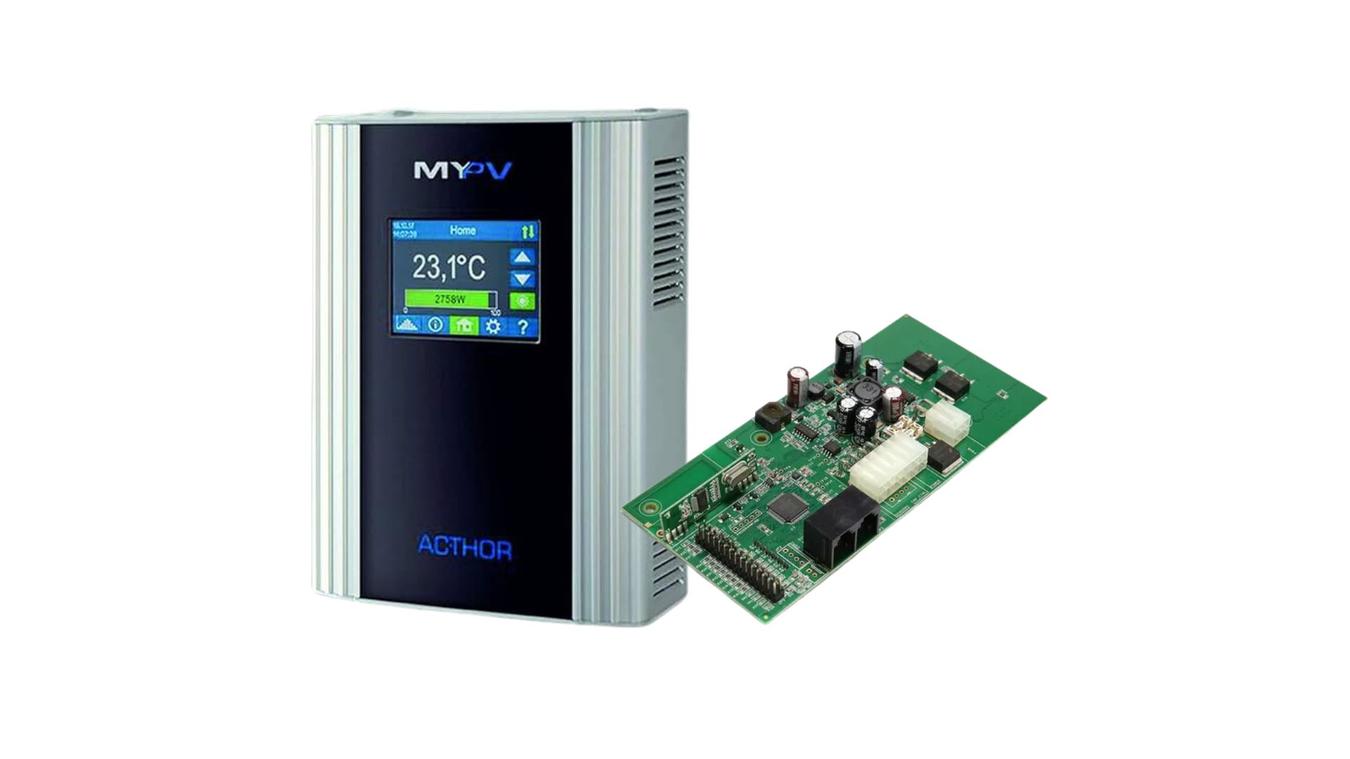
Look at the two objects in Synergy Technology’s solar-heating example. One is a tidy silver appliance with a small display. The other is a green circuit board, all connectors and components. The appliance is my-PV’s AC•THOR. Synergy’s published role is circuit-board manufacturing and assembly. The photograph makes a useful distinction visible: the company whose name you see on the finished product need not be the company that makes its electronics.
- Custom electronics: design, prototype, assemble, test, and support.
- Connected operations: factory, energy, and agricultural data through SynExta.
- The commercial ambition: reusable systems and recurring platform revenue.
That is a good place to begin with Synergy, a Thai engineering and manufacturing business founded in 2008. Its story is about the distance between an idea and a dependable product, then the further distance between a dependable product and useful information. Neither journey looks especially glamorous on a slide. Both can be expensive to get wrong.
The appliance has a second author
Synergy sits in the electronics supply chain, serving businesses that need help bringing hardware into production. Its services run through circuit design, embedded software, prototypes, circuit-board assembly, and box build: assembling the enclosure, wiring, and subsystems into a finished unit. It also supplies testing and support. A customer can arrive with a product concept rather than an already perfected production package.
Two examples give that work some shape. The group identifies Synergy as a supplier to Thai Stanley Electric, with automotive lighting work covering research, prototypes, and production. It also lists PCBA work for my-PV’s photovoltaic heating controller. A car lamp and a device for turning solar electricity into heat have different jobs. They share a need for electronics that can be assembled and checked repeatedly.
This is business-to-business work, sold through a quotation process. For buyers, the useful comparison is between one engineering-and-manufacturing relationship and several separate suppliers. Consolidation may reduce the number of handoffs. It also makes the scope of responsibility an unusually important part of the contract.
The prototype must learn to behave
Synergy’s published development process has eight stages, starting with requirements and ending with after-sales support. Between them sit design, prototyping, verification, manufacturing preparation, mass production, and deployment. Notice how much happens after the prototype. The demonstration proves a possibility; validation and production preparation ask whether that possibility can survive being repeated.
The group also offers pre-testing before a product reaches a certification laboratory. Its stated purpose is to reduce testing failures and save time and cost. This is an appealingly modest kind of innovation: find the awkward surprise while it is still comparatively cheap to address. The service is preparation for formal testing, rather than a substitute for it.
- 01Define
Requirements - 02Build
Design + prototype - 03Verify
Test + refine - 04Repeat
Production + support
A condensed view of Synergy’s published development process.
For a hardware founder, the lesson is portable. Budget for the work between “it functions” and “we can ship it.” Ask who handles component sourcing, test fixtures, documentation, and repair. A supplier’s polished prototype is useful evidence. A clear plan for the next batch is useful evidence of a different kind.
The factory becomes a customer, too
Synergy also sells systems to organizations operating machinery, rather than only to organizations selling electronic products. Its smart-factory offering connects machine and production data, brings it into a common view, and supports alerts, analysis, and integration with business systems. The problems it names are familiar: unplanned downtime, scattered records, disconnected equipment, and incomplete traceability.
Customers listed in its factory material include TFP Automotive Accessories and S.P. Metal Part. In an August 2026 case-study announcement, Synergy reports an 18% improvement in overall production efficiency at TFP after connecting stamping and assembly lines through SynExta. Read that as a company-reported result for a particular installation. A buyer still needs a baseline, a measurement period, and a definition of efficiency before comparing it with their own plant.
“Never stop learning.”Synergy Technology’s stated Learner value
Its engineering scope includes installation, commissioning, user training, and maintenance. That last stretch matters. A dashboard becomes operationally useful when people can act on it. Integration therefore reaches beyond cables and software into the routines of the people running the factory.
A rice field is another kind of system
The agriculture offering moves the same connected-system idea outdoors. Synergy describes sensors, weather stations, irrigation equipment, and multiple farms feeding a central platform. Rules can control pumps and valves; dashboards show field conditions. Public-sector examples on its site include the Royal Irrigation Department and the Rice Department.
The environmental portfolio is equally concrete. The group lists water-management monitoring in Kamphaeng Phet and smart poles with weather monitoring and automatic watering at Benchakitti Forest Park. These are applications with decisions attached: where water is needed, what conditions are changing, and when equipment should respond.
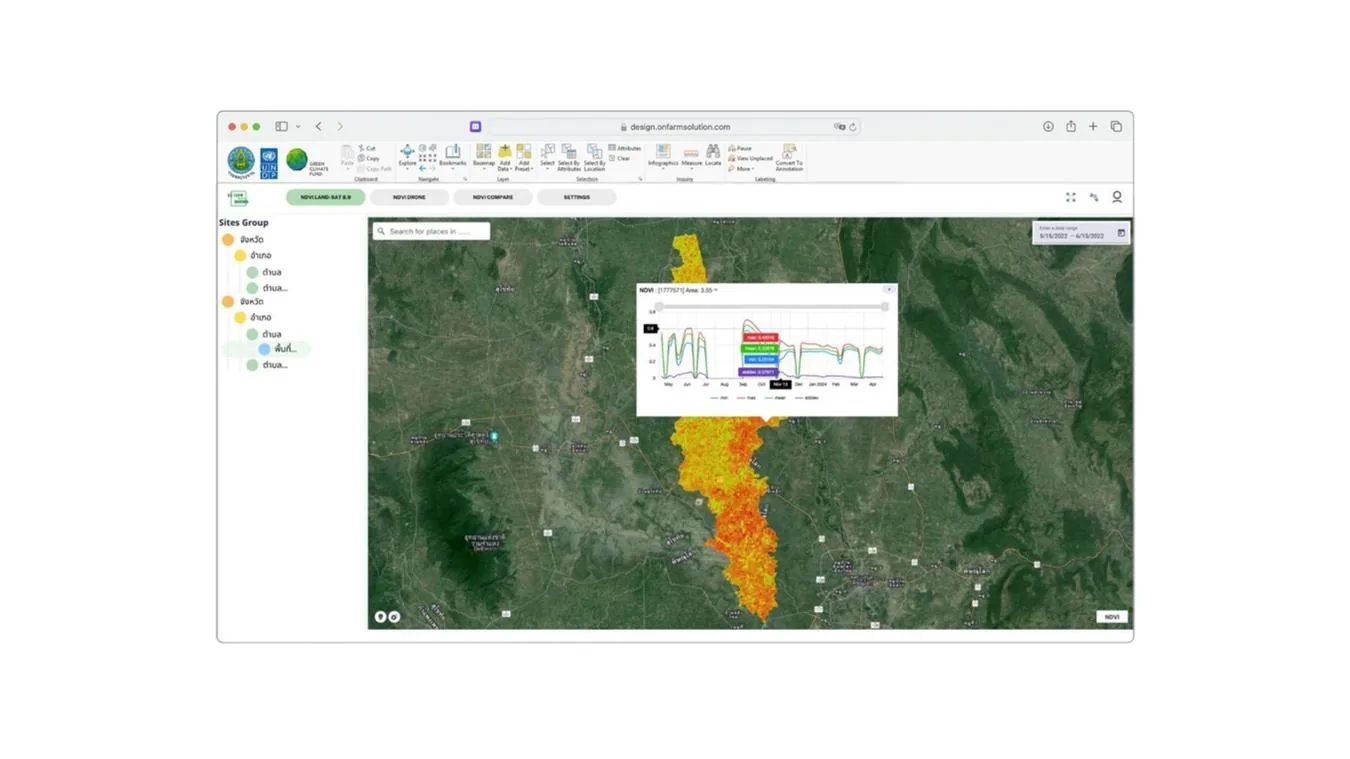
Its agriculture page reports pilot cost savings of 500-1,100 baht per rai, while explicitly tying results to crop, soil, water supply, and management. That qualification belongs beside the number. Sensors can inform irrigation; they cannot make two different farms economically identical.
The next bet is reuse
The business began with engineering projects. Its current innovation policy describes a move toward owning an AIoT platform and hardware ecosystem, with recurring income from platform services and smart devices. SynExta is the proposed common foundation. Reusable hardware and software could let experience from one installation carry into the next.
That ambition helps explain why Synergy’s portfolio crosses industries. Energy monitoring, production monitoring, and irrigation all require devices, connectivity, data, and a decision. Reusing those layers is the commercial proposition. The distinctiveness is the combination of physical manufacturing and operational software under the same company’s offering.
The company also declares values that spell POSSIBLE, including ownership, sincerity, and empathy. Those words describe an intention rather than prove a workplace culture. Still, ownership is a relevant promise in a business whose customers need to know who answers when a delivered device misbehaves.
The surrounding group adds another route to customers. Sister operation SYNHUB offers startup consultation, investor matching, and development facilities. Synergy can serve the engineering needs of a young hardware business as well as an established manufacturer. For either buyer, the sensible first move is a bounded project: define the decision, test the hardware, measure the result, and agree who keeps it working. The circuit board is where the story starts. The recurring work begins when somebody depends on it.