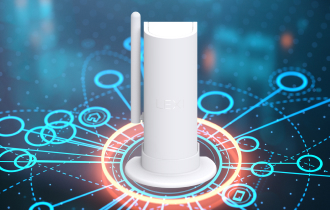
The company that decided the smart-building wars didn't need another winner - they needed a polyglot.
Most of LEXI's customers will never see the thing they bought. It lives in a server closet, a utility cabinet, the dim space above a corporate ceiling tile. From there, a single LEXI Universal IoT Gateway is doing a quietly absurd amount of work: listening to Wi-Fi thermostats, Zigbee light switches, Z-Wave locks, 900MHz industrial sensors and LoRaWAN trackers two parking lots away. It is translating all of them, in real time, into one tidy stream of data. Then it is making decisions about that data before the data ever leaves the building.
That single act - making the gateway the place where the IoT actually agrees with itself - is the whole company. Not the white-label cameras. Not the slick mobile app. Not the cloud dashboards with their charts about kilowatt-hours saved. The gateway. The translator. The thing in the ceiling.
LEXI calls it the world's first Universal IoT Gateway. That is the kind of claim that ought to come with footnotes, and LEXI has footnotes: five major wireless protocols supported out of the box, upgrade paths to Thread and Matter, an NXP processor capable of running AI models on-device, and four U.S. patents covering the machine-learning and computer-vision work that holds it together.
Every device you buy that calls itself "smart" arrives with its own passport. The thermostat speaks Wi-Fi and reports to one cloud. The light bulb prefers Zigbee and reports to another. The asset tracker on the loading dock would like a word with LoRaWAN, thank you. The industrial vibration sensor was assembled in 2014 and has opinions about Modbus.
LEXI's response is unfashionably ambitious: build one box that holds dual citizenship in all of them. The Universal IoT Gateway speaks Wi-Fi, Bluetooth, Zigbee, Z-Wave, 900MHz and LoRaWAN today, and the team has wired in upgrade paths for Thread and Matter - the two protocols the smart-home industry has been promising will fix everything since roughly the second Obama administration.
This matters because most enterprise buildings do not get to start over. They have a BMS from one era, a lighting controller from another, sensors that were bolted on the year someone got serious about IAQ, and a security stack that nobody quite wants to touch. LEXI's pitch to facilities teams is unglamorous and therefore credible: leave it. Plug the gateway in. We'll talk to all of it.
The Gateway gets the headlines. Underneath it, LEXI sells a coherent stack designed to be either deployed whole or peeled apart and white-labeled by an OEM.
Standard variant on an NXP IMX8 quad-core; Ultralite on the IM6ULL. Runs AI inference on-device, supports every major wireless protocol, ships in two SKUs for very different deployment budgets.
A wireless building management system designed for retrofits. Automated carbon reporting, climate-mandate compliance, and integration with whatever ageing BMS already lives onsite.
Wireless enablement for industrial, manufacturing, retail and utility equipment - no rewiring, no engineering changes, no asking the OEM nicely for a firmware update.
U.S.-hosted device management, analytics and reporting with role-based access. The company claims up to 90% cost savings versus AWS IoT Core and 40% faster performance.
White-label iOS and Android apps. OEMs put their own branding on top; the same control plane runs underneath.
Lighting and controls, air-quality and occupancy sensors, security cameras, water management, asset trackers. The catalogue exists so customers can buy a finished story, not a parts list.
LEXI was founded in 2017 in Berkeley by Scott Cahill, who spent the next seven and a half years as CEO, slowly turning a thesis - that IoT needed an honest broker, not another walled garden - into a working stack. The work is the kind that does not photograph well: silicon selection, RF tuning, certification, the patient negotiation between an embedded Linux build and a cloud pipeline that has to behave the same in Lebanon, Ohio as it does in Berkeley, California.
The company raised roughly $2.6 million in a seed round, dabbled in equity crowdfunding via Republic, and otherwise did the thing deep-tech founders rarely get credit for: stayed small, shipped hardware, and held a small team of about 38 together long enough to actually have a product to sell.
In 2024 the story turned a page. Cahill recruited Hans Bukow - a serial operator who had taken eWork to IPO in Europe, co-founded FASTech (acquired by Brooks Automation), and led Provade through its sale to SmartERP - to take over as CEO. The signal was clear enough: the building years are done; the scaling years are next.
Cities are passing carbon-reporting laws faster than facilities teams can read them. New York's Local Law 97. California's SB 253. The EU's CSRD. The owner of a 300,000-square-foot office building does not have the luxury of replacing the HVAC system to comply; they have to instrument what they have, prove the numbers, and pay penalties if the numbers are wrong.
LEXI's SmartBMS exists for exactly that moment. It is wireless because retrofits cannot afford copper. It is open-protocol because the BMS that's already onsite isn't going anywhere. It exports compliance reports because compliance reports are the actual product, and energy savings are the bonus.
If LEXI is right - that the next billion connected devices in commercial real estate will be retrofit, not new build, and that they will be heterogeneous, not uniform - then the universal-gateway thesis stops looking quixotic and starts looking obvious.
The space LEXI plays in does not have a single competitor; it has three. There are the hyperscaler IoT clouds (AWS IoT Core, Azure IoT) that win on scale and lose on cost-to-serve a small building. There are the platform companies (Samsara, Particle, Losant, Tuya) that each carved out a vertical and built upward. And there are the incumbents in building management (Honeywell, Johnson Controls, Siemens) that own the existing copper and don't love wireless.
LEXI's wager is that none of them want to fight on protocol breadth. The hyperscalers don't ship hardware. The platform companies pick a stack. The BMS incumbents are protecting margin, not chasing it. Which leaves a quiet middle of the market - the retrofit, the multi-protocol building, the OEM who wants white-label without buying AWS - and LEXI is camped there.
Samsara · industrial telematics & fleet
Particle · developer IoT platform
Tuya · global smart-home OEM platform
SmartThings / Hubitat · consumer-grade hubs
Honeywell / JCI · legacy BMS incumbents
AWS IoT Core / Azure IoT · hyperscaler clouds
Return to the ceiling. The gateway hasn't moved. It is still listening to a small population of devices that were never designed to talk to each other, still translating in real time, still nudging an HVAC loop down a degree because an occupancy sensor said the floor was empty.
Nothing in the building looks different. The lights are the same lights. The thermostats are the same thermostats. The walls have not been opened. And yet the building is now legible - to its operator, to its accountant, to the regulator who will eventually ask for the carbon numbers. That legibility is the product. The blinking box is just where it lives.
LEXI's bet is that the universal translator is the first piece of infrastructure the climate decade actually needs. If they're right, the box stays in the ceiling. If they're wrong, it stays there anyway, because nobody has the budget to take it down.