A cardboard box has a surprisingly eventful life for something with so little conversation. It waits on a loading dock, crosses a warehouse, rides a truck and disappears into a stockroom. Software may record its departure and arrival. The intervening adventures often remain the box’s own business. Tal Tamir has built a company around persuading it to be less discreet.
At Wiliot, the object gets a tiny battery-free sensing device, and the business gets information it can use. The ambition sounds almost polite: let ordinary things report what is happening to them. The engineering is less accommodating. A label cannot demand the price, charging habits or attention routinely granted to a telephone. It has to fit into the economics of the thing wearing it.
Tamir came to that problem after an earlier company, Wilocity, had already taken him through the familiar entrepreneurial sequence of invention, growth and acquisition. Qualcomm bought Wilocity in 2014. Wiliot, which he co-founded in 2017, put him back at the beginning, facing another question that silicon had yet to answer.
A career spent negotiating with radio waves
His preparation combined engineering with the business of getting engineering into the world. He earned a degree in electrical engineering at Technion and a joint MBA through Tel Aviv University and Northwestern’s Kellogg School of Management. He completed the Kellogg-Recanati executive MBA in 2003.
Before Wilocity, he worked at Conexant and Intel. At Intel, his responsibilities included wireless strategic planning. These were useful vantage points for someone interested in how a technical capability becomes part of a product people actually buy. A radio specification has its own beauty, but a customer generally expects it to do something.
Wilocity, co-founded in 2006, worked on 60 GHz wireless chipsets associated with WiGig. The aim was fast wireless communication for computing and related devices. When Qualcomm announced the acquisition, it described applications including wireless docking, content sharing and high-resolution video. Tamir had helped build a business addressing the appetite for moving more data between machines.
He subsequently served as a vice president of product management at Qualcomm. The career had crossed the boundary between a small company and a large one again. That boundary matters: an invention needs room to be invented, then a route into the systems, partners and products that can carry it further.
The battery was an expensive guest
With Wiliot, the subject changed from computers moving information quickly to everyday objects supplying information at all. Tamir co-founded the company with Yaron Elboim and Alon Yehezkley, colleagues whose experience also ran through Wilocity. Elboim became chief operating officer; Yehezkley became chief technology officer. There was continuity in the people, even as the task changed.
The battery was a central obstacle. Attach a conventional powered device to enough inexpensive objects and the practical questions multiply: cost, bulk, replacement and maintenance. A system meant to observe ordinary goods cannot depend on somebody making a round of introductions with a charger. Its demands have to be modest.
Wiliot’s IoT Pixels harvest radio-frequency energy and communicate using Bluetooth. The stamp-sized devices provide signals that can be processed into information about physical goods. The cloud software supplies another part of the system, interpreting the stream rather than leaving customers with a collection of unexplained transmissions. The small device and the software belong to the same proposition.
The implications are easiest to see at a warehouse door. A digital record can say an item should have arrived. Sensing can help establish whether it did, where it went and what conditions it experienced. The commercial value lies in the decisions that follow: finding stock, verifying a shipment or noticing a delay while there is still time to respond.
HOW A THING BECOMES INFORMATION
A simplified view of Wiliot’s sensing system.
“a problem that is difficult to solve”
Tal Tamir, on choosing what to build
The warehouse gets a vote
In July 2021, Wiliot raised a $200 million Series C led by SoftBank Vision Fund 2. The financing brought the reported total raised at that point to $270 million. Investors already included companies with interests in cloud computing, electronics and identification. The backing provided resources for a proposition whose usefulness depended on several kinds of technology working together.
Money, however, is an unusually poor substitute for a functioning loading dock. Tamir’s company needed customers, partners and manufacturing capacity. Its challenge extended beyond demonstrating that a tag could send a signal. The information had to arrive in a form that made an ordinary working day easier to manage.
The Walmart collaboration, announced in October 2025, brought that ambition into a large retail network. In his account of the relationship, Tamir described millions of IoT Pixels being deployed to support inventory accuracy, shipment verification and the recording of temperature conditions. The work connected Wiliot’s physical sensing with Walmart’s AI systems and associates’ operational decisions.
There is something bracing about this setting for a technology story. A pallet has no interest in the elegance of a presentation. It has a destination. The useful questions concern its arrival, its contents and its condition. Tamir’s opportunity is to give the people responsible for it better answers with less dependence on intermittent manual checks.
That also puts a practical meaning on his company’s language about physical AI. An intelligent system working with goods needs observations of goods. A delivery record and a forecast are useful, but neither automatically describes what is happening inside a particular operation at a particular moment. Wiliot’s work sits at the point where those observations begin.
Small chips need large arrangements
Manufacturing is another part of the story that refuses to remain in the background. Avery Dennison and Wiliot expanded their partnership in September 2025, with plans for next-generation Bluetooth-enabled sensors using a smaller chip footprint and simpler inlay architecture. Those details bear directly on performance and the cost of making the devices.
In April 2026, Avery Dennison announced a $75 million minority investment in Wiliot. The relationship included preferred inlay design, manufacturing and commercial partnership, as well as a board seat. For Tamir, the significance reaches beyond another funding figure. Labels have to be designed, produced and sold through arrangements capable of meeting actual demand.
A small object can therefore imply a rather large organization behind it. There are chip designers, label manufacturers, software teams, receiving devices and customer systems to consider. Tamir’s earlier experience in wireless chips offers a relevant foundation, while Wiliot asks him to coordinate a broader chain of dependencies.
The January 2026 introduction of Wiliot’s Gen3 IoT Pixel added another turn of the engineering screw. The company described improved energy harvesting, wider energizing and reading ranges, and lower unit costs. Its dual-band architecture uses 2.4 GHz and sub-1 GHz frequencies. Encrypted Bluetooth Low Energy signals carry data to compatible receiving infrastructure.
Range and cost can sound like footnotes beside a grand ambition. In practice, they help decide where the ambition can afford to go. A device that works in more operating environments, with less infrastructure expense per observed item, gives customers a different set of choices. This is where the engineer’s incremental work meets the founder’s larger plan.
A plaque, and more work waiting
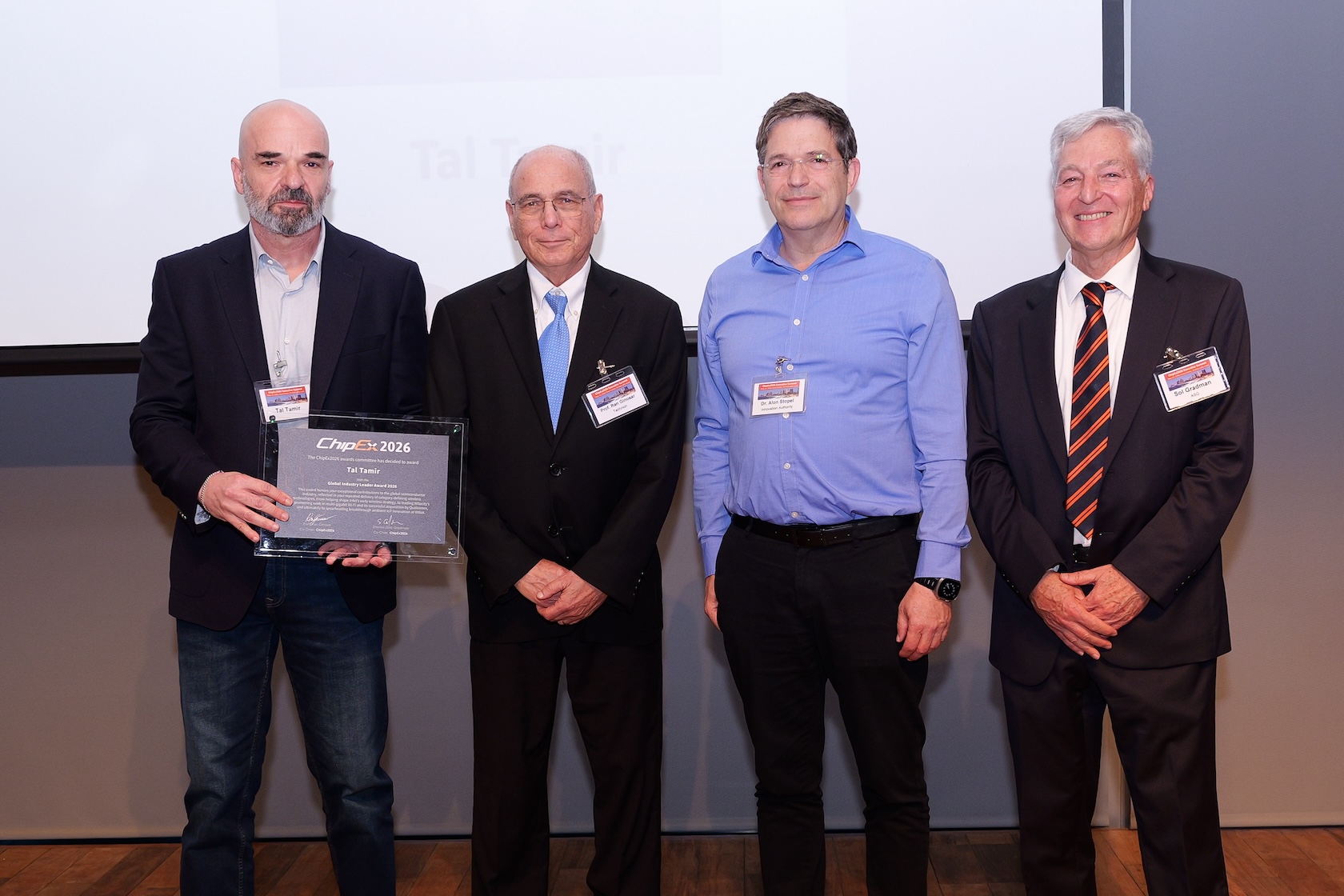
On May 13, 2026, Tamir received the Global Industry Leader Award at the ChipEx Executive Summit in Tel Aviv. The recognition linked his work at Wilocity with Wiliot’s battery-free sensing technology. It placed a formal punctuation mark in a career that had continued to circle wireless communication, semiconductor design and the effort to make new systems useful.
The company’s next announced applications suggest that the punctuation was a comma. In October 2026, Wiliot and Thinaer announced a partnership addressing defense manufacturing. The initial 1.7 million IoT Pixel deployment is scheduled to begin in the first quarter of 2027. The intended setting is an aerospace and defense manufacturer’s internal supply chain.
That schedule belongs in the future tense. The underlying question is familiar: can materials and parts remain visible as they move through multiple production stages and locations? Retail goods and factory components lead different lives, but both can leave gaps between what a business records and what its people can actually locate.
The songs he would take along
There is a gentler way into Tamir’s relationship with information. Asked about meaningful songs during a Mr. Beacon conversation, he spoke about the music attached to videos he had made for his three children’s bar mitzvah celebrations. The songs mattered because repeated editing and viewing had joined them to images of his children.
It is a charmingly domestic answer from someone whose professional life concerns signals, interpretation and physical things. Here, the carrier is a song and the information is a family memory. The association is an observation about his story, rather than a theory he proposed. It does help bring a person into focus behind the company names.
In the same conversation, Tamir described his attraction to “a problem that is difficult to solve”. The phrase fits the career without requiring much decoration. Fast wireless links were one such problem. A sensor that can earn its place on inexpensive goods supplies another, followed by the work of making the resulting data useful.
His public ambition remains expansive: connect everyday objects and make their circumstances visible enough to improve how they are handled. The measure will be found in ordinary operations, among pallets, containers and stockrooms. A cardboard box has always had a journey. Tamir would like the rest of the business to hear about it.