Before the Nasdaq ticker, there was a bedroom. In El Dorado Hills, California, five former Intel engineers gathered around whiteboards in a cluttered room and tried to imagine a different kind of processor. Dinakar Munagala was among them. For a venture concerned with the future of computing, the accommodation was agreeably domestic.
The contrast has become sharper with time. Blaize began in 2010; its shares started trading on Nasdaq in January 2025 following a combination with BurTech Acquisition. Between those dates lay years of development, fundraising and the awkward business of persuading other people that a diagram might eventually become something worth buying.
Munagala's central concern has remained fairly easy to picture. Intelligence should work close to the things producing the data: cameras, vehicles, industrial equipment. The harder questions arrive immediately afterward. How much electricity will it need? How quickly can it respond? Who will write the software? And can a company built around those answers sustain a business?
A graphics engineer changes the question
His route into this problem ran through Osmania University in India and a master's degree at Purdue University in the United States. Electrical and computer engineering gave him a language for thinking about systems. Intel supplied the scale: he spent 12 years there working on graphics processor architecture and design.
His work included multicore, multithreaded graphics chips and the architecture for Intel's first integrated CPU/GPU product family. These are the sorts of accomplishments a laptop owner benefits from without ever learning the names of the engineers involved. Much of semiconductor work has that character. The more smoothly it works, the less anyone thinks about it.
Moving from that environment into a startup changed the task. At an established chip company, architecture sits inside an existing commercial machine. A founder must help assemble the machine as well: investors, customers, software, distribution and colleagues willing to spend years on an unfinished proposition. Engineering judgment becomes the beginning of the job.
Munagala co-founded Blaize with Satyaki Koneru and Ke Yin. Their backgrounds connected the venture to graphics and processor design, while their new work asked what a different computing architecture could make possible. The initial interest in energy-efficient general-purpose processing developed into a more specific focus on AI and its physical applications.
The electricity bill has a vote
Consider the difference between demonstrating an AI model and leaving it to work beside a camera or inside a machine. A demonstration can choose its surroundings. A deployed system inherits them. Power, space, cost and response time become part of the design brief. An elegant answer that arrives too late can be an expensive way of missing the point.
Blaize's technical answer is its Graph Streaming Processor, or GSP. The architecture uses streaming execution and parallel tasks, with software designed alongside the silicon. At its simplest, the proposal is to organize the work and movement of data around the application, making constrained deployments more practical. The company markets that combination for AI inference, the process of applying a trained model.
The distinction matters to Munagala's story because it describes the sort of problem he chose to spend his time on. Bigger models are one part of the AI industry. Getting a useful result from equipment with a particular budget and job is another. His career has increasingly centered on that second set of constraints.
The software side extends the same argument. AI Studio provides visual tools for preparing data, developing applications and managing deployed models. Its workflow includes labeling, model import, optimization and performance monitoring. A processor can be technically interesting while remaining difficult to use. The software addresses the distance between those two conditions.
For a founder who came from chip design, that is a consequential expansion of responsibility. The customer has to get through the entire job. Data preparation and deployment are less photogenic than a new piece of silicon, but a blocked workflow can stop a project just as effectively as an unavailable component.
Partners who bring their own hard questions
By 2025, Munagala's public biography described more than $330 million raised from financial and strategic investors. The names included Temasek, Franklin Templeton, Samsung Catalyst Fund, Mercedes-Benz, DENSO and Magna. That mix puts software-era ambition beside businesses accustomed to physical products, manufacturing requirements and long development cycles.
In 2021, Blaize announced a $71 million Series D led by Franklin Templeton and Temasek. The round illustrates the capital demands behind the bedroom origin story. A whiteboard makes experimentation cheap. Turning an architecture into products, and supporting customers who use them, introduces an entirely different set of bills.
The partnerships also complicate any tidy picture of Munagala as an opponent of cloud computing. In 2022, Blaize and OrionVM announced an AI-as-a-service offering, including virtualized GSP resources and access to AI Studio on OrionVM's cloud platform. The practical question was where the work could run effectively. Cloud infrastructure remained part of the answer.
His conversations with Vantiq show the same preference for complete applications. Discussing industrial command centers, he described the difficulty of asking people to interpret information from thousands of sensors. Pairing AI processing with software that connects events to responses gives the hardware a specific purpose. A command center needs more than another screen to watch.

Four days, four different jobs
Asked about his working routine in a 2025 conversation, Munagala described dividing his week by function: customers and revenue, product and innovation, direct reports, and investors. The calendar provides a small glimpse of the transition from engineer to chief executive. Each group has a legitimate claim on his attention; each needs a different conversation.
He also recalled adopting Zoom when the video company had fewer than ten people. For a business spread across countries, remote collaboration was already an operating requirement. That detail is more revealing than a grand declaration about modern leadership. Somebody still has to get the people in different time zones into the same discussion.
His account of early support is similarly personal. He remembered an investor with deep chip expertise backing the team during its earliest phase, and said he continued speaking with his first investors. The origin story contains a technical bet, but also the much older mechanism of somebody agreeing to take a chance on somebody else.
“He backed us right when we were in garage mode.”
Dinakar Munagala, on an early investor and mentor
There is another strand to his public biography beyond the company. It records fundraising leadership for CRY/Vibha's Sacramento activities supporting educational projects for disadvantaged children, and support for Kiva and Vittana's nonprofit lending initiatives. Education and access appear here in a concrete form: projects, fundraising and loans that help people pursue their own plans.
Nasdaq did not shorten the distance
A public listing gives a founder a recognizable milestone. It also replaces the relatively private development cycle with a recurring public reckoning. For Munagala, the recent chapter has made that distinction difficult to miss. Blaize's September 30, 2026 restructuring announcement described a workforce reduction affecting approximately 26% of employees.
The company projected annual savings of $7.5 million to $8.4 million and said it expected substantial completion by December 31. Munagala identified hybrid AI, related services, autonomous systems and sovereign AI programs as priorities. The figures were expectations attached to a plan, with colleagues directly affected by the decision.
On October 5, Blaize estimated preliminary third-quarter revenue at approximately $0.5 million and revised its full-year revenue guidance to $32 million-$36 million. It cited shipment timing and working-capital requirements. The quarterly estimate remained subject to closing procedures. These numbers describe a company still trying to convert its technology and orders into a dependable operating business.
That month's disclosures also reported Department of Justice subpoenas and inquiries, SEC information requests and a preliminary shareholder class action concerning statements about contracts. Blaize said it was cooperating with the agencies and could not predict the outcome. The complaint's allegations remained unresolved. Those matters belong in the current picture alongside the product and financing milestones.
The remaining work is close to the ground
Munagala has described his ambitions in terms of broader deployment, more customers and a deeper network of manufacturers, developers and systems integrators. The language of accessibility recurs in his product choices: efficient processors, visual development tools, partners who can turn components into working systems. Each addresses a different reason a promising application might never leave the demonstration stage.
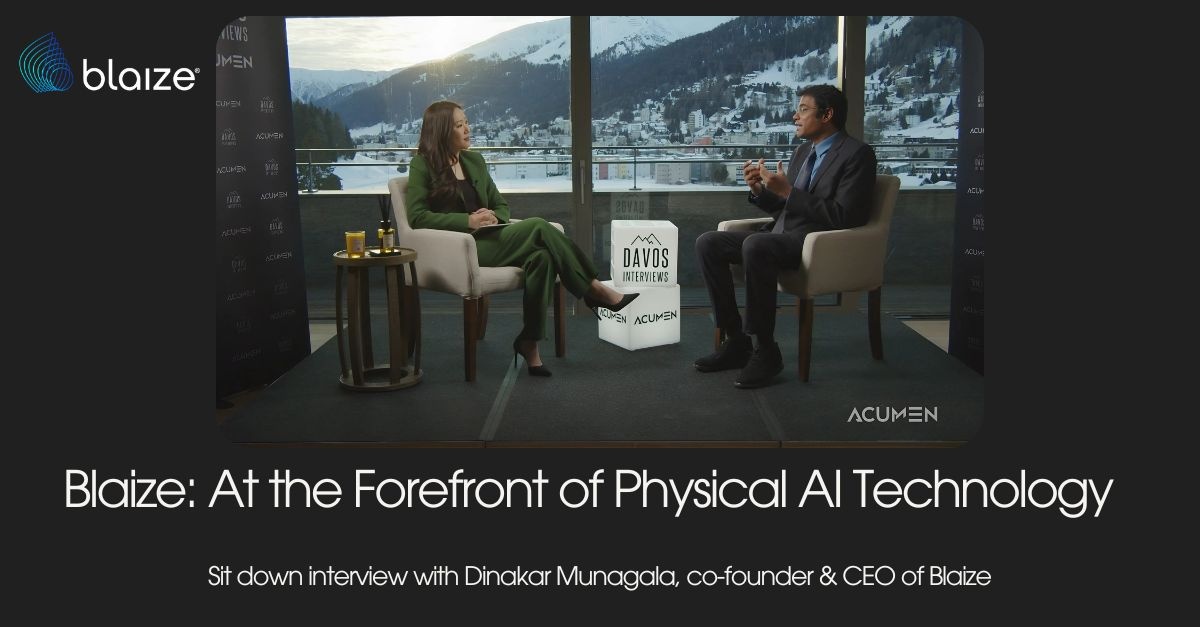
His path offers a less compressed view of an AI career than the familiar launch-and-applause sequence. There are years of engineering before the company, years inside the company before the listing, and difficult decisions after it. The bedroom and the exchange ticker are memorable images. Most of the work happens in the unglamorous space between them.
The question that connects those stages is still practical: what would make intelligence useful where a machine actually operates? Munagala has spent a substantial part of his career building an answer. The next test is whether the business can deliver it consistently, at a price and pace that customers can live with. Even a clever processor must eventually earn its place in the room.