A case of strawberries can have immaculate paperwork and a terrible afternoon. The warehouse records a departure. The store records an arrival. Between those two entries, the fruit gets warmer. The records agree that the shipment moved. They say rather less about what happened to it.
That gap is Wiliot’s business. Its battery-free labels, called IoT Pixels, turn ordinary goods and containers into sources of information. In one grocery project, Wiliot attached them to strawberry cases and followed temperature and location from a distribution center, through transport, into stores. The useful discovery was a set of temperature and handling problems that operators could address.
- Battery-free Bluetooth labels report goods’ location and condition.
- Walmart, Royal Mail and Shufersal are named deployments.
- The sticker needs a network, software and someone who acts.
The battery was the wrong thing to scale
Wiliot began in 2017 with Tal Tamir, Alon Yehezkely and Yaron Elboim. Their previous venture, Wilocity, developed wireless technology and was acquired by Qualcomm in 2014. These were engineers accustomed to thinking about radio. At Wiliot, radio became a way to power a computer as well as connect it.
A Pixel harvests energy from radio signals and broadcasts encrypted Bluetooth data. Put one on a crate and it can help reveal where that crate is and what conditions surround it. No battery replacement rounds. No charging rack for a mountain of labels. That matters when the ambition extends from valuable equipment to mundane packaging.
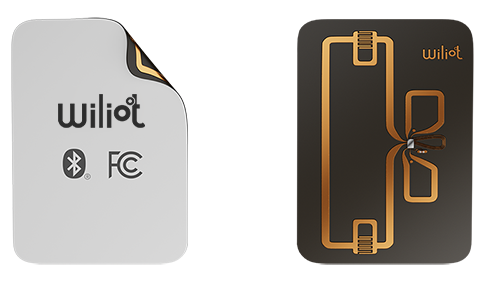
The complete system has three parts. Bridges supply radio energy and collect transmissions. Gateways forward data to the cloud. Wiliot’s platform interprets signals as events: a case arrived, a container moved, a temperature crossed a threshold. Its software supports inventory counting, receiving, shipment verification, reusable asset tracking and condition monitoring.
This is an enterprise software business attached to a hardware ecosystem. Customers buy access to sensing and intelligence, with tags, network equipment and deployment supplied through Wiliot and its partners. The cloud is integral: the company says Pixels cannot operate independently of its platform. Buyers are choosing an ongoing system relationship.
The alternatives deserve their own hearing. Barcodes work well when a deliberate scan is enough. Passive RFID identifies goods through radio readers. Battery-powered Bluetooth tags trade maintenance for a different power budget, while temperature loggers document conditions. Wiliot’s particular bet combines battery-free sensing with observations across equipped areas. Its appeal grows when the business problem lives between scheduled reads.
Start with the thing that comes back
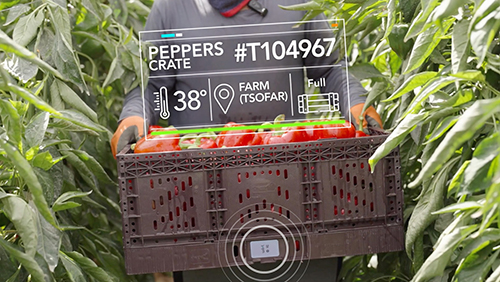
Consider the reusable crate. It carries produce, empties out and starts again. Losing it costs money; leaving it idle wastes capacity. In 2022, Wiliot announced a reusable transport packaging solution with Israeli retailer Shufersal, monitoring crates and produce along the farm-to-store journey. The container gives the tracking investment another trip to earn its keep.
Royal Mail applied the idea to wheeled containers called Yorks. Its October 2024 announcement described a program to tag 850,000 containers, then nearing completion. Tracking the carrier of many parcels offered a practical starting point. Tagging individual parcels remained a future intention. A digital map of containers could help staff spot network problems and improve vehicle loading.
Walmart brought another scale. In October 2025, Wiliot reported millions of sensors across 500 Walmart locations. The announced expansion aimed for 4,600 stores, more than 40 distribution centers and 90 million pallet-tracking tags by the end of 2026. Those larger numbers were targets. The operational proposition was already concrete: automate receipt signals and help workers find inventory or handle cold-chain exceptions.
The phone went to sleep
A smaller experiment supplies a useful complication. In a March 2025 account, researchers at Belgium’s Arteveldehogeschool described a campus trial using Pixels on participants’ lanyards. Smartphone and tablet gateways lost Bluetooth connections when the devices entered standby. Tag orientation and proximity also affected reliability. The observation network needed more care than the sticker suggested.
The researchers cited approximately €0.10 per Pixel, with bridges, gateways and software adding costs. That is a historical trial figure. Budgeting requires the whole system. Their setup also predates Wiliot’s January 2026 Gen3 launch, which promised improved harvesting, range and unit costs. The trial’s limits should not be treated as Gen3 measurements.
There is a practical distinction here. A label price tells you little about coverage in a loaded trailer. Bluetooth location depends on network observations; the Pixel is no miniature GPS receiver. An operation that needs isolated, wide-area tracking must examine a different set of tradeoffs. An alert also needs a destination: a person or workflow able to respond.
“BLE is a complementary technology to RFID.”
Francisco Melo · Avery Dennison · April 2026
Software can make those observations easier to question. Wiliot announced WiliBot in August 2024, a natural-language interface intended to let enterprise users ask about connected products and supply chains. The launch described pilots. A conversational interface is useful only to the extent that the underlying observations support the answer. Asking a polished question cannot recover a temperature measurement that never reached the gateway.
A label business, an AI ambition
Avery Dennison’s position is instructive. In April 2026, the label and digital identification company announced a $75 million minority investment and a preferred manufacturing and commercial partnership with Wiliot. Its executive described Bluetooth Low Energy as complementary to RFID. Different sensing methods can coexist. The purchase decision should begin with the missing observation.
Wiliot had already raised a $200 million Series C led by SoftBank Vision Fund 2 in 2021. Its newer partnerships address the work beyond silicon: AT&T for deployment, connectivity and operations; CISC for production testing. In October 2026, Thinaer announced a defense partnership, with an initial 1.7 million Pixels planned for deployment in early 2027.
For an operator, the copyable lesson is modest. Choose one expensive uncertainty: the missing crate, the misloaded shipment, the strawberry waiting outside refrigeration. Establish what happens today. Test whether continuous observations produce timely interventions, then count the savings against deployment and operating costs. Expand when the evidence supports it. A supply chain becomes more useful when its records help someone change what happens next.