In May 2017, Philipp von Gilsa published three lessons about leading a technology company. Then he gave himself a C. Here was an executive managing more than twenty people across departments and time zones, writing about vision, focus, and learning, and declining to award himself a distinction. Anyone can publish management advice. Adding a mediocre report card takes a little more nerve.
The grade is a useful place to begin with the CEO and co-founder of Kontakt.io. His business concerns indoor location: using connected devices and software to understand where things are inside buildings. His writing keeps returning to another sort of location problem. Where should a company place its attention? Which customers should it serve? At what point does an opportunity become a distraction wearing a particularly expensive suit?
Years before a $47.5 million investment brought a larger financial headline, von Gilsa was already working through those questions in public. Follow that earlier trail and a particular kind of founder emerges: interested in the machinery of organizations, willing to discuss the less flattering parts of management, and suspicious of technological enthusiasm that never quite reaches a purchase order.
A prize for asking who makes a good buyer
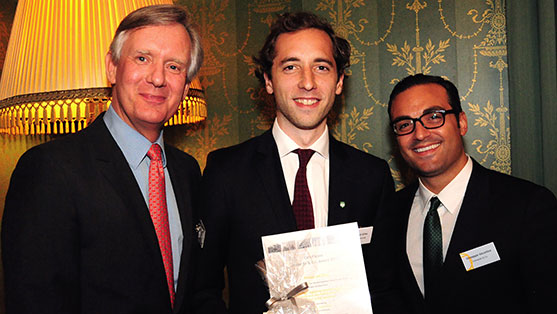
There is an appropriate photograph from 2014. Von Gilsa stands between two men in suits, holding an award. The occasion was the Leonardo & Co. Award, presented in Frankfurt for his bachelor’s thesis at Zeppelin University. His subject was acquisitions by German family businesses. Even before running a technology company, he was studying how ownership might shape commercial judgment.
He had investigated whether family-controlled companies were better acquirers than businesses without family control, measured through changes in value following acquisition announcements. His hypothesis concerned restraint: a family’s influence on strategy might discourage managers from pursuing unprofitable purchases. The findings supported the premise. It is an unusually fitting early subject for someone who would later write about the value of refusing business.
The academic thread continued. A paper titled Corporate Acquisitions and Family Control, co-authored with Mark Mietzner and Reinhard Prügl, received an Academy of Management Best Paper Award nomination in 2015. The young executive’s early work had already crossed the boundary between the seminar room and the boardroom. Questions about incentives, authority, and judgment would prove portable.
Public policy, private enterprise
Von Gilsa’s education took him through Zeppelin University in Germany, Peking University in China, and the London School of Economics. His later studies concerned public administration and public policy. His public professional profile lists Peking for 2013-2014 and LSE for 2014-2015, and records first-place academic rankings. The geographical itinerary is striking; the subject matter is just as revealing.
Administration sounds like an unlikely preparation for a business built around Bluetooth. Yet both involve coordinating people and resources under imperfect conditions. A policy can be beautifully designed and awkwardly implemented. A connected device can function perfectly while the organization buying it struggles to put it to work. Von Gilsa’s career brings those two kinds of problem into the same frame.
Before Kontakt.io, his work included analyst positions at J.P. Morgan and a country-manager role with Rocket Internet in Paris. That combination put finance beside company building. A spreadsheet asks whether the numbers hold together; an operating role asks who will do the work on Monday. His later public arguments would keep both questions close at hand.
When the demonstration has to become a business
By May 2017, von Gilsa was appearing as Kontakt.io’s vice president of market operations. In Phoenix, he joined colleague Filip Karwala for a filmed conversation with Steve Statler about the company’s products and commercial approach. Bluetooth Low Energy, usually shortened to BLE, was the underlying technology. Real-time location systems, or RTLS, were among its possible applications.
His account of that period is refreshingly interested in the work after the demonstration. He argued that customers needed evidence of reliable signals, performance in difficult environments, and the ability to scale. He welcomed a market becoming less fashionable and more practical. The disappearance of the first round of applause was, in his telling, an opportunity to get on with the job.
Most revealing was his willingness to turn customers away. A prospective buyer’s enthusiasm for Bluetooth did not establish that Bluetooth suited the job. There is a familiar temptation in a young market to accept every invitation. Von Gilsa was arguing for a narrower guest list. A failed installation, however enthusiastically sold, would do little for the next one.
“We, as providers, need to say ‘no’ sometimes.”
Philipp von Gilsa, 2017
The price of a small plastic box
He was also thinking about how to charge. In 2016, he described several ways beacon businesses could earn money, including an upfront hardware payment and a deferred subscription arrangement. Software and services allowed further choices: charging for API calls, charging by device over time, or selling tiers of platform access. The device on the desk was only one part of the commercial proposition.
His advice was to allow more flexibility as deals grew. That is a distinctly practical position for an executive in a field whose vocabulary can become extravagantly abstract. A customer may admire a technical architecture and still need a payment arrangement that fits a budget. The invoice is a fairly stern editor of the sales pitch.
Look at the early pricing discussion alongside his insistence on suitable projects and a consistent commercial concern appears. The technical possibility has to survive the terms of an actual transaction. A useful product needs a buyer who can adopt it, a provider who can support it, and a contract that allows both parties to keep going.
A company needs its own coordinates
After Mobile World Congress in Barcelona in March 2017, von Gilsa returned to Berlin with observations about the beacon market. He saw businesses finding firmer ground through specialization, customer knowledge, and partnerships. He paid attention to the conversion of proofs of concept into contracts. A calendar crowded with demonstrations could conceal an empty order book.
His argument also extended beyond the hardware itself. Delivery, configuration, maintenance, and support influenced whether a larger installation would work. Small suppliers could earn a place through expertise and dependable service. The purchase was bound up with a relationship that would continue after the boxes arrived.
The resulting portrait is of an executive watching the connective tissue of a business. Partnerships divide the work. Contracts sustain it. Support keeps promises from expiring on delivery day. These are ordinary commercial concerns, which may explain why they are so easily overlooked while everyone is admiring a new technology.
The numbers get larger
In 2022, the European Investment Bank agreed to provide Kontakt.io with €12 million to support investment in advanced artificial intelligence technologies. The agreement identified Krakow as the location for the research activity. It placed the company inside a wider European effort to support digital development, with a concrete place and program behind the language of expansion.
Two years later came a different form of backing. On April 16, 2024, Kontakt.io announced a $47.5 million investment led by Growth Equity at Goldman Sachs Asset Management. Christian Resch would join its board. The funding was intended to support growth and the expansion of its AI solutions. By then, von Gilsa was CEO.
European Investment Bank financing agreement
2022
Investment led by Goldman Sachs Asset Management’s Growth Equity business
April 2024
These milestones changed the scale of the resources available to the business. They also added counterparties and governance responsibilities. The earlier questions about focus and execution acquire more weight when substantial capital is involved. An investment announcement fits neatly on a screen. The organization it finances has to function across teams, budgets, products, and years.
Giving away a job to do the job
One account of his work with sales advisers Cremanski & Company offers a less ceremonial view of expansion. Von Gilsa had been running the sales department as well as the company. The engagement examined responsibilities, processes, and the sales funnel. Within two months of the workshops, Kontakt.io hired an experienced vice president of sales.
He described involving middle management in developing new processes and measures, moving away from an approach directed primarily from the top. The detail matters because it gives the broad word “growth” a human shape. Sometimes expansion requires the person in charge to stop being the person in charge of everything.
The same account records his ambition to move from five million to fifty million in revenue. That was a goal, rather than a reported result. It is best understood as a question about organizational capacity: what responsibilities, decisions, and information would have to change? His answer included bringing in outside help and handing a substantial function to someone else.
The C grade stays in the picture
There is another small moment worth keeping. During a later NYSE TV interview, an opening compliment placed the spotlight on von Gilsa personally. He redirected the credit to the team and asked that the correction be on camera. It was a brief intervention, but a revealing public choice about who belonged in the frame.
His original self-assessment makes a fitting companion to that moment. The C grade leaves room for colleagues, revision, and further work. Across the thesis, the early commercial writing, and the management decisions, the recurring interest is how an organization makes better choices. The company has changed in size and technical ambition. The question remains admirably usable: what deserves our attention next?