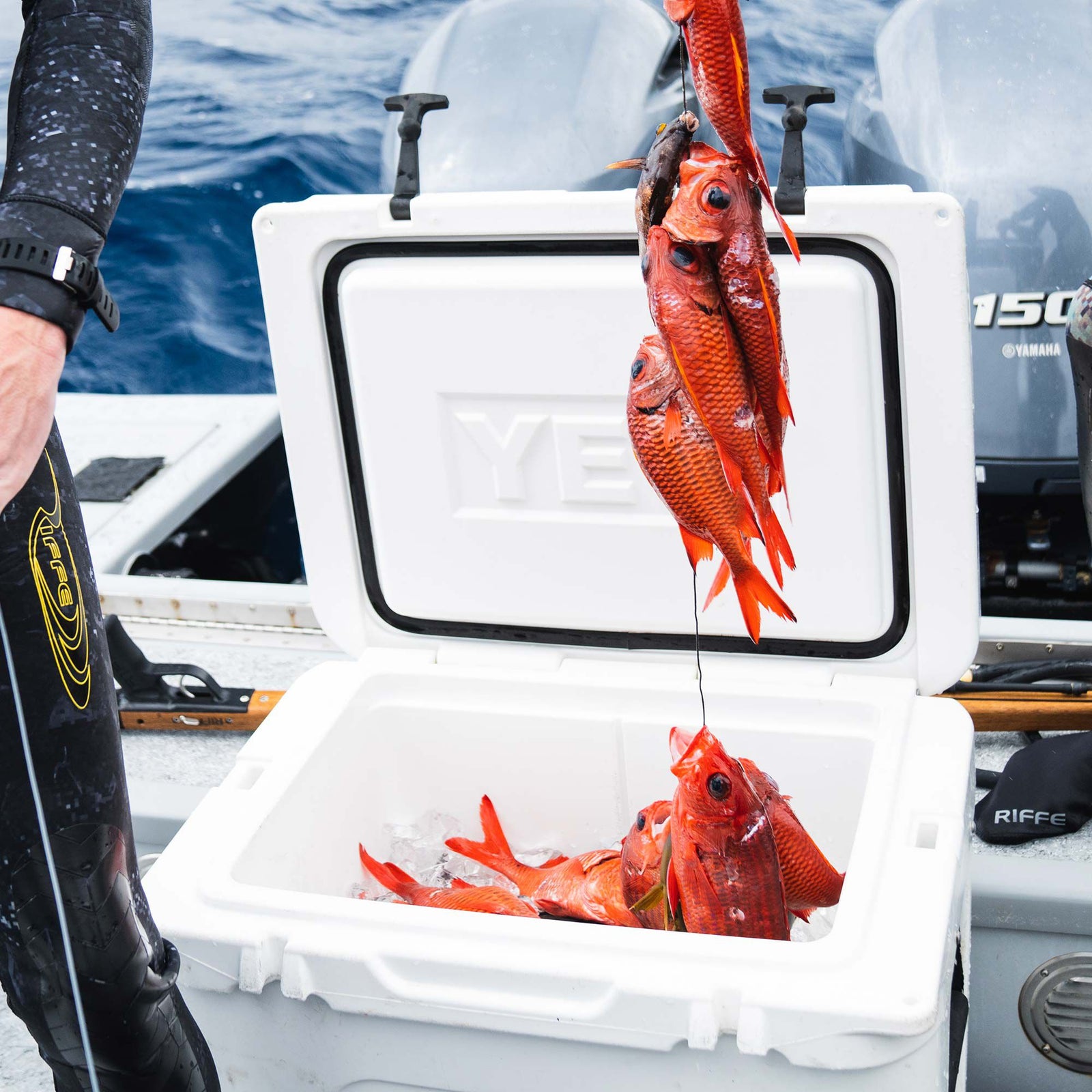
The revealing part of the YETI story is the lid. An ordinary cooler can hold lunch. Ask it to double as a platform for a fisherman, however, and its weaknesses become rather personal. Roy and Ryan Seiders knew the other failures, too: broken handles, snapped latches, another ice chest needing replacement. To someone shopping for a picnic, these might look like minor inconveniences. To someone planning a day on the water, they were defects in the day itself.
- The starting point: build for anglers who punish their equipment.
- The expansion: bring that reputation to cups, bags and everyday routines.
- The catch: a premium price makes every failure expensive.
That difference in perspective explains a company whose Tundra 45 now lists for $325. YETI sells coolers, insulated drinkware, bags and outdoor equipment. Its more interesting business is persuading people that an object usually bought with little thought deserves closer attention.
01 A very particular kind of customer
The brothers founded YETI in 2006. Their original ambition was wonderfully narrow: build the cooler we’d use every day if it existed
. They understood the customer because they were the customer. A cheaper cooler that needed replacing could be a poor bargain for someone who used it relentlessly.
The Tundra’s answer is physical: rotomolded construction and thick insulation. The product page specifies up to three inches of insulation. These are features a buyer can inspect, alongside the lid, handles and latches. The price requires a practical explanation before it can become a statement of taste.
For occasional users, the calculation can come out differently. Weight, storage space and purchase price matter. A family carrying drinks a short distance may reasonably choose a simpler cooler. YETI’s early insight was that the demanding customer and the occasional customer did not need the same compromise.
02 Then the cooler became a cup
A fishing cooler has a limitation as a growth engine: most people do not need one on the way to work. Drinkware changes the frequency of the relationship. A tumbler can accompany breakfast, a commute and an afternoon meeting. The company’s Rambler line arrived in 2014, bringing a lower entry price and a much broader set of occasions.
This was a consequential extension. Someone could buy into the product reputation without buying a large ice chest. The same brand could serve hunters, anglers, parents, travelers and people whose most demanding daily expedition involved a parking garage.
Hopper soft coolers widened the range in another direction, toward portability. Bags and cargo equipment followed the wider logic: things people need to carry, protect or keep organized. The common thread is a job the owner can recognize.
03 A brand needs somewhere to sell
There is an operational story beneath the outdoor imagery. YETI brought its first internal sales team onboard in June 2013, giving it a more active role in expanding its dealer network. Cortec Group had invested the previous year. In October 2018, YETI completed its public offering at $18 a share.
Today, it combines retail partners with direct selling. The distinction deserves care: YETI’s direct channel includes Amazon Marketplace, company stores and corporate orders alongside its websites. Calling it an internet-only business would miss much of the machinery.
Fiscal 2025 net sales / rounded
Corporate customization adds another use: a useful object bearing somebody else’s logo. The Trading Post portal lets approved business customers select eligible products, upload artwork and review a proof. A cup can be outdoor equipment, a personal purchase or a company gift. Distribution makes those different transactions possible.
04 The promise gets a bill
Durability creates an unusually clear test for a brand. In March 2023, YETI recalled about 1.9 million soft coolers and gear cases in the United States. Their magnet-lined closures could fail, releasing magnets that posed a serious ingestion hazard. The CPSC reported 1,399 closure-failure or degradation reports and no reported injuries or magnet ingestions.
YETI had initiated a global stop sale in January. Its initial recall accounting reduced fiscal 2022 operating income by $128.9 million, including inventory write-offs and estimated remedies and other costs. That figure was an accounting impact, rather than a final tally of cash spent.
A premium price makes the promise visible. A recall makes the obligation visible.
Redesigned versions arrived in the fourth quarter of 2023. The episode exposes the work required behind a familiar logo: testing materials, responding to failure and changing a product when the evidence demands it.
05 Buying the next set of skills
YETI’s expansion also involves acquiring expertise. In 2024 it bought backpack maker Mystery Ranch and assets of cast-iron cookware specialist Butter Pat. Those purchases brought capabilities into categories where a cooler’s reputation alone cannot design the product.
The company keeps design specifications and owns the molds and tooling used to make its products, while working with third-party manufacturers. That arrangement helps explain where its expertise sits: choosing the product, defining how it should perform and managing production to that standard. The factory relationship matters because the customer experiences the finished object, regardless of which company made a particular component. The logo collects both the credit and the complaints.
At its September 2026 Investor Day, management outlined ambitions for a billion-dollar Bags & Soft Coolers platform and a billion dollars in international sales. Those are goals. The reported second-quarter numbers offered nearer-term evidence: sales rose 9% to $483.9 million, with international sales up 19%.
06 Take the useful part home
For a buyer, the practical lesson starts with the trip. Choose the carrying format and capacity you need. Pre-chill the cooler and its contents. YETI recommends roughly two parts ice to one part chilled provisions. Thick walls cannot compensate indefinitely for warm drinks, too little ice and a lid opened every few minutes.
For a business builder, the copyable idea is equally concrete: find the failure your frequent users can describe precisely. Fix it in ways they can inspect. Then expand into an adjacent job that deserves the same attention. The idea depends on customers who value the improvement enough to pay for it. Without that, a sturdier box remains an expensive box.