A garage, a 3D printer, and a handful of website domains: Ryan Olson and Pete Ducato’s starting equipment at STEL would have fitted comfortably inside a much grander founder’s origin story. They wanted to make 3D printing accessible in Santa Barbara. Before the cases, batteries, and military equipment, there was the useful business of turning somebody’s idea into something they could pick up.
There is a particular honesty to a prototype. It can be admired on a screen for weeks, then become awkward the moment someone wraps a hand around it. The button is in the wrong place. The clip catches. The elegant solution requires a third hand, which customers have proved stubbornly reluctant to grow.
Olson’s career has kept returning to this meeting between a drawing and a person. He co-founded STEL, became co-founder and CEO of Bunker Supply, and now leads MAAK as its co-founder and CEO. The businesses connect through physical products and the practical questions around them. Where does the equipment go? How does it attach? What happens when its owner needs to move?
A garage with something to prove
STEL began in 2015. Olson served as chief operating officer alongside Ducato, the firm’s fellow co-founder. Its early printing service grew into broader product development, with prototyping woven through the process. The progression matters: a printer could introduce a customer to the studio, while the object it produced opened a conversation about design and manufacturing.
Olson’s education offers an earlier connection to making things. At the University of California, Santa Barbara, his graduate thesis examined three-dimensional lattice structures and their performance in energy absorption, with an emphasis on additive manufacturing. A lattice is an arrangement of spaces as much as material. Its usefulness depends on how the parts work together. That subject sits comfortably beside his subsequent interest in the construction of physical products.
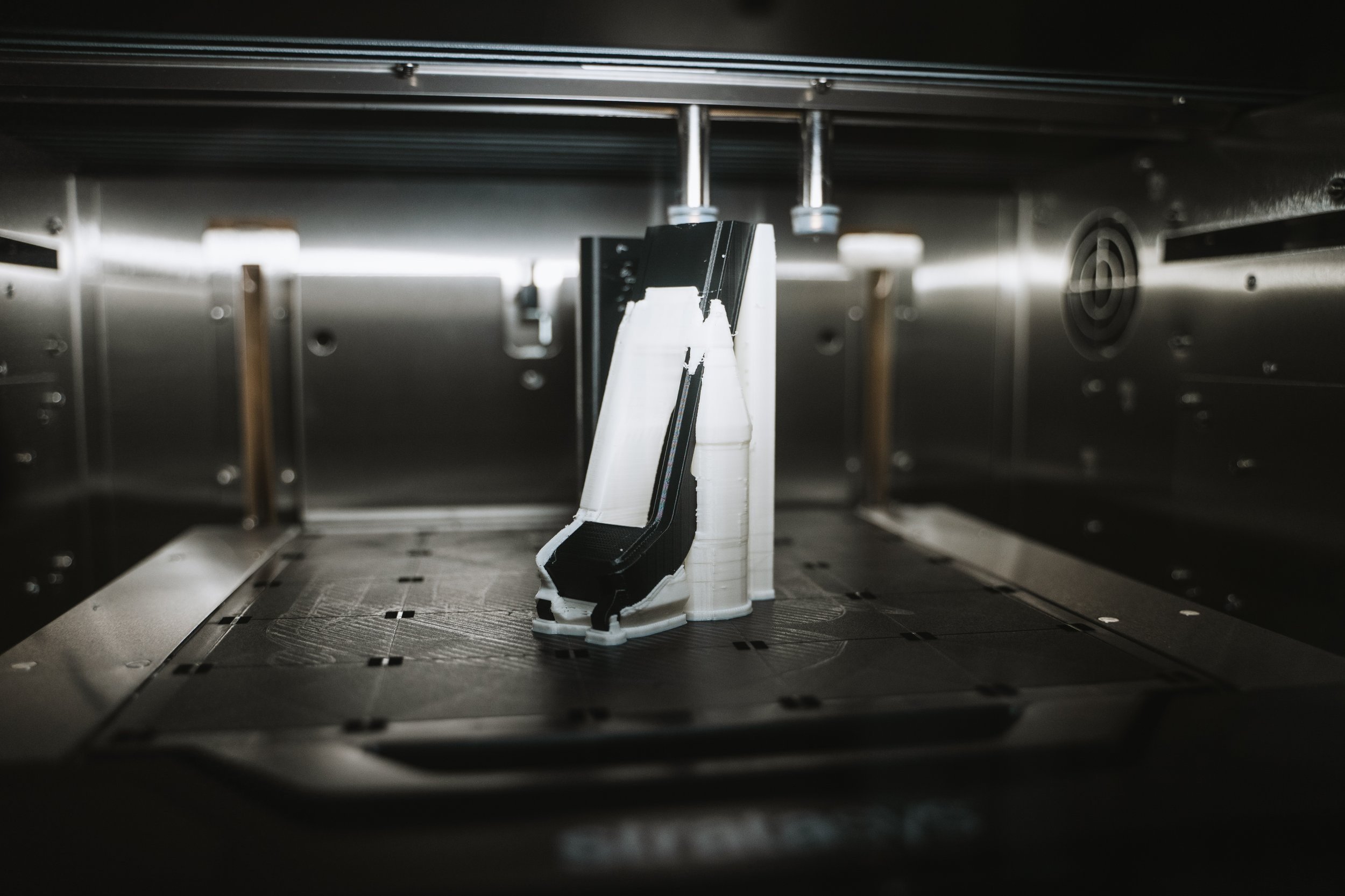
By March 2021, STEL was describing a dedicated lab with four printers, including machines using stereolithography and fused deposition modeling. Different machines handled different demands, from intricate geometries to engineering materials. The garage had acquired a more orderly successor.
The appealing part of this origin is its scale. A local service gave the founders a way to work on real objects with real customers. Each print could expose a proportion, a clearance, or a fit that needed another attempt. The service and the learning happened in the same place.
The equipment has to go somewhere
Bunker Supply brought that product development background into government equipment. The company traces its direction to feedback from Homeland Security in 2018. Olson has described its beginnings through work with U.S. Customs and Border Protection on equipment for an Android Team Awareness Kit rollout. That work also brought the team into contact with goTenna and its mesh radios.
A radio makes an unusually clear argument for thinking beyond the device. It needs protection, a place on the body, access when wanted, and a connection that stays connected. Each requirement competes for space. Add movement, a bag, a belt, and the other things a person must carry, and a modest plastic housing becomes a fairly demanding piece of design.
Bunker’s Rugged Expedition Case for goTenna addresses those surrounding tasks. Its attachment platform supports mounting on webbing, belts, and straps. Users can adjust the angle. A two-finger release disconnects the radio from its holster, while a dual lock guards against accidental release. A sliding cover can conceal the device’s indicator lights.
These details are easy to pass over in a product photograph. They are easier to appreciate when imagining the sequence of using the object: attach it, position it, reach for it, release it, put it back. The sequence gives a founder quite a different brief from simply making a protective shell.
Carry it. Power it. Reach it. Move it.
The actions around the device are part of the product.In 2021, Olson was already discussing a broader equipment management ambition: compatibility across the field, the station, and the vehicle. His stated interest was in making gear easier to manage across those settings. The mounting point, humble as it looks, appears repeatedly in that work.
In his 2024 discussion of goTenna’s EdgeRelay, Olson described another version of the mounting problem. The communications system uses a universal plate to accommodate several kinds of mounting hardware, including options for poles, walls, and tripods. Its enclosure and installation features had to work together. The system needed to survive its surroundings and also be manageable for the person putting it in place.
A balanced center of mass, a carrying handle, and an integrated tool kit belong to that second part of the brief. They concern the trip to the installation point and the work performed there. It is a useful example of the range of decisions hidden inside a word as compact as “rugged.” Protection has to coexist with handling, setup, and service. An enclosure can keep the weather out while still asking thoughtful questions about the hands coming in.
The people holding the prototypes
One of Olson’s more emphatic public statements begins with a stage direction: a foot stomp. He then makes his position plain.
“It begins and ends with end-users!”
Ryan Olson, on collaboration with FATHOMWERX and NavalX
The occasion was a video about working with FATHOMWERX and the Ventura Tech Bridge. Olson described the value of connecting with users, refining the equipment, and advancing Bunker’s work with Naval Air Systems Command. His accompanying message challenged innovation pursued merely for the appeal of the word.
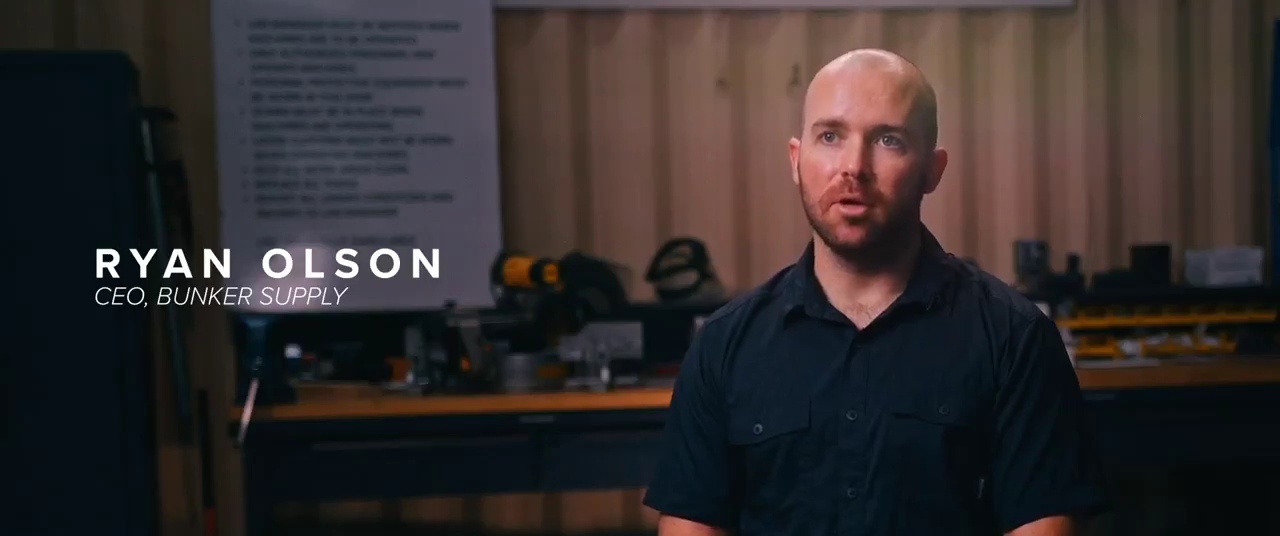
The collaboration has a practical appeal. Someone who uses equipment daily can show a developer which interaction is awkward, which step consumes time, and which feature solves a problem that barely exists. A prototype becomes more informative when it leaves the room where everyone already knows how it is supposed to work.
Olson’s projects also extend beyond wearable accessories. A 2024 Air Force Phase II award names him as principal investigator for Bunker Supply’s Electric Mobility Operations Vehicle, or E-MOV. The $1,238,418 award supported development of an electric mobility system intended to carry up to four airmen and their tools. The documented objective was to address transport and logistics around aircraft maintenance and dispersed operations.
A vehicle and a phone mount are different assignments. Both ask developers to account for people, equipment, and the journey between one place and another. In Olson’s record, the dimensions change considerably; the need to understand the job remains.
A battery acquires a social life
MAAK brings connected equipment to outdoor and everyday customers alongside tactical users. Olson became its co-founder and CEO in 2024. The range includes Scout power, Forge device cases, mounts, locking cables, and accessories. A case can meet a mount; a battery can join the arrangement. The individual objects have been designed with company in mind.
Olson has a less formal description for the people interested in these connections. In a post about the Scout Battery and Chest Mount, he asked: “Anyone modularity nerds like us?” He compared the system’s versatility to robust building blocks. There is room for a little playfulness in a discussion of attachment hardware.
A simplified view of the published product relationships. Device-specific adapters determine compatibility.
The Chest Mount makes one of the benefits concrete. Its mounting hardware can be swapped when the user changes devices, allowing the main mount to remain. That is an understandable proposition for anyone whose drawer contains accessories retired by a perfectly ordinary phone upgrade.
Scout took a public test on Kickstarter between January 30 and March 1, 2025. The campaign set a $5,000 goal. It finished with $101,486 pledged by 568 backers, a little over twenty times the target. Those numbers describe pledges to a particular campaign. They also record a group of people willing to back MAAK’s proposition before it became another item in the shopping routine.
Bars use the same scale. Pledges reached 20.3 times the goal.
The battery’s published specifications include 10,000mAh capacity, two USB-C ports, and Qi2 wireless charging. Its mount-ready design gives it a place within the wider kit. The significance for Olson’s story is the attention paid to the space around a familiar product. Power is useful; having it positioned where the rest of the equipment needs it adds another design problem worth solving.
The distinction between a finished object and a finished arrangement is useful here. A phone case can be complete on its own terms while its owner is still sorting out the cable, the mounting position, and the moment it must come off the kit. MAAK’s product range gives those surrounding decisions a shared set of components. Customers still choose their configuration, but the components begin with published relationships to one another.
Back to the printer
MAAK’s downloadable modules provide a pleasing return to the garage. Users can obtain files for accessories such as an ID wallet, a storage box, and a Scout-to-GoPro adapter, then print the parts themselves. The company says it will update the files through community feedback and add more.
That offer gives a customer a way to adapt the kit with a printer. It also puts a small piece of product development into the user’s hands: choose the useful attachment, make the part, try the fit. For a founder whose first business began around accessible printing, the connection is unusually tangible.
Olson is also listed among the Scheinfeld Center’s Get REAL Accelerator mentors at Santa Barbara City College. It is another local connection in a career that has moved between design services, government projects, and consumer gear. Santa Barbara remains the place tying those chapters together.
There are larger objects in Olson’s working life now, and more elaborate systems around them. Yet a printer making a small part still offers a good way into the story. Something imagined becomes something held. Someone tries it. The next question is how well it fits.
Follow the connections
Continue with Olson’s work, conversations, and the gear.