Every washing machine in the order had bad gears. All 100 of them. For the Upton Machine Company, a young Michigan manufacturer with five or six employees, the discovery threatened a crucial customer relationship before the business had properly begun. Federal Electric had ordered washers. Upton had delivered a repair problem.
According to Whirlpool’s corporate history, the company absorbed the cost of fixing every one. Before Whirlpool could sell convenience, it had to accept responsibility for inconvenience. It is an unusually useful opening scene for a company whose products become conspicuous chiefly when they stop working.
- Whirlpool owns a whole appliance aisle: Maytag, KitchenAid, Amana and more.
- Its removable-agitator washer turns a familiar customer compromise into a physical choice.
- Big sales conceal a harder business: 2025 free cash flow was just $78 million.
A patent after a bad bet
Lou Upton had already experienced a more personal failure. At 22, he invested his $500 savings in a venture that collapsed. He came away with a wringer-washer patent. His next idea was to add electricity. His uncle Emory supplied mechanical expertise; Lowell Bassford joined the founding enterprise. In 1911, the Upton Machine Company began making electric wringer washers.
There is something appealingly literal about that beginning. Electricity replaced effort in an existing household task. The clothes still needed washing. The invention changed who, or what, supplied the work. In 1948, the business launched an automatic washer bearing the Whirlpool name. Two years later, the corporation took that name itself.
The part that gets out of the way
A century later, the work remained surprisingly intimate. Whirlpool’s researchers heard from consumers who had switched from high-efficiency washers back to machines with a central agitator. They perceived the older arrangement as cleaning better. Yet the post occupied space that could otherwise accommodate bulky laundry.
Pam Klyn, then a product-organization executive, recalled asking, “why can’t we have a removable agitator?” Engineers developed and tested the mechanism. Select Whirlpool washers introduced it in 2021. The user could keep the post for one load and remove it for another.
“why can’t we have a removable agitator?”Pam Klyn, recalling the development discussion
The revealing detail is the direction of travel. Customers were switching back. Product teams often read progress as a procession toward whatever they have just designed. Here, dissatisfaction made the research valuable. The practical lesson is to study the person abandoning your preferred solution. That person may be identifying a compromise your product category has mistaken for a law of nature.
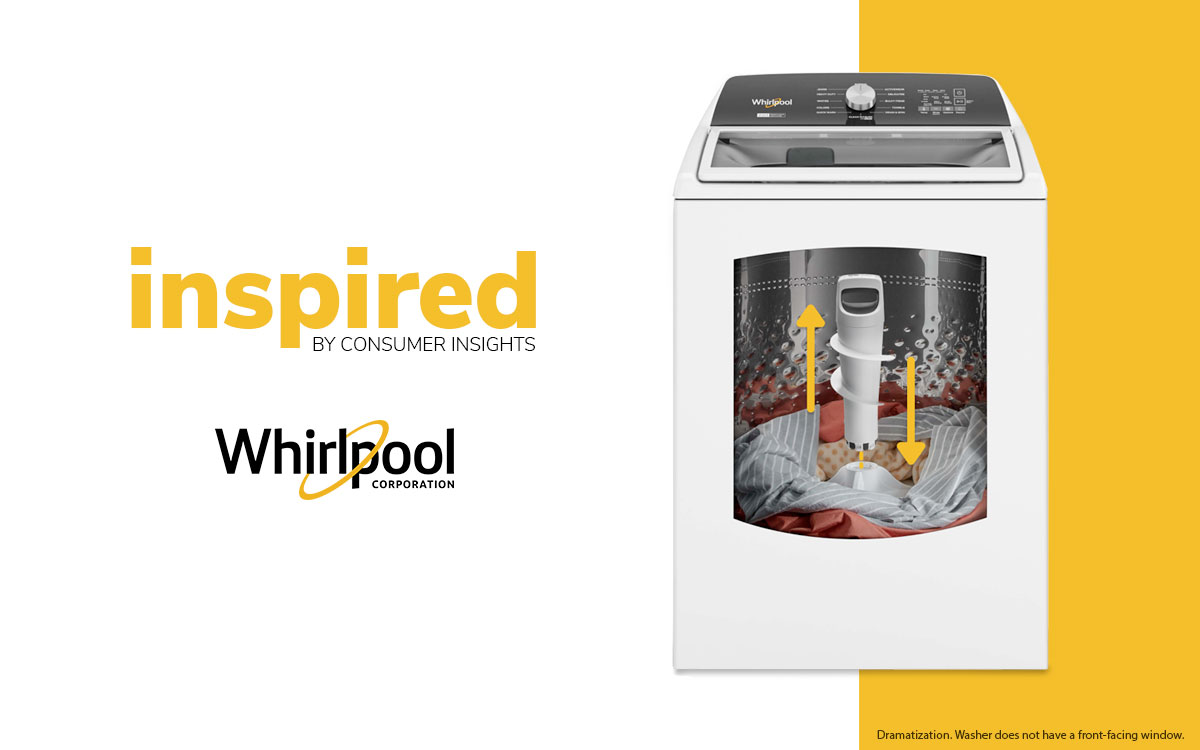
For a buyer, the benefit is specific: more flexibility for different loads, including bulky bedding. It belongs on a shopping checklist alongside dimensions, installation requirements, running costs and service availability. Only models designed for removal offer this function. A clever mechanism is useful when it matches the laundry you actually do.
One parent, several shopping lists
Whirlpool Corporation is larger than the badge on a Whirlpool washer. Its portfolio includes KitchenAid, Maytag, JennAir, Amana, Brazil’s Brastemp and Consul, and InSinkErator. Across those businesses it sells refrigerators, cooking equipment, dishwashers, washers, dryers, countertop appliances and products beneath the sink.
The customers include households, retailers, distributors and homebuilders. Appliances reach consumers through trade channels and direct sales. Parts, filters, cleaners and licensing add other revenue streams. The corporation’s expertise sits in the combination: understanding household routines, engineering machines, manufacturing them and getting them into kitchens and laundry rooms.
That creates several ways to compete with Samsung, LG, Haier’s GE Appliances, Bosch and Electrolux. A buyer may encounter Whirlpool’s group through a mixer, a builder’s kitchen package or a replacement dryer. This breadth offers more occasions to make a sale. It does not establish that any particular model is better than the alternative.
The price of choosing a smaller map
Portfolio strategy also has a cash register. Whirlpool announced its InSinkErator purchase in 2022 at $3 billion in cash. The acquisition added food-waste disposers and instant hot-water dispensers, extending the company’s place in the kitchen without depending on another refrigerator purchase.
Elsewhere, it reduced control. In April 2024, Whirlpool combined its European major-appliance operations with Arçelik’s businesses in Beko Europe, retaining a 25% interest at closing. Management presented the transaction as a move toward higher growth and margins. In November 2025, a separate share sale reduced its Indian ownership from 51% to about 40%, generating roughly $166 million in gross proceeds intended for debt reduction.
Reported sales fell 6.5%. Changes in the business portfolio affect the comparison.
The financial results explain the urgency. Whirlpool reported $15.524 billion of 2025 sales and $78 million of free cash flow, its non-GAAP measure of cash after capital spending. In second-quarter 2026, sales were $3.517 billion and ongoing EBIT margin, another non-GAAP measure, was 1.8%. A secured refinancing cleared debt maturities until 2028, according to the August release. Breathing room still has to become operating progress.
The company’s historical account also records a week of paid vacation for employees in 1917. Lou Upton asked their wives to encourage actual rest rather than garage cleaning. The paternalism dates the gesture; the attention to exhausted people makes it recognizable. Today, Whirlpool names integrity, respect, inclusion and diversity among its values. Those declarations describe the culture it seeks, rather than proving how every employee experiences it.
What comes out of the wash
Whirlpool’s stated mission is “Earn trust and create demand.” Its community work offers a concrete interpretation. Care Counts, run with Teach For America, supplies laundry equipment and supplies to schools. The company reported reaching 193 schools across all 50 states through 2025. Clean clothes address one barrier to attendance; the program cannot remove every reason a child misses class.
That limitation belongs beside the business lesson. An appliance maker can improve the task within reach. It cannot manufacture a housing recovery, guarantee a household’s budget or make financing costs disappear. Whirlpool’s most persuasive ideas are the tangible ones: accept the repair, notice the awkward load, let the obstructing part come out. The household gets a useful machine. The company gets another chance to be chosen.