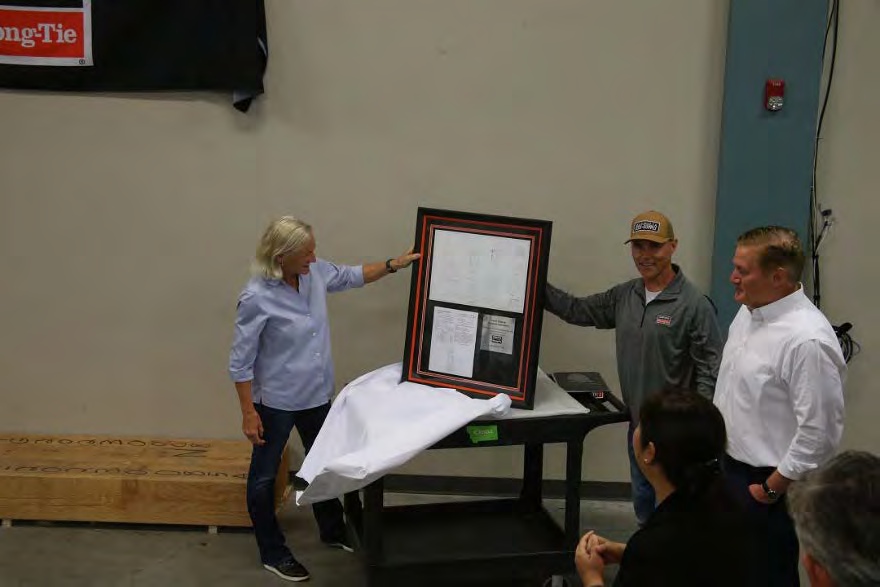
At the ceremony for the research laboratory that would bear her name, Karen Colonias received an unusually appropriate retirement present: her own homework. David Huerta, the lab manager, presented a framed copy of her hand-drafted HD5A production drawing, together with her first patent for the product. After decades of promotions, balance sheets and board meetings, there was the drawing again. Someone had kept the evidence.
The gift neatly reversed the usual executive farewell. The important object in the room belonged to the engineer who had arrived in 1984. By the time she stepped down as Simpson Manufacturing’s chief executive at the end of 2022, Colonias had run a factory, overseen finance and spent eleven years leading the building-products company. A drawing could tell the beginning of that story without requiring a single slide.
The engineer at the roof joint
Before Simpson, Colonias worked as a civil engineer at Bechtel. Her qualifications include a civil engineering degree from California State University, Sacramento, an MBA from California State University, East Bay, and a professional civil engineering license. The combination would eventually make sense on an executive biography. Initially, there was a more immediate task: designing construction hardware that would perform as intended.
At Simpson Strong-Tie, she joined research and development as its second engineer. She would design more than 25 major products, including the initial prefabricated Strong-Wall shearwall. That is a particular kind of authorship. A product can become familiar to builders while its designer remains a name in a technical file. The public admires the finished house; the connection inside the wall receives rather less applause.
Consider her hip ridge connection, patented in January 1995. It addresses the meeting of hip rafters and a ridge member in a roof. A formed sheet-metal connector provides seats for the rafters and attaches to the ridge. In one version, the slope can be adjusted on site. The invention concerns a practical difficulty at a very specific intersection of timber.
Its interest lies in that specificity. A roof drawing must eventually accommodate real lumber, real angles and someone standing there with tools. The useful idea is the one that survives that encounter. Colonias’s early work occupied the space between a design’s clean geometry and the builder’s less obliging afternoon.
Two hip rafters. One ridge member. A connector designed to accommodate the angle between them.
Another of her inventions, the construction connector anchor cage system, deals with positioning anchors in a foundation. The patent granted in March 2012 names Colonias as inventor. The system combines a securing member with a rebar cage and can use placement guides to locate anchors more accurately. It is an exercise in getting something right before concrete makes revision inconvenient.
Those inventions help explain what the word “engineering” means in her career. It includes the small accommodations that make an installation possible, repeatable and inspectable. Her work was close enough to construction to concern itself with placement, fastening and adjustment. The finished object needed to work for the person using it as well as the person specifying it.
Learning the business from several doors
In 1998, fourteen years after joining, Colonias became vice president of engineering. Her responsibilities included research and development, product testing and code development. It was a promotion within a discipline she already knew. The next major move required a wider field of vision: from 2004 to 2009, she managed Simpson Strong-Tie’s Stockton manufacturing operation.
Stockton put production, sales and Northwest regional operations in her remit. A drawing specifies what should be made; a branch manager must contend with making it and getting it to customers. The move brought several parts of the business into the same job. It also gave her a substantial operating assignment before the financial titles arrived.
In May 2009, she became Simpson Manufacturing’s chief financial officer, treasurer and secretary. The progression is striking because it crosses functions that corporate careers often keep apart. Research, factory operations and finance each describe the same company in a different vocabulary. By the time the board chose her to become CEO, she had held responsibility in all three.
- 1984Research & development engineer
- 1998Vice president of engineering
- 2004Stockton branch management
- 2009Chief financial officer
- 2012Chief executive officer
Her appointment took effect on January 1, 2012, succeeding Tom Fitzmyers. The announcement gave her a brief that extended beyond the residential construction business into commercial building products. It also credited her work on strategic business planning and acquisitions as CFO. She entered the role with both an internal history and an assignment to expand the company’s reach.
There is a useful distinction between knowing a company for a long time and knowing it from several jobs. Colonias had both. Her path to the top included the research department where a product began, the operation that produced and sold it, and the finance function that accounted for the business. The job titles describe an accumulation of perspectives.
A larger company, in plain numbers
Simpson Manufacturing recorded $657.2 million in net sales in 2012, her first year as CEO. By 2021, annual revenue exceeded $1.573 billion. Those are company results across a period of many employees’ work and changing construction markets. They establish the scale of the business she led without turning the entire enterprise into a solo performance.
The product range also conveys what running the company involved. By the middle of her tenure, Simpson’s offering included structural connectors, anchors, fasteners, lateral systems, truss plates, software and concrete repair and strengthening systems. The customer’s problem might arise in residential, commercial, industrial or infrastructure construction. A chief executive with a hardware designer’s background was overseeing a business with many ways into a building.
In 2014 alone, the company launched twenty products. Its stated strategy combined strengthening the core business, entering additional business areas and taking products into international markets. That mixture matters to this story: the company kept developing physical products while broadening where and how it sold them. The original engineering work remained part of a much larger operating task.
The people who could see a path
Colonias also became a visible example for women building engineering careers. Rachel Holland, a Simpson engineering supervisor, recalled that seeing her in leadership had helped attract her to the company. That is a concrete effect of representation: an applicant could look at the person running the business and see that an engineering career there could move upward.
Wendy Allen, a senior field engineer and associate technical manager, described Colonias as fair, inventive and enjoyable company. She made a careful distinction: Colonias had not been her direct mentor. Even so, following her progression helped Allen imagine her own next steps. A leader can influence someone’s career without ever holding a formal mentoring meeting.
The less ceremonial version of that influence appears in Huerta’s recollection of her hiring preferences. Colonias wanted “Engineers with Personality.” It is an economical phrase, and a welcome amendment to the idea that technical competence requires conversational punishment. Her colleagues remembered someone interested in their development as people and professionals. The personality requirement made room for a human being alongside the calculations.
“Engineers with Personality.”
David Huerta’s recollection of Colonias’s hiring preference
Her own account of company culture put the emphasis on opportunity over time. She had worked closely with founder Barclay Simpson and regarded her career as an example of his willingness to invest in employees. Preserving that culture became part of her responsibility as CEO. The engineer who moved through the company was now responsible for what other employees could expect from it.
She expressed the standard directly in her introduction to the company’s 2021 code of conduct: “It’s about knowing what’s right and doing what’s right.” It is a short instruction with few hiding places. The same introduction asked employees to raise concerns about conduct inconsistent with company values. Culture, in that formulation, involved what happened between people during ordinary work.
A name above the laboratory door
The succession plan announced in September 2022 set out a gradual departure. Michael Olosky would become CEO on January 1, 2023. Colonias would assist as an executive adviser until retiring on June 30. Her Simpson board service ended on April 26, 2023. The dates mark a handover with time allowed for the people taking responsibility.
Her board work at Reliance continued. Appointed in October 2016, she remains an independent director, chairs the compensation committee and serves on the audit committee. Reliance’s 2026 proxy records experience in plant operations, strategy, acquisitions, international business and finance. Read beside her career, those qualifications have identifiable places of origin.
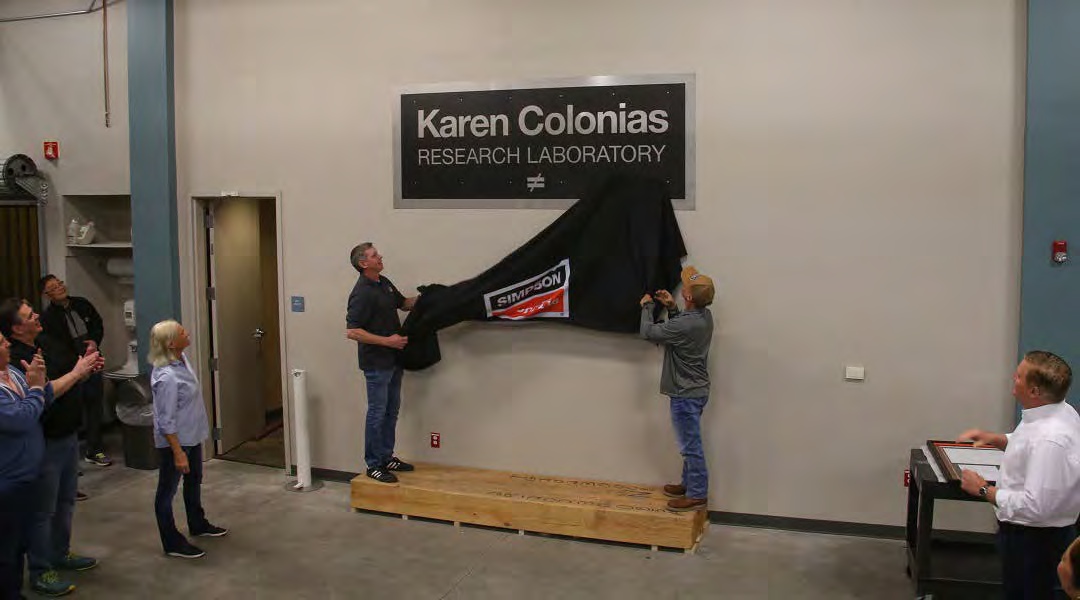
At the laboratory in Pleasanton, work continues on connectors, fasteners, truss plates and full assemblies. Its research includes corrosion, wood and concrete. Naming it for Colonias places her name where products are examined and tested, the work with which she began. The framed drawing supplies the companion image: an early design returned to its maker after a career spent learning what else a company needs.
For a former chief executive, it is a pleasantly practical form of remembrance. The sign belongs to a working laboratory. The drawing still has dimensions.