A roof membrane is a peculiar product. If it performs perfectly, almost nobody thinks about it. If it fails, everybody develops a sudden interest in seams, drains and vapour pressure. SOPREMA Canada has built a national business inside that asymmetry. The company makes the waterproofing, insulation, air barriers and vegetated systems tucked between weather and occupied space - then surrounds those materials with enough design help, testing, training and paperwork to make an expensive failure less likely.
The Canadian operation began in 1978, seven decades after building-materials merchant Charles Geisen founded the parent company in Strasbourg. Its early burlap cloth dipped in hot bitumen looked enough like elephant skin to earn the name MAMMOUTH. The animal stayed in the logo; the name became part of the SOPREMA acronym. It is an unusually charming origin for a company whose daily vocabulary includes “wind uplift resistance” and “polyisocyanurate.”
Today, Drummondville is the Canadian headquarters and home of the North American research centre. SOPREMA reports more than 1,000 Canadian employees, 16 manufacturing plants and 11 sales offices. The catalogue reaches from low-slope roofs to foundations, bridge decks, parking garages, pools and walls. In practical terms, the company sells control over four unruly things: water, air, heat and installation risk.
The product is the assembly
SOPREMA’s range looks sprawling until one sees the common logic. SBS-modified bitumen and PVC membranes keep roofs watertight. Liquid-applied ALSAN systems wrap awkward corners and traffic surfaces. SOPRA-ISO and SOPRA-XPS boards slow heat transfer. SOPRASEAL products manage air and vapour at walls. SOPRANATURE turns a roof into planted infrastructure that can retain stormwater. Civil-engineering systems protect concrete where leaks become structural problems rather than ceiling stains.
That breadth changes the sales conversation. An architect is rarely choosing an isolated roll. The choice is an assembly: deck, vapour control, insulation, cover board, membrane, fasteners, flashings and details. Each interface introduces another opportunity for incompatibility or sloppy execution. SOPREMA can specify more of that stack, test it as a system and support it under one technical umbrella.
The services are not decorative. SOPREMA offers specification support, estimators and drafters, system-selection tools, technical representatives, warranty programs and courses with both theory and practical evaluation. Training covers SBS, PVC, green roofs, wall barriers, spray foam, foundations and pool waterproofing. A product with demanding surface preparation or seam work is only as reliable as the crew’s last metre, so teaching the installer protects both the building and the brand.
“The use of this product made it possible to finish the job two days ahead of schedule.”Sébastien Gauthier, SOPREMA product manager, on the Bowmanville reroofing
What failed first
At Bowmanville Indoor Soccer in Ontario, the first failure was blunt: a December 2022 winter storm brought 90 km/h gusts and damaged the roof. The replacement became a tidy demonstration of SOPREMA’s two-in-one pitch. Its 2-1 SOPRASMART panel arrives with a bitumen base sheet factory-laminated to a high-density polyiso support panel. Two site operations become one.
In SOPREMA’s published comparison, two roofers finished the relevant work about two days ahead of a conventional approach and reduced labour tied to installing the support panel and base sheet by roughly 40 percent. The job also avoided open flame and hot kettles, which can lower site risk and related insurance costs. This is the company’s differentiation in miniature: engineer one interface out of the field, then quantify the time saved.
The C$42.8 million change of mind
Industrial conviction is easier to spot when it comes with concrete. SOPREMA initially anticipated spending C$20 million on an extruded-polystyrene insulation plant in Sherbrooke. By 2017, the plan had grown to C$42.8 million. Quebec and Canadian governments contributed C$8.5 million in loans and non-repayable support. The factory opened in 2018, with Université de Sherbrooke and municipal support cited as deciding factors in the location.
The useful takeaway is not “spend twice the budget.” It is that local manufacturing can become part of the product in a climate-sensitive category. Canadian roofs and walls see freeze-thaw cycles, heat, wind and regional codes. Nearby plants shorten supply paths; nearby technical staff learn the recurring details; an R&D centre can adapt assemblies to the market. The strategy works when local complexity and freight matter enough to reward the capital. It works less well in a standardized, low-margin category where customers buy only the cheapest unit and service carries no premium.
tonnes of polystyrene recycled in 2023 for SOPREMA’s Canadian XPS manufacturing stream, according to the company
From environmental claim to purchasing data
Building-material sustainability has long suffered from brochure language. SOPREMA’s more interesting move is administrative. In 2025 it launched a calculator that lets a designer enter surface area, select products and estimate greenhouse-gas impact using available third-party-validated environmental product declarations. It also began placing available product and order carbon footprints on invoices.
That sounds mundane. It is also how a fuzzy ambition enters a workflow. An architect can compare options before specification; a contractor can carry the number into project records; an owner can fold purchases into a carbon report. The invoice becomes a tiny environmental ledger. The limit matters: results depend on which products have EPDs, which life-cycle modules are covered and whether two declarations are genuinely comparable. A carbon number is evidence, not absolution.
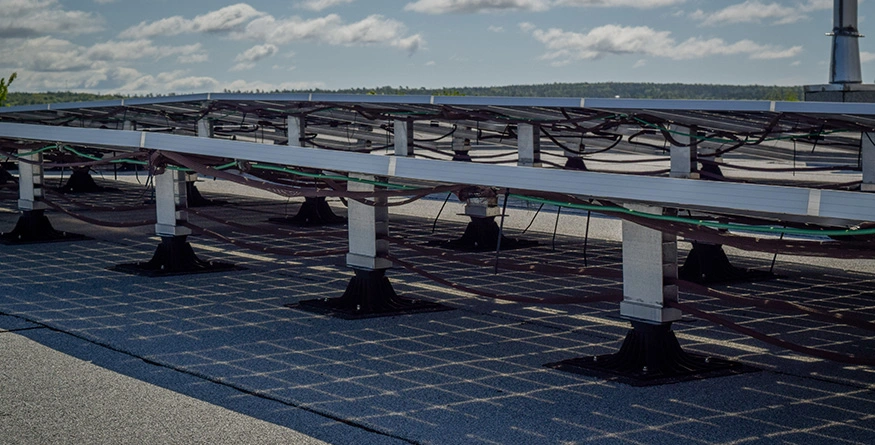
SOPREMA has also used its own sites as case studies. A 20,000-square-foot office and warehouse in Dartmouth combined a photovoltaic roof with a solar thermal wall and efficiency work. The company reported a 64 percent reduction in carbon impact after the project. At Sherbrooke, recycled polystyrene feeds XPS insulation production; SOPREMA said it processed more than 10,000 tonnes in 2023. At Woodstock, a LEED v4-certified membrane plant later won an international Smart Building award at the 2025 Green Solutions Awards presented during COP30.
Who pays, and why
The direct customers include contractors and distributors. The people shaping demand are broader: architects, envelope consultants, engineers, specifiers, owners, facility managers and public agencies. Their incentives differ. A roofer values speed and familiar installation. A designer values tested assemblies and clean details. An owner values service life, warranties and fewer disruptions. A public buyer may need Canadian content, environmental declarations and code documentation.
SOPREMA earns by selling physical materials through that network. It does not publish Canadian revenue or a neat service split. The business model is nevertheless visible: manufacture a wide set of compatible products, make them easier to specify, train people to install them and support the completed system. Technical help creates demand for the material; the material funds the help. Acquisitions in distribution, cellulose insulation, pre-laminated panels and, more recently, roof-monitoring technology widen the loop.
Bundle the failure points
If interfaces cause trouble, sell and support the whole assembly rather than one component.
Teach the operator
Training is product quality control performed before the product reaches the job.
Put proof in the workflow
Carbon data on an invoice is more usable than a sustainability claim in a campaign.
Installation still wins
Wrong substrates, weather, detailing or workmanship can defeat a well-tested assembly.
Where the playbook breaks
This model is strongest on complex commercial, institutional and infrastructure work, where water ingress is costly and multiple professionals influence the specification. It is weaker when a buyer is chasing the lowest upfront price, when a tiny project cannot absorb training or technical overhead, or when local crews lack experience with the chosen system. Some methods have hard conditions: SOPREMA’s cold-weather flameless products still require prescribed installation procedures and are advertised only down to -10°C.
Nor can a manufacturer own every outcome. SOPREMA’s own FAQ notes, for example, that wind uplift is not covered by its warranty. Building performance sits across design, substrate, fastening, workmanship, maintenance and weather. The company’s answer is not to erase that complexity. It is to make more of it selectable, teachable and testable.
That is what makes SOPREMA unusual within the crowded market for membranes and insulation. Competitors such as Carlisle, Sika, GAF, IKO, Johns Manville, Henry, Tremco, Owens Corning and DuPont can match pieces of the catalogue. SOPREMA’s pitch is the density of the package in Canada: domestic manufacturing, envelope breadth, field support, education, system testing and now carbon accounting. The company under the roof would like to own more of the reasoning that puts it there.
The lesson is pleasingly unglamorous. When the physical product disappears into a wall, make its performance visible. Show the test. Train the crew. Count the carbon. Put the result on the invoice. A century after MAMMOUTH, SOPREMA is still selling a barrier between the building and a bad day. It has simply learned to sell the evidence, too.