The most revealing thing about concrete is how impatient it is. Once mixed, the clock starts. A truck has a limited radius, a construction crew has a schedule, and a supplier that arrives late can idle an entire site. Cement can travel farther, but aggregates are bulky and cheap relative to their weight. Asphalt cools. In this business, geography is not a map on an investor slide. It is the product.
That helps explain Holcim, the Swiss building-materials company whose operations sit close to quarries, cities and job sites across 43 markets. It also explains why a company with a global research network still behaves like hundreds of local businesses. The customers are contractors, developers, governments, engineers, architects, distributors and ready-mix producers. They need foundations that bear weight, roads that survive traffic, walls that manage heat and deliveries that turn up in the correct sequence. Reliability is less glamorous than invention, but on a building site it often is the invention. A beautiful specification means little when the nearest plant cannot make it, the local code will not accept it or the truck misses the pour.
A materials company learning to sell the whole building
Holcim begins with the elemental stack of construction: limestone becomes cement; cement, water and aggregate become concrete; crushed stone and sand go into roads, railways and buildings. The company also sells ready-mix concrete, surfacing and project services. Increasingly, however, it wants to reach from the foundation to the roof. Building systems, walling, insulation and higher-performance concrete sit beside the old bulk materials. Its 2030 strategy targets an even sales split between Building Materials and higher-value Building Solutions.
The distinction is commercially useful. A ton of undifferentiated cement invites comparison on price. A specified low-carbon mix, paired with engineering advice, delivery data and a wall or roofing system, gives Holcim more ways to solve a customer’s problem and more places to earn a margin. Acquisitions accelerate the shift. The 2026 purchase of Xella brought autoclaved aerated concrete walling brands and energy-efficient systems. Alkern added precast products. Regional deals in ready-mix, recycling and surfacing thicken the local network.
Three brands explain the bet
ECOPlanet is Holcim’s lower-carbon cement range. ECOPact is its lower-carbon concrete range. Both are marketed around a practical promise: reduce embodied carbon while preserving expected performance. Holcim says the flagship products start at 30 percent lower carbon dioxide emissions than conventional reference products. That qualification matters. Structural engineers and contractors are paid to manage risk. A climate product that requires them to surrender strength, predictability or code compliance will remain a brochure.
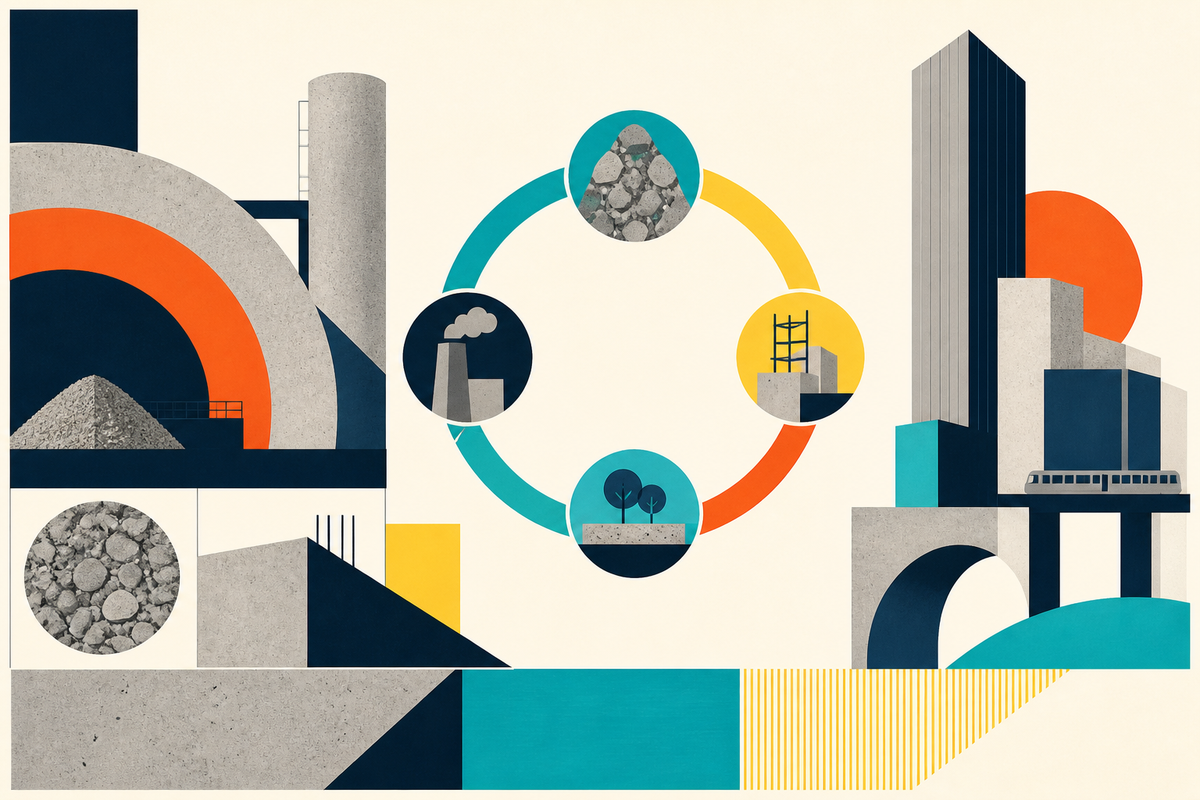
ECOCycle supplies the circular part of the proposition. Its technology processes construction and demolition material for use in new building products. Depending on the application, Holcim says those products can contain from at least 10 percent to as much as 100 percent recycled demolition material. Aggneo does something similar for reclaimed aggregates. The simple idea is also the provocative one: the next useful quarry may be the building already standing across town.
“Building better with less” is not only an environmental line. It is a supply-chain strategy for a world where virgin material, disposal space and carbon budgets all carry a price.Holcim’s operating idea, in practice
The kiln is the difficult bit
Concrete’s usefulness is not in dispute. It is moldable, widely available, durable and essential to infrastructure. The trouble sits inside cement, its binding ingredient. Producing clinker requires very high heat, and the chemistry of turning limestone into clinker releases carbon dioxide even before fuel emissions are counted. Renewable electricity can help with energy. Alternative raw materials and lower-clinker recipes can help with formulation. Neither makes the residual process emissions politely disappear.
Holcim’s response is a portfolio rather than a single miracle. It substitutes materials where specifications permit, uses waste as fuel and feedstock, refines lower-carbon recipes, electrifies pieces of production and develops carbon capture for what remains. Eight of its European capture projects have support from the EU Innovation Fund. Together, the company says, they are intended to enable more than 8 million tons of near-zero cement for customers by 2030.
CaptureLab, opened at Holcim’s Martres-Tolosane plant in France, makes this work unusually tangible. The facility connects pilot equipment to real cement-plant flue gas. Technology partners bring their capture units; Holcim provides pretreatment, utilities and analysis. The lab can treat roughly 5 to 30 tons of carbon dioxide a day, while a full-scale installation would be about 100 times larger. Air Liquide is the first pilot partner. The arrangement lets researchers discover the dull but decisive problems of impurities, uptime and purification before a technology is bolted onto an operating plant.
Specify lower-carbon cement or concrete, incorporate recycled mineral content, select permeable concrete for stormwater management, use modular walling and insulation systems, and plan or track deliveries through digital services. The value is practical only when product data, local availability and project requirements line up.
A moat measured in miles
Holcim competes with Heidelberg Materials, CRH, Cemex, Buzzi Unicem, Vicat and a long tail of local producers. There is no universal rival across every product and country. Competition changes by postcode and material: a regional quarry may matter more than a global brand; a roofing specialist may be formidable in one system; a small ready-mix operator can win by being closer and faster.
Holcim’s differentiation comes from the bundle. It controls or accesses mineral reserves, operates plants near demand, manages dense logistics, develops formulations through a global research organization and supports customers through local technical teams. Premium product brands give architects and buyers something specifiable. ECOCycle links demolition services with new material sales. Holcim+, an AI-powered customer platform introduced in its 2026 reporting, brings planning, ordering and live delivery tracking into the relationship. None of these elements is uncopyable by itself. Together, in a region with the right assets, they are difficult to reproduce quickly.
The model also explains Holcim’s appetite for acquisitions. Buying a local operator can add reserves, a plant, permits, customer relationships and haulage density in one move. In early 2026 the company completed a majority investment in Peru’s Cementos Pacasmayo and added operations in Belgium and New Zealand. Growth here is not a viral loop. It arrives on a balance sheet, then has to be integrated quarry by quarry and route by route.
The company after America
In June 2025, Holcim completed the spin-off of its North American operations into Amrize. That separation is easy to miss because old company profiles still quote the larger group’s employee count, sales and footprint. Today’s Holcim is a different shape: more than 45,000 people across Europe, Latin America, Asia, the Middle East and Africa. In 2025 it produced CHF 15.7 billion in net sales, CHF 2.9 billion in recurring operating profit and an 18.3 percent recurring operating margin.
The cleaner perimeter places more pressure on the remaining strategy. Management calls it NextGen Growth 2030. The plan combines market expansion, mergers and acquisitions, premium products, circular construction, artificial intelligence and decarbonization. The culture wrapped around it is called the Holcim Spirit: Purpose, People and Performance. Behind the tidy alliteration is a decentralized operating structure with hundreds of local profit-and-loss leaders. That is appropriate for a company whose products refuse to become weightless.
Holcim fits in the market between commodity-scale materials and engineered building systems. It is still unmistakably an industrial manufacturer. Kilns, quarries and trucks pay the bills. But its desired future resembles a construction platform made of physical assets: recover material from an old site, design a lower-carbon replacement, supply the foundation and walls, coordinate delivery, document performance and eventually capture emissions at the plant.
There is tension in that ambition, and that makes the company worth watching. Society needs more housing and infrastructure. Cement’s process emissions are stubborn. Recycling helps, but recovered material must be clean, nearby and suitable. Carbon capture can address residual emissions, but it needs energy, pipelines, storage, permits and patient capital. Holcim cannot solve those dependencies alone, which is why partners from Air Liquide and Eni to SaltX, Paebbl, Build Change and the European Union appear throughout its plans.
The test is not whether Holcim can design an elegant pilot. It is whether thousands of ordinary projects can buy a verified lower-carbon product at the right plant, on the right morning, at a price the budget accepts. In construction, transformation still has to arrive by truck.