In 2018, Aurimas Sabulis joined a meeting about a window. Around the table sat architects, developers, contractors and consultants working on a large Washington project. The conversation lasted two hours. Its subject, stubbornly, remained the installation of that one window. Sabulis had already spent years in commercial glass, so he knew construction could turn a small detail into an opera. But this meeting revealed something larger: the industry’s visible work happened on site, while much of its expensive friction lived in the translations between drawings, engineering, procurement and fabrication.
He would later laugh at the mythology of the founder’s light-bulb moment. Most ideas arrive slowly, wearing work boots. This one, he says, actually flicked on. A facade was being treated as a chain of separate jobs when it might behave as one connected system. The architect could draw; software could test what was buildable; a factory could assemble complete panels; crews could attach them from inside the structure. The exterior wall would arrive with insulation, cladding and windows already aboard, rather like a room-service tray with considerably stricter wind-load requirements.
That idea became Dextall, the New York construction-technology company Sabulis founded in 2020. Its public product is easy to photograph: prefabricated facade panels moving from a controlled factory floor to a rising building. Its more consequential product is almost invisible. Dextall is trying to turn the long, error-prone handoff between design and production into a data pipeline. The wall is the artifact. Coordination is the business.
The beautiful machine nobody wanted
Dextall’s first big lesson came from building something impressively fast and strategically wrong. The team created software that, by Sabulis’s account, could compress three or four years of facade coordination into roughly a day. The founders expected architects to celebrate. Architects admired the engineering and declined the bargain. The system had taken away control of the design, which was precisely the part of the job they were unwilling to outsource.
There is an entrepreneurial morality play tucked inside that refusal. People do not use tools simply because the tools produce a faster answer. They use tools that respect what they believe their work is. For an architect, choosing the rhythm, texture and proportion of a facade is not clerical drag waiting for automation. It is authorship. Dextall had made the backstage machinery splendid while accidentally moving the playwright out of the theatre.
“That was sort of a wake-up call for us that we have to tweak our software and give the control of design back to architects.”Aurimas Sabulis
So the company rebuilt around a more diplomatic division of labor. Architects would keep designing in the software they already knew. Dextall’s system would absorb the repetitive coordination behind their choices: panel grids, manufacturing constraints, materials, costs and production information. In 2026, that logic surfaced publicly as Kora Studio, a Revit-native facade tool. Its promise is not to replace the architect’s eye. It is to stop highly trained people from spending afternoons chasing lines through a model after every change.
Watch Kora Studio move from facade idea to buildable modelPlay video ↗Touch the proof
A second lesson was heavier and harder to fit in a conference room. Dextall showed customers detailed drawings. They nodded. The company made 3D animations. Customers called them cool, then returned with the same questions. At last the team built full two-story mockups and invited people to stand beside them. The reaction changed instantly. After months of explanation, prospects looked at the physical wall and said they got it.
Sabulis speaks often about the role of touch and emotion in physical industries. A rendering can explain geometry; it cannot reproduce the sensation of leaning toward a panel joint and seeing how the pieces meet. Nor can it transfer the reassurance of a finished building that has survived weather, tolerances and the unruly choreography of a job site. Software businesses can distribute belief with a login. Industrial companies sometimes have to deliver belief by truck.
The proof ladder
That created a ladder. Dextall began with buildings around nine or ten stories and stacked completed work until customers would consider projects three and four times taller. Each delivery made the next decision less adventurous. Sabulis calls the older window business his “street credibility”: before founding Dextall, he founded INTUS Windows in 2010 and learned to deliver commercial products for American buildings with European manufacturing behind them. The new company still had to prove its own system, but he entered the room fluent in the consequences of getting glass, schedules or tolerances wrong.
Pick a lane wide enough for a building
Sabulis is fond of saying that a founder cannot boil the ocean. Dextall’s chosen water runs from roughly six to forty stories. Below six, American buildings often use wood framing, a different construction type. Above forty, all-glass skyscrapers present another facade category. Between those boundaries sit steel, concrete and mass-timber buildings where a unitized panel system can repeat without demanding that every building look repeated.
The constraint clarifies what the company should automate and which fights it can postpone. Construction offers a hundred traditions to challenge before breakfast. Sabulis’s filter is practical: “Is this the fight worth fighting?” The company might tackle three or four frictions, deepen its position with customers, then return for the others later. This is not timidity. It is sequencing, a skill equally useful in endurance racing and enterprise sales.
Sabulis came to this work by a crooked route. Born in Lithuania, he studied economics at Stockton, graduated in 2009, worked as a financial adviser at Merrill Lynch and later earned an MBA at Georgetown. He is neither architect nor engineer by training, a fact he delivers with amusement. Yet economics may be a surprisingly apt education for a facade founder. Buildings allocate scarce labor, time, capital and materials in spectacularly tangible form. A coordination error does not remain a cell in a spreadsheet. It arrives late on a flatbed.
“Nobody is seeing that. But this is where probably the gold mine is. This is where the backbone of the prefab is.”Aurimas Sabulis on the hidden design-coordination cost
The athlete and the assembly line
Away from the factory, Sabulis cultivates a second life built from repetition. He completed the Ironman World Championship in Kona in 2022 and returned a 9:51:44 result in 2024. Before the earlier race, a Lithuanian newspaper reported, he prepared for Hawaii by switching off the air conditioning in his New York home, pulling on warm layers and riding indoors for five or six hours. It is an image of comic domestic extremity: Central Park outside, artificial Kona inside, a family learning to navigate around the bicycle.
His account of an ideal day begins at 4:45 a.m. with a hard interval run, wanders through a sunrise Daybreaker dance session at Rockefeller Center, then reaches the first calls from the car before nine. The routine has more color than the standard executive catechism about waking early. It also reveals his preferred operating system: hard blocks, deliberate transitions and a little sanctioned absurdity. Endurance is not glamorous while it is happening. Neither is checking whether the three-hundredth panel matches the first.
That manufacturing discipline is now meeting robotics. Dextall says it standardized five structural hook variants into one design before automating the weld. The robot came after the process became stable, an order Sabulis considers essential. Automation multiplies whatever it receives. Give it exceptions and confusion; it produces faster exceptions and confusion. Give it a repeatable decision; it becomes useful. The same principle shaped the software: first understand which choices belong to architects, then automate the machinery surrounding those choices.
A facade with a memory
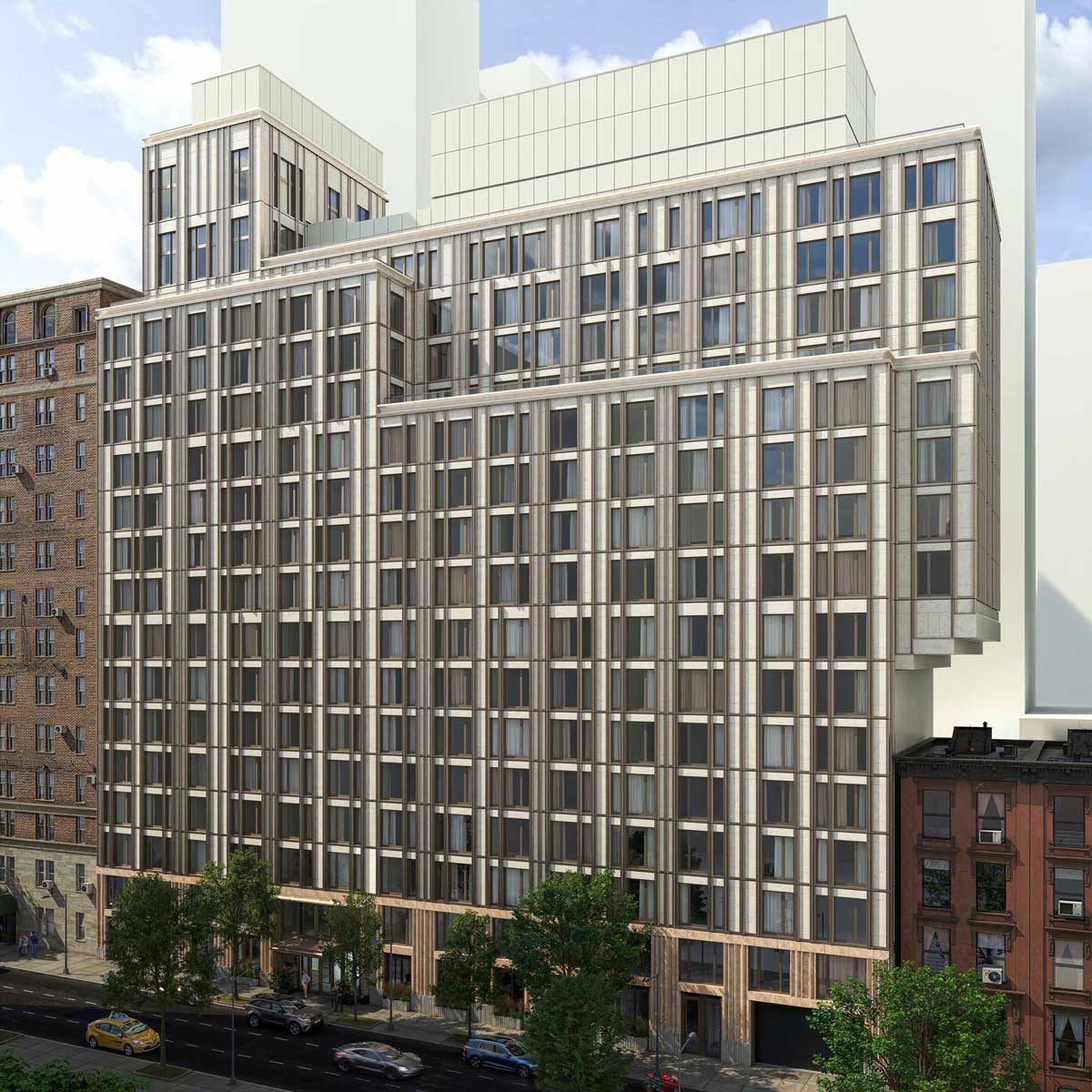
The current Dextall is both industrial company and accumulating memory. Its models encode what factories can fabricate. Completed projects feed credibility into sales. Standardized components give robots reliable work. Kora Studio places that knowledge inside the architect’s familiar Revit environment. The company announced a $15 million Series A in 2025, then opened Kora early access in 2026 while facade installation advanced on projects including 38 East 35th Street in Manhattan. The latter uses 73,000 square feet of prefabricated panels on an 18-story tower, including factory-integrated porcelain tile and rounded aluminum profiles designed to read continuously across panel joints.
This is the tension that makes Sabulis’s project interesting. Factories crave sameness; cities require character. Architects protect choice; manufacturers protect repeatability. Dextall is attempting a handshake between the two: standardize the hidden logic, preserve expression on the surface. Its best product decision arrived only after the architects refused the original terms.
The window meeting from 2018 now looks less like a complaint about inefficiency than an early sketch of that handshake. Every person at the table had a valid concern. The failure was in the connections. Sabulis has spent the years since trying to make those connections carry design intent all the way to the factory and back into the skyline. A wall, in his telling, is never merely a wall. It is a long conversation that should have learned, by now, to speak more quickly.