Loren Burnett’s sixth company began with an organism most people associate with a neglected fish tank. Microalgae, given light, water and carbon dioxide, can participate in making minerals. Coral reefs and seashells have used related biological choreography for ages. Prometheus Materials is trying to turn that old natural lesson into a contemporary industrial one: a cement technology that can lower the carbon carried inside concrete.
The charming version of this story ends there, somewhere between a microscope and a seashell. The useful version keeps going. It enters a pilot plant in Longmont, Colorado. It sits through standards testing. It meets architects, ready-mix producers, construction crews and officials who quite reasonably want proof before a new material holds anything important together. Burnett’s real product is not simply biology. It is permission for biology to become ordinary.
That is a fitting assignment for an executive whose career has moved through finance, software, technology transfer and clean technology. Burnett passed the CPA exam during his final semester at the University of Delaware, then accumulated more than three decades in CEO, COO and CFO roles. Prometheus says he founded six technology companies, four built around transferred intellectual property, and achieved five exits that produced more than $375 million in shareholder value. He had learned how invention escapes the institution that produced it. The surprise was choosing cement for the next escape.
The carbon bug bites through a window
Before concrete, there were windows. In 2011 Burnett founded e-Chromic Technologies around technology licensed from the National Renewable Energy Laboratory. Its electrochromic film was designed to reflect infrared radiation and reduce the energy required to cool buildings. He later said that venture was where he was “bitten by the carbon bug.” It changed the target of his entrepreneurship. Carbon was no longer a useful side effect of efficiency. It became the problem he wanted to work on directly.
The opportunity that became Prometheus arrived through the University of Colorado Boulder. Four faculty researchers - Wil Srubar, Sherri Cook, Mija Hubler and Jeffrey Cameron - had developed the underlying technology after years of cross-disciplinary work initially supported by the U.S. defense research agency DARPA. The original question was logistical: could biology help make construction material where hauling conventional concrete would be difficult? The research yielded a process involving microalgae and biomineralization.
CU Boulder’s venture network introduced Burnett to the researchers in February 2021. They formed Prometheus the next month. The arrangement joined people fluent in materials science, structural engineering, biotechnology and sustainability with an operator fluent in financing, commercialization and the peculiar diplomacy required when a laboratory discovery meets a market.
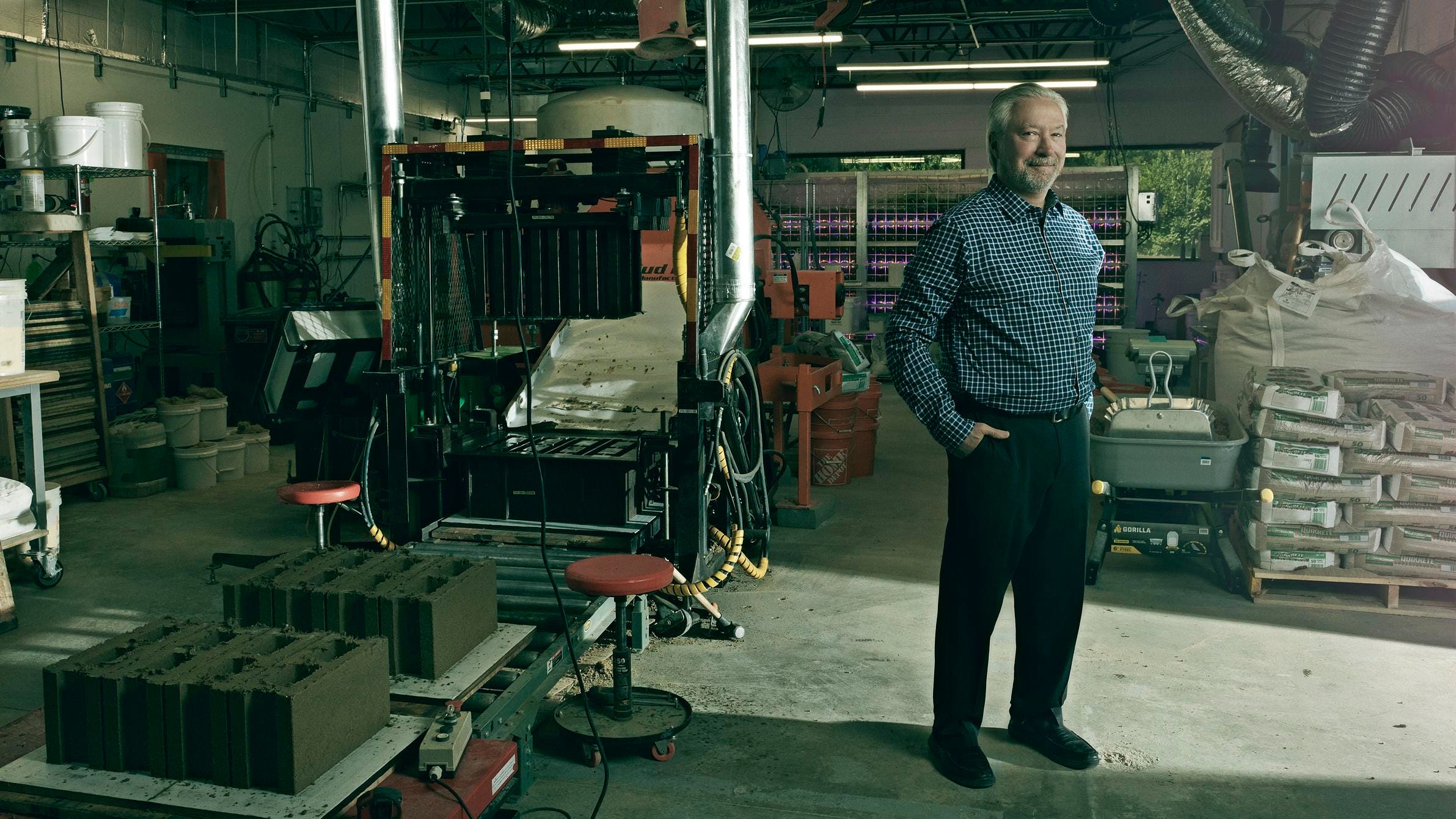
“I can’t stop starting companies and taking them from ideation through a successful conclusion.”Loren Burnett
Nature provides the recipe. Industry writes the shopping list.
Prometheus cultivates microalgae and stimulates biomineralization, the creation of minerals by living systems. The resulting material can become part of a cementitious blend. Its current ProZERO offering is designed to replace a portion of traditional cementitious material on a one-to-one basis and to enter existing ready-mix production without demanding a new fleet of equipment. That last detail is not decorative. It is the commercial thesis.
From living input to a familiar pour
Climate technology has a fondness for immaculate new systems. Construction owns billions of dollars’ worth of old ones, staffed by people who know exactly how they behave. Burnett’s route to scale is therefore partly an exercise in humility: fit the factories, trucks and habits already present. Prometheus can make products itself, but its global ambition depends on licensing the technology to established producers with existing plants and distribution.
That logic also explains an unusual investor list. The company’s $8 million Series A in 2022 was led by Sofinnova Partners and included Microsoft’s Climate Innovation Fund, architecture firm Skidmore, Owings & Merrill, roofing manufacturer GAF and Autodesk Foundation. Money mattered. So did position. Architects specify materials. Building-products companies understand distribution. A data-center builder creates demand for concrete at sobering scale. Each partner occupied a useful point along the route from formula to foundation.
Algae keeps a faster calendar than a building code
Burnett is candid about the drag in the system. The principal challenge for a new building material, he has said, is navigating standards, codes and approvals. There is no single gate. National tests may establish performance, while a city, county, state or country can still have its own requirements. A material can work in the lab and remain functionally unemployed.
Prometheus began with masonry blocks in part because their regulatory threshold was more approachable than other structural uses. It worked with SOM on the Bio-Block Spiral, a curving installation displayed during the Chicago Architecture Biennial. Later work moved closer to ordinary infrastructure: precast products, supplemental blends for ready-mix and a field installation for the New York Climate Exchange’s campus on Governors Island, completed with SOM, Skanska USA and D’Annunzio Group.
The company reported reaching full-scale production and commercialization across its ProZERO line during 2024. In 2026 it announced a 10-year agreement, with extension options, making Green Stream Algae its exclusive supplier of microalgae and biomineral across North and South America. A supply agreement is less photogenic than a spiral pavilion. It may say more about seriousness. Scale begins when the exotic ingredient gets a dependable purchase order.
Burnett’s favorite startup book is Geoffrey Moore’s Crossing the Chasm. He says he carries its lessons into every company and every new product. Cement makes the metaphor almost indecently literal. Early adopters enjoy novelty; mainstream buyers prefer evidence, supply and a quiet Tuesday. Prometheus must cross from a block that starts conversation to a blend that disappears into routine.
“The biggest challenge for us is going through the regulatory process, the codes and approvals.”Loren Burnett
Instrument flying for founders
In public, Burnett’s management philosophy sounds less like bravado than accumulated corrections. Teams are everything, he says. He has also described an expensive failure: hiring senior people whose resumes impressed him more than their ability to lead and build culture. His conclusion is plain enough to tape above a founder’s desk. A bad team can waste a strong product; a strong team can keep improving a mediocre one.
He has another analogy, drawn from being a pilot. Flying through clouds requires trusting the instruments and trusting the team even when the horizon disappears. Hard climate technology offers plenty of cloud. A promising reaction may resist scale. A factory deadline slips. A standard requires another test. An investor’s enthusiasm and a customer’s procurement calendar prove to be different species of time.
Burnett makes room for clearing his head. He meditates occasionally, skis in winter and calls himself a “wannabe golfer” in summer. Outdoor recreation, he says, lets him return to a stubborn problem with a new angle. It is a small but instructive admission from someone who describes himself as intensely engaged. Obsession needs a door through which to leave the room, if only long enough to see it properly.
His stated ambition is not small: technology that eventually helps reduce carbon dioxide by a gigaton or more each year. He knows Prometheus cannot manufacture its way to that figure alone. Licensing and large producers are essential. Nor does he imagine the company ending with concrete. He has spoken about using biology to create many kinds of materials, asking what useful product nature might teach industry to make next.
For now, concrete is enough of a riddle. It is cheap, trusted, local, regulated and nearly everywhere. Replacing it outright is a fine premise for a keynote and a poor opening bid to a plant manager. Burnett’s more interesting wager is that a climate material can be novel in origin and boring in use. Grow the biology. Prove the performance. Secure the supply. Let the truck arrive on schedule.
There is wit in asking the sea to improve a sidewalk, but no magic. Between the algae and the building stands the company: raising money, recruiting judgment, surviving tests and persuading a conservative industry one specification at a time. Burnett has spent a career taking ideas toward conclusions. His sixth company is testing whether one of those conclusions can harden underfoot.