The first useful thing to know about Prometheus Materials is that its product is not a tiny civilization living inside your sidewalk. The second is that the truth may be stranger anyway. The company uses microalgae and biominerals to make a dry supplemental blend that replaces a portion of Portland cement. A ready-mix producer can dose it into concrete, add local aggregate and carry on with familiar batching. The algae has already done its work upstream: capturing carbon through photosynthesis and helping form biogenic limestone without the quarry-to-kiln routine that makes ordinary cement so carbon intensive.
That difference matters because concrete is both indispensable and stubborn. Cement and concrete account for roughly 8 percent of global carbon emissions, according to the company and industry estimates. Portland cement is cheap, standardized, globally available and written into a thicket of specifications. A new material does not merely need to work. It needs to arrive on schedule, move through a silo, behave under a finisher's trowel, pass local tests and avoid giving a contractor a fresh reason to lose sleep.
The Frankenstein assignment
The origin story starts at the University of Colorado Boulder, where civil engineer Wil Srubar, environmental engineer Sherri Cook, structural engineer Mija Hubler and biochemist Jeff Cameron answered a DARPA call. The government wanted a material with structural and biological function - something load-bearing that could also behave like a living system. Srubar later called it a "Frankenstein objective." A roughly $1.85 million research program began in 2017.
The team did not stroll directly from grant proposal to magic brick. It initially worked with ureolytic bacteria, organisms already studied in civil engineering, before shifting toward photosynthetic cyanobacteria. In Srubar's account, the researchers spent about two years spinning their wheels. The turn came from looking at stromatolites, ancient structures made through the activity of cyanobacteria, and from learning how to combine microorganisms with sand and a hydrogel scaffold. The first viable samples could grow into a solid material. Nature had supplied a manufacturing metaphor: coral and shells form mineral structures without a rotary kiln glowing at around 1,450 degrees Celsius.
“It sounded impossible, a bit like a Frankenstein objective of bringing building materials to life.”Wil Srubar, co-founder and technology adviser
Prometheus Materials was formed in 2021 to commercialize the work. CU Boulder's venture network introduced the researchers to Loren Burnett, a serial entrepreneur who became president, chief executive and co-founder. This was less a lone-genius founding than a relay team: academic inventors, a technology-transfer office and an operator accustomed to turning licensed science into companies.

The block was the demo. The blend is the bet.
Early coverage centered on Bio-Blocks, concrete masonry units made without Portland cement. They were tactile and legible: a person could hold one, stack one or, in one wonderfully homespun test, watch a co-founder's young children make sample blocks in a backyard. In 2023, SOM turned the blocks into a curving, walk-through spiral for the Chicago Architecture Biennial. Masons used conventional techniques. Visitors wandered among brown walls grown from an idea that had begun in a petri dish.
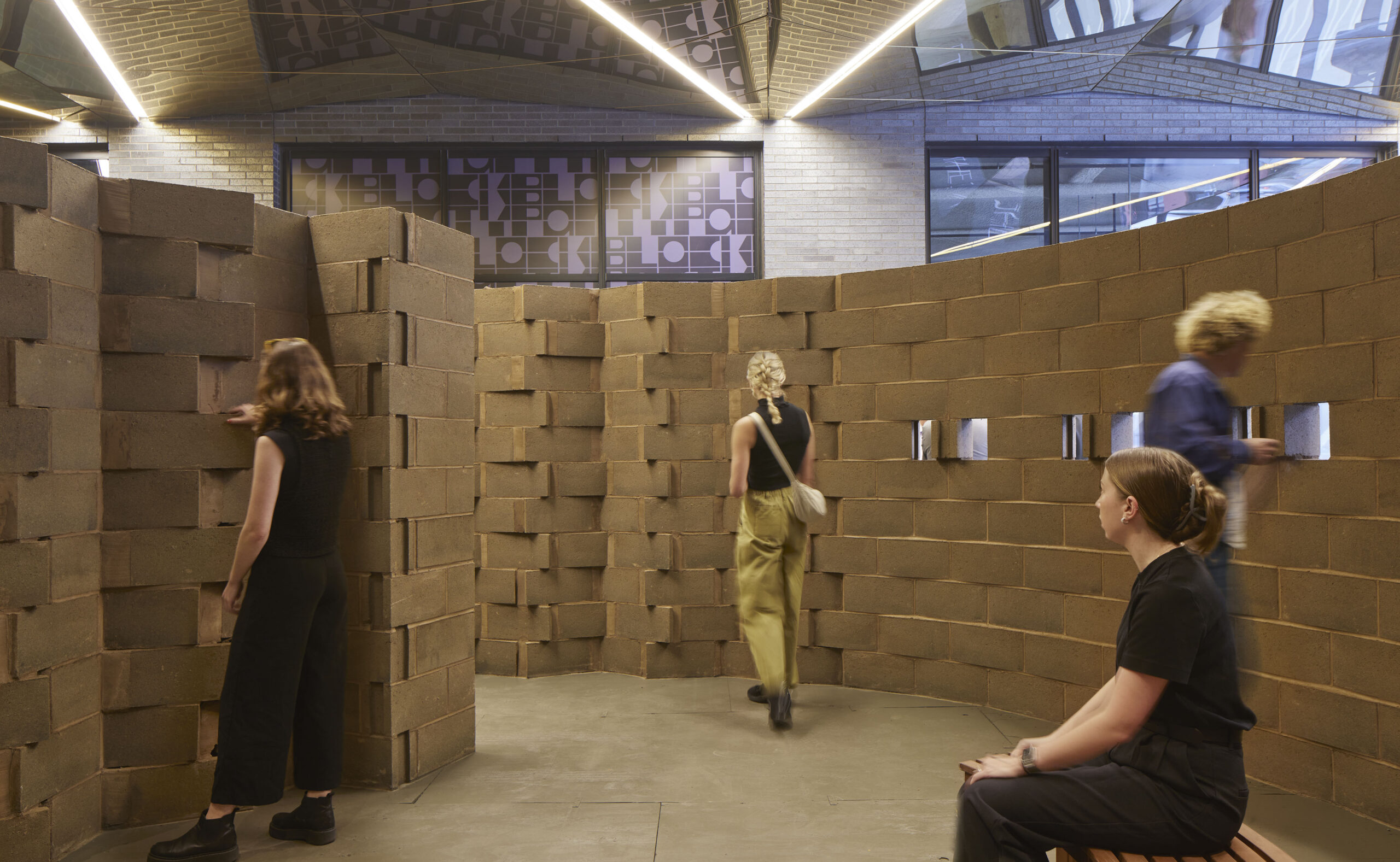
The spiral earned attention and, with SOM, a 2024 Fast Company World Changing Ideas award. But a Colorado factory shipping finished blocks is not the obvious way to change a global commodity. Freight punishes heavy products. Local aggregates vary. Concrete plants already exist near customers. Prometheus' current flagship, ProZERO, is therefore a concentrated supplemental blend. The company sells it for ready-mix and manufactured products and offers licensed material solutions to existing producers.
- Microalgae grows in large raceway ponds and captures carbon through photosynthesis.
- Biomineralization produces limestone without mining and firing conventional limestone.
- The biomineral and proprietary binder system become a stable supplemental blend.
- Concrete producers replace a selected share of cement using familiar batching practices.
That is the strategic move readers can copy: innovate where your advantage lives, then conform everywhere the customer feels pain. Prometheus changes the carbon chemistry but tries to preserve the ritual. ProZERO can arrive in bags, super sacks or bulker trailers. Suppliers use their own aggregate, their own lab and their existing handling equipment. Dosage becomes a dial rather than a creed. The company says typical ready-mix replacement is 10 to 40 percent, chosen around strength, global-warming-potential and budget targets.
Selling proof by the cubic yard
The customers are not homeowners buying a fashionable tile. They are architects, engineers, ready-mix suppliers, contractors, developers, manufacturers and building owners. Each has a veto. That explains the company's parade of pilots. An interior slab tests finishability. An exterior slab tests weather. Pavers handle foot and light-vehicle traffic. A ductbank puts lots of concrete in a comparatively low-risk application. A public roadway on Governors Island adds marine exposure and New York procurement.
At a data-center project in Aurora, Colorado, about 63 tons of ProZERO went into more than 2,500 cubic yards of low-voltage ductbank concrete at an 8 percent replacement level. Material moved through bulkers, temporary silos and ordinary concrete trucks. At a Maryland hyperscale data-center campus, more than 300 cubic yards were placed with 20 percent replacement. Prometheus estimates that mix cut global-warming potential by 45 percent against a conventional all-Portland-cement comparison. These are company-reported project figures, but they are more informative than a perfect lab cube. They show the product encountering logistics, crews and weather.
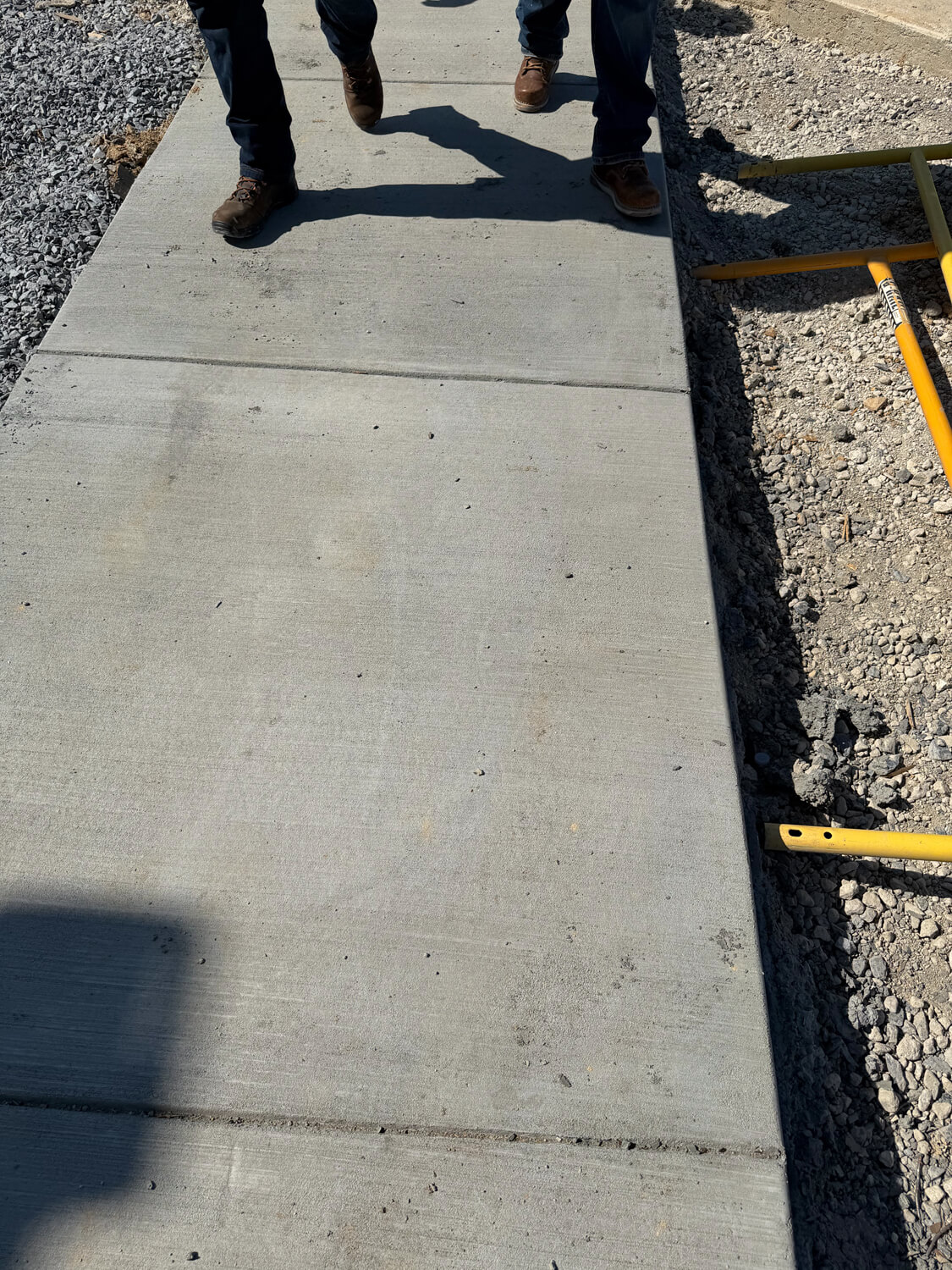
A 2026 supplier kit reports that a sample ready-mix design reached 1,857 psi at three days, 2,920 psi at seven days and 4,597 psi at 28 days. The company says its broader formulations span flowable fill around 150 psi through concrete reaching 6,000 psi. Those numbers are not a universal promise. Concrete performance depends on local cement, aggregate, admixtures, curing and mix design. Prometheus explicitly recommends that customers or their accredited labs test with their own materials and placement practices.
What it cost - and what is still expensive
There is no public ProZERO price list. In 2022, when Time asked about block pricing, Burnett declined to name a final number and said the goal was no green premium. Current terms say shipping is paid by the buyer, FOB Longmont. The real cost includes freight, trial batches, laboratory work, specification changes and the time required to satisfy local authorities. A cheap ingredient that delays a pour is expensive; a pricier one that helps meet embodied-carbon requirements may win anyway.
Capital has paid for the bridge. Prometheus raised an $8 million Series A in 2022 led by Sofinnova Partners, with Microsoft Climate Innovation Fund, SOM, GAF and Autodesk Foundation participating. A 2024 SEC filing disclosed $6.25 million in debt financing, taking publicly reported outside financing to $14.25 million, apart from the earlier university research grants. Valuation is not public. A supplied private-company estimate puts annual revenue near $3.8 million, but the company has not publicly confirmed it.
The 14-person team faces the standard industrial-climate bind: it must finance production before demand is fully proven, while customers want abundant supply before specifying the product. In May 2026, Prometheus addressed one side of that loop with a ten-year agreement making Green Stream Algae its exclusive microalgae and biomineral supplier in North and South America, plus two optional five-year extensions. GSA also became an investor. The partnership shifts algae cultivation toward large outdoor ponds on non-arable land using non-potable water, rather than asking one startup to own every step.
The proof premium
Prometheus competes with more than Portland cement. Fly ash, slag, limestone and natural pozzolans already lower clinker content. Newer companies attack the problem through alternative chemistries, electrified processes, captured-carbon mineralization and biology. The differentiation is a combination of biogenic limestone, potentially carbon-negative formulations and compatibility with incumbent plants. The weakness is the same as the promise: a novel input must earn trust mix by mix and jurisdiction by jurisdiction.
When the playbook does not work
- If local freight overwhelms the carbon or cost advantage of shipping from Colorado.
- If a structural or specialty application has not been tested with the producer's local materials.
- If permitting officials, owners or insurers require a long service record the product cannot yet provide.
- If algae and biomineral supply cannot scale with demand, despite the new long-term supplier agreement.
- If carbon-negative claims use boundaries a buyer's life-cycle assessment or procurement rules reject.
This is why Prometheus joined a $10 million Department of Energy collaboration with NREL, Oak Ridge and Lawrence Livermore national laboratories to improve measurement, reporting and verification of carbon removal in cement and concrete. A negative number on a marketing chart is not enough. Buyers need an agreed ledger: where the carbon entered, how much the process avoided, how long it remains stored and what happened during transport and construction.
The transferable lesson is not “put algae in everything.” It is to find the smallest substitution that carries the largest climate benefit. Let the incumbent supply chain keep its sunk equipment. Give buyers a dosage rather than an ultimatum. Begin in applications where failure is containable. Publish field performance. Secure the awkward upstream input before the demand curve forces the issue. And accept that in construction, the product is partly powder and partly permission.
Prometheus began by asking whether a building material could live. Its market now asks a more prosaic question: can it arrive, batch, finish, cure and pass? A spiral of algae blocks made people look. A plain gray sidewalk may be what finally makes them buy.