The most consequential object in a modern toolbox may be the least glamorous: a rectangular battery pack, scuffed at the corners, with just enough charge left to finish the afternoon. The drill or saw above it gets the attention. The battery makes the next purchase predictable. Once a carpenter owns three packs and a charger, a compatible bare tool is cheaper, simpler and already at home in the van.
KOKI Group understands that arithmetic. The Tokyo manufacturer behind HiKOKI, Metabo, Metabo HPT, CARAT and Sankyo Diamond Tools makes roughly 1,300 products, from impact drivers and circular saws to compressors, vacuums and diamond blades. It sells in more than 120 countries. Yet its strategic center is getting smaller, not larger. It is the interface where a battery meets a tool - and the trust that persuades a professional to clip them together.
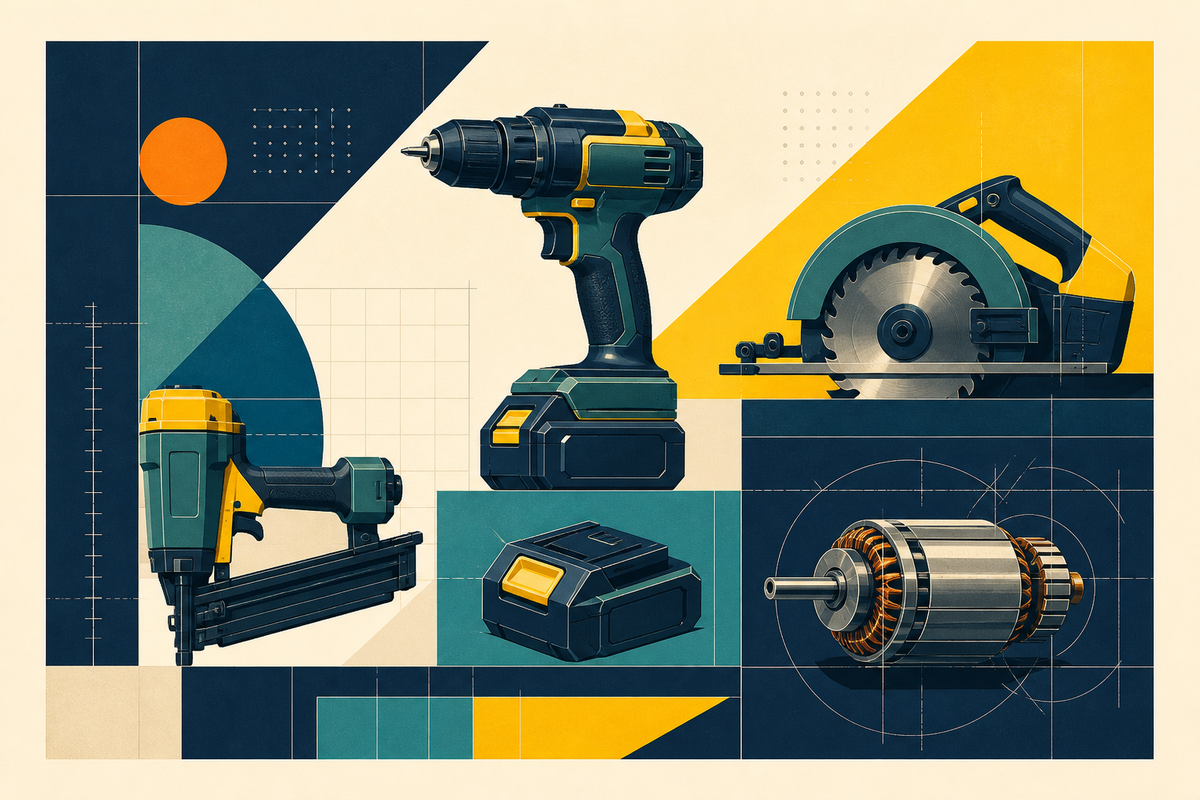
A company with several names
The naming takes a minute. The industrial lineage starts in 1918, when Nichihira Shokai began making electric drills domestically in Japan. The corporation arrived in 1948 as Hitachi Koki, producing coal-mining machinery and power tools. It added pneumatic tools in 1960, began selling cordless drills in 1979 and spent decades exporting Hitachi-branded equipment.
Then the family tree changed. Hitachi Koki acquired the German manufacturer Metabo in 2016. A KKR-backed entity took Hitachi Koki private the next year, separating it from Hitachi. In 2018, the corporation became Koki Holdings and its main tool brand changed from Hitachi to HiKOKI. In the United States and Canada, that line became Metabo HPT. The initials nodded toward “Hitachi Power Tools” while giving the newly independent business a name it could own.
Metabo remained a distinct, German-rooted professional brand, especially strong in metalworking and industry. CARAT and Sankyo Diamond Tools served cutting, drilling and abrasive niches. What looks from the aisle like an untidy collection is, from headquarters, a way to preserve hard-earned reputations in different trades and regions.
Five logos sit on the shelf. The useful question is what can be shared underneath them.
Freedom, measured in missing hoses
KOKI's customers are not abstract “makers.” They frame houses, hang drywall, drill concrete, grind welds, install pipes, trim gardens and repair the places everybody else occupies. Many are paid for the completed job, not the elegance of the equipment. Their recurring problems are blunt: extension cords, compressor hoses, dead batteries, vibration, dust, kickback, misplaced tools and downtime waiting for a part.
The company's best engineering answers remove something. Cordless nailers using air-spring or mechanical-spring drive replace a compressor and hose. Brushless motors reduce wear. Reactive Force Control can cut motor power when a bit binds. Vibration-control systems make repeated heavy work less punishing. Dust extractors chase the debris generated by the saws and grinders sold a few pages earlier in the catalog.
One pack, two working voltages
VOLT
PACK
MultiVolt, launched in 2018, is the cleanest expression of that logic. The pack changes between 18 volts and 36 volts depending on the tool. Users can keep lighter 18V equipment for routine work and reach for 36V output when the job asks more. Selected 36V tools also accept an AC adapter, a pragmatic admission that “cordless” is not a religion. Sometimes mobility matters; sometimes the work should continue all day beside an outlet.
Metabo brings a second platform idea. Its Cordless Alliance System, or CAS, lets specialist manufacturers build tools around a shared battery interface. In 2026, KOKI Group said the alliance had grown from nine manufacturers in 2018 to 50, offering more than 500 compatible cordless tools. The proposition is pointed: a carpenter, installer and fabricator can each buy specialist equipment without carrying a separate charger for every niche.
The quiet economics of green plastic
KOKI Group is a manufacturer, but its business behaves partly like a platform. It designs and produces tools, batteries, accessories and consumables, then reaches users through distributors, specialist dealers, home-improvement chains and ecommerce. Amazon is described by the company as its largest ecommerce partner. Repair, parts and warranty networks keep the installed base working.
The first tool sale can be competitive. The sixth has context. A crew already owns packs, chargers and cases; the dealer knows the line; replacement parts are familiar. That does not make customers captive - professional users can be unsentimental when a tool fails - but it raises the value of compatibility and service. Milwaukee, DeWalt, Makita, Bosch, Hilti and others are fighting on the same ground. Catalog breadth matters because a gap in one trade can force a customer to start a second battery collection.
The platform is not merely the technical standard. It is the standard plus shelf space, repair confidence, spare batteries and enough specialist products that a customer rarely needs to leave.
This explains KOKI's North American clean-up. Metabo and Metabo HPT combined their headquarters, service and distribution operations in Braselton, Georgia, in 2022. In late 2025, KOKI announced that North American Metabo products would transition to the Metabo HPT name in waves through mid-2026. Existing warranties, repairs, parts and Metabo batteries would remain supported; newly introduced cordless products under the consolidated name would use MultiVolt.
It is less a dramatic merger than a reduction in cognitive load. Retailers get a clearer sign. Buyers get fewer explanations. German-made concrete and metalworking tools can join the North American range without asking a shopper to decode two adjacent green brands.
The factory learns USB-C
A mature manufacturer can look slow until its history is laid out as a sequence of removed constraints. Cordless drills removed the outlet. Cordless nailers removed the air line. In February 2026, Metabo HPT introduced a compact USB-C module that attaches to an 18V or MultiVolt battery. It can charge the pack from a certified USB-C Power Delivery source or reverse the flow, using a tool battery as a power bank for a phone, tablet or laptop.
That accessory is modest, but revealing. A battery platform becomes more valuable when energy can move in and out through ordinary ports. The same month's Tracker Pro added compatibility with Apple's Find My and Google's Find Hub networks, treating the misplaced tool as a software-addressable jobsite problem.
The environmental work is more industrial than theatrical. KOKI reports that energy-related Scope 1 and Scope 2 emissions fell from 27.0 kilotonnes in fiscal 2021 to 19.9 kilotonnes in fiscal 2024, with emissions intensity improving 19 percent against the 2021 baseline. Its newer European logistics network adds distribution centers in Sweden, Poland and Belgium around a central German hub. The company estimates that revised routes will cut transport-related emissions by roughly 2,000 tons a year while improving delivery reliability.
A market built on time
KOKI sits between mass retail and highly specialized industrial supply. HiKOKI and Metabo HPT offer the broad construction range. Metabo carries authority in metalworking and industrial applications. CARAT and Sankyo stay close to diamond cutting and drilling. The combination gives the group reach without asking every brand to mean everything.
That range also broadens the answer to “who is it for?” A framing crew may care about cordless nailers and saws; a fabrication shop about grinders and metal-cutting equipment; a concrete contractor about rotary hammers, dust extraction and diamond blades. Electricians, plumbers, roofers, remodelers, landscapers and serious home users enter through different catalog pages. The buying decision can run through an independent tool dealer, a distributor, a home-improvement chain or an online marketplace. KOKI therefore serves two customers at once: the person holding the tool and the channel expected to stock, explain and repair it.
For a buyer, the useful test is not whether every KOKI brand shares every battery - they do not. It is whether the relevant regional line covers enough of the work ahead. HiKOKI and Metabo HPT's MultiVolt families are related; Metabo's established battery base and CAS alliance follow a different path. Model-by-model compatibility still matters, particularly during the North American brand transition. A platform is convenient only when its boundaries are legible.
Its differentiation is not a single specification. Japanese motor and fastening development, German metalworking expertise, a century of accumulated product knowledge and two approaches to battery compatibility all matter. So does distribution. KOKI's stated “One Koki” effort is meant to connect those assets across borders, while the internal KOKI Way puts customer satisfaction, challenge, safety, compliance and environmental responsibility into one operating vocabulary.
The softer edge of that strategy appeared in Metabo HPT's Bring Back Shop Class campaign. Working with the Shop Class Foundation, the brand has supplied tools, mentoring and support for a mobile classroom while promoting routes into skilled work. It addresses a real labor shortage, but also a fact manufacturers know instinctively: tool preference often begins with the first reliable machine someone learns to use.
For professionals, the practical promise is simple. Choose a platform wide enough for today's work, with enough service behind it for tomorrow's. For KOKI Group, the assignment is harder: make a collection assembled across a century feel coherent every time somebody reaches for a battery. The drill may still get the photograph. The system earns the space in the van.