When Mark Hershey told his grandmother he was joining Armstrong, she had a shorter explanation than any executive recruiter could have supplied. “Oh, you’re coming home.” Hershey grew up in central Pennsylvania. Armstrong was a familiar name long before it became the place where he would spend the next fifteen years learning how to run a manufacturing business.
He arrived in 2011 as a lawyer. On April 1, 2026, he became president and chief executive officer. Between those dates, the company separated from its flooring business, sold overseas operations and bought businesses that widened its architectural repertoire. Hershey helped with those changes before inheriting responsibility for what they would produce together.
There is something pleasingly literal about this career. A corporate attorney moves into a company that makes ceilings and eventually rises to the top. The pun arrives ready assembled. The more interesting part is how much of the business beneath him had changed along the way.
A finance degree, then the fine print
Hershey studied finance at Penn State and earned his law degree at Villanova. His professional experience before Armstrong included senior legal positions at IKON Office Solutions and Ricoh Americas. These were businesses concerned with office equipment, distribution and services: the working machinery of other people's workplaces.
At Ricoh Americas, his responsibilities included legal affairs, ethics, compliance, security and regulatory matters. That is a useful collection of subjects for anyone hoping to understand how a company holds together. A business needs customers and products, but it also needs agreements that work, obligations that are understood and decisions that survive contact with the details.
Armstrong appointed him senior vice president, general counsel and secretary effective July 1, 2011. He subsequently added chief compliance officer to his responsibilities. The progression initially looked like a familiar legal career inside a public company. Over time, business development, sustainability and operations would make the job considerably wider.
It is tempting to treat the legal years as a prelude to the business years. The transactions suggest a closer relationship. Buying a company, separating one or leaving a market involves a practical question about what an organization should become. Contracts record those choices. Someone still has to make them work.
The business got smaller. The possibilities widened.
The Armstrong that hired Hershey included floors as well as ceilings. In 2016, Armstrong World Industries and Armstrong Flooring became separate companies. For people who know the name from a floor underfoot, the distinction matters. The business Hershey now leads concentrates on architectural applications including ceilings, specialty walls and exterior metal solutions.
Another major change followed in September 2019. Armstrong completed the sale of its EMEA and Pacific Rim businesses to Knauf. The announced purchase price was $330 million, subject to customary adjustments. The sale completed a shift toward the Americas, with investment directed toward mineral fiber ceilings and architectural specialty ceilings and walls.
Hershey played a leadership role in both the flooring separation and the overseas divestitures. These were consequential assignments for an executive who had entered through the legal department. The company was deciding where to compete, which capabilities to retain and where its next investment should go.
The sequence offers a useful way to read his subsequent appointment. He had worked on the boundaries of the business before taking responsibility for its daily operation. A narrower geographic footprint could coexist with a wider range of things to make. Size and scope, in this case, were moving along different axes.
- 2011General counsel
- 2016Flooring separation
- 2022Americas leadership
- 2025Chief operating officer
- 2026President & CEO
A collection of companies needs a common purpose
Armstrong's expansion into Architectural Specialties brought a succession of businesses into the group. Tectum joined in 2017. Arktura, Móz Designs and Turf followed in 2020. Their materials and methods widened the choices available to architects. A ceiling-and-wall company could participate in a design conversation involving felt, metal, wood and other surfaces.
When Hershey's succession was announced in January 2026, Vic Grizzle credited him with helping develop and execute the strategy and complete all fourteen acquisitions that had built the segment at that point. Grizzle had worked closely with him throughout their years at Armstrong. The board presented the appointment as the outcome of long-term succession planning.
That distinction gives the handover its character. Hershey was taking over a strategy he had helped shape. His predecessor moved to executive chair, and Hershey joined the board. Continuity here came with a considerable amount of personal responsibility: he knew how the portfolio had been assembled.
A portfolio becomes more useful when its parts can work together. Consider the difference between giving an architect ten separate catalogs and helping that architect resolve a single room. The second task asks more of the manufacturer. It requires people who understand materials, engineering, production and the point where one supplier's work meets another's.
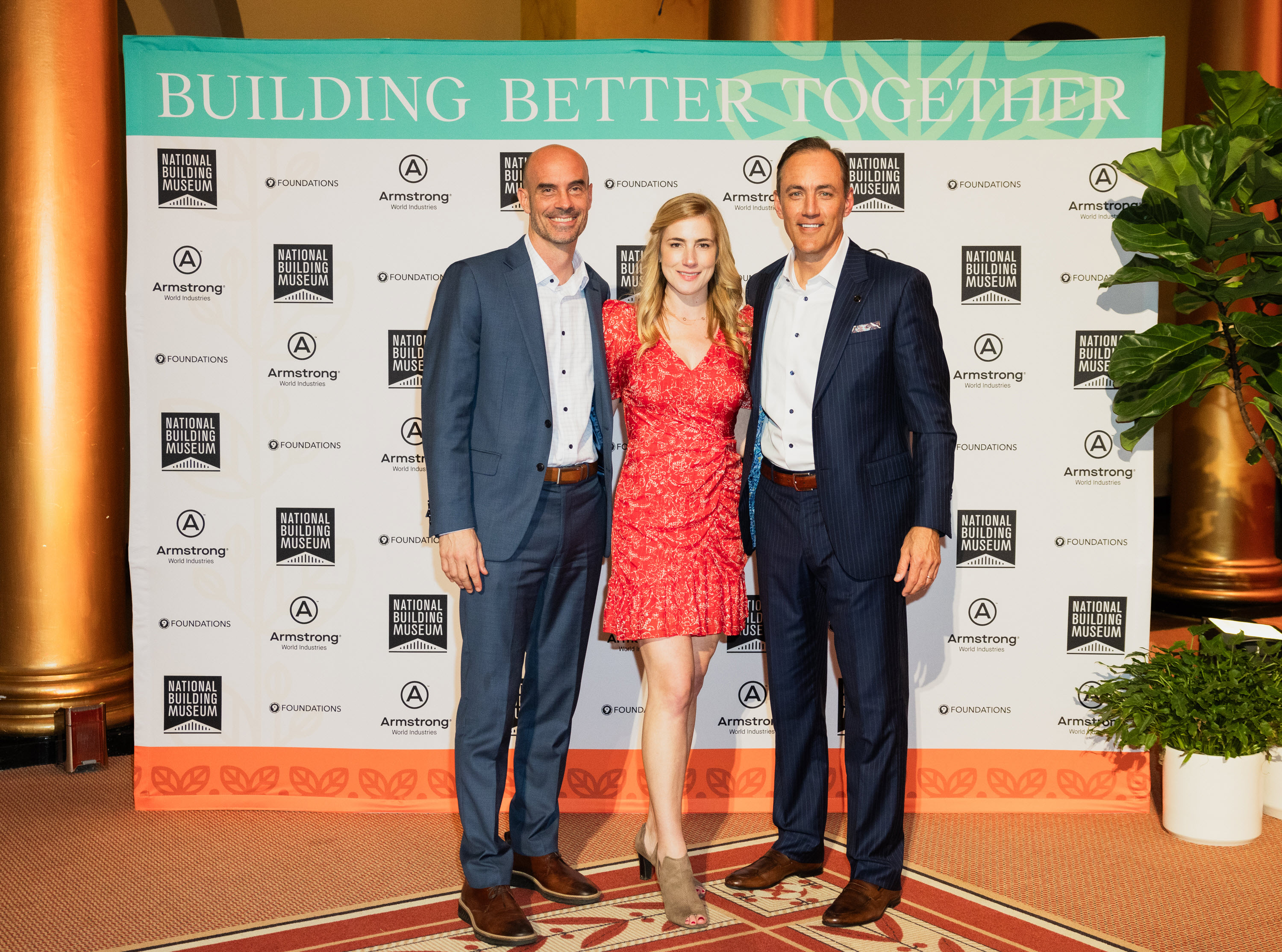
His connections also extend beyond the company. Hershey serves on the board of trustees of the National Building Museum in Washington, D.C. In 2023, he appeared with the museum's Aileen Fuchs and Joseph Allen at the launch of Building Better Together. The gathering brought more than 200 people from the building sector together around sustainable building practices.
Where a drawing meets a delivery
By January 2022, Hershey was senior vice president, Americas, responsible for the strategy and operations of both Mineral Fiber and Architectural Specialties. Business development remained part of the brief. He became chief operating officer in April 2025, adding another clearly marked step between the legal office and the chief executive's chair.
His responsibilities covered innovation and enterprise-wide strategic planning as well as the two operating segments. The combination is revealing. A product idea and a manufacturing decision belong in the same conversation when the promise to a customer depends on both. A drawing can be revised in an afternoon; a manufacturing process asks for a different kind of commitment.
Armstrong's 2026 exhibition program gave that conversation a public setting. Its Chicago showroom at The Mart gathered brands including Turf, 3form, Arktura, Zahner, Móz and LightArt. Visitors moved through daytime workplace settings and nighttime hospitality settings. The company was demonstrating combinations of capabilities in rooms people could actually enter.
During a NeoCon walk-through, Hershey described a broader choice of materials for designers and an increased role for early collaboration. One practical example involved LightArt lighting integrated into a WoodWorks Grille ceiling system. Separately specified components had created installation problems; coordinated development helped the light fit the ceiling. An ambitious corporate strategy can come down to whether two pieces fit.
There is a modest pleasure in that example. Nobody commissions a building in the hope of acquiring an especially interesting installation problem. The appeal of a wider portfolio rests partly in how much friction it can remove before materials reach the site.
Asking more of a ceiling
Energy efficiency is another priority Hershey has discussed. Armstrong's Templok panels incorporate phase change material into mineral fiber ceilings, adding a thermal function to a familiar building component. The company has pursued installations in its own facilities as a way to demonstrate the product and encourage conversations with building owners.
The first phase, completed by the end of 2025, covered nearly 18,000 square feet across locations including Lancaster, Pensacola and the offices of BŌK Modern and Arktura. Site selection considered climate conditions, compatible air handling systems and occupancy. Those qualifications matter: a thermal product needs to suit the building in which it is installed.
A partnership with Integrated Environmental Solutions, announced in November 2024, aimed to incorporate Templok into energy-modeling software. It put the product into the tools engineers and architects use to assess building performance. Hershey was involved in that announcement while leading the Americas business, before the CEO succession was announced.
Nearly this much Templok ceiling was installed across Armstrong locations in the first phase, completed in 2025.
The thread runs from product development to modeling to actual installations. It also connects with a responsibility Hershey held earlier: leading Armstrong's sustainability efforts. In May 2026, the company released its sixth annual sustainability report, covering progress during 2025. His comments emphasized reduced waste, operational efficiency and the performance of products such as Templok.
The handover is only the beginning
Hershey describes his leadership approach in terms of collaboration, transparency and long-term value. He places emphasis on giving capable people room to do their work while keeping them aligned around a strategy. These are his stated principles; the CEO role gives them a much larger testing ground.
“My leadership is built on being collaborative, transparent, and focused on creating long-term value.”
Mark Hershey
His first months also brought a measurable operating result. For the second quarter of 2026, Armstrong reported consolidated net sales growth of 11.2% over the prior-year quarter. Hershey pointed to contributions from both Mineral Fiber and Architectural Specialties while acknowledging economic and geopolitical uncertainty. One quarter offers a checkpoint, with the longer work still ahead.
The career has a clear shape now: finance student, lawyer, transaction leader, operating executive, CEO. Each position brought him closer to responsibility for the entire business. His grandmother's greeting gives that progression a human scale. Coming home was an arrival in 2011. Fifteen years later, the familiar company had become his to lead.