Look closely at an Owens Corning roofing shingle and you will find a pale strip running across its face. It is easy to overlook. The strip marks where the nails belong. In the company’s SureNail design, engineered fabric also reinforces that fastening area. A roof is an enormous surface exposed to weather. Its performance still depends on a person putting a small piece of metal in the right place.
- Owens Corning now centers on roofing, insulation, and doors.
- The Masonite acquisition cost about $3.9 billion; glass reinforcements was sold in 2026.
- Its useful design habit: pay attention to the person doing the installation.
That little strip offers a way into an unusually consequential corporate rearrangement. Owens Corning, the Toledo company associated with pink fiberglass, bought door manufacturer Masonite in 2024. Then it sold its glass reinforcements business. A company built around a material is organizing itself more tightly around buildings and the people who work on them.
A small strip with a large job
Today, its three businesses address familiar household problems. Roofing keeps weather outside. Insulation slows heat transfer and helps control sound. Doors provide access, privacy, security, and a visible finish. Builders and homeowners use the products; distributors, home centers, lumberyards, and contractors help get them to the job.
This is a manufacturing business. Revenue comes from selling physical products through those channels. Its expertise combines material science, factory operations, and knowledge of how building components get specified and installed. The competitive question is wonderfully concrete: why should the next truck carry your shingles?
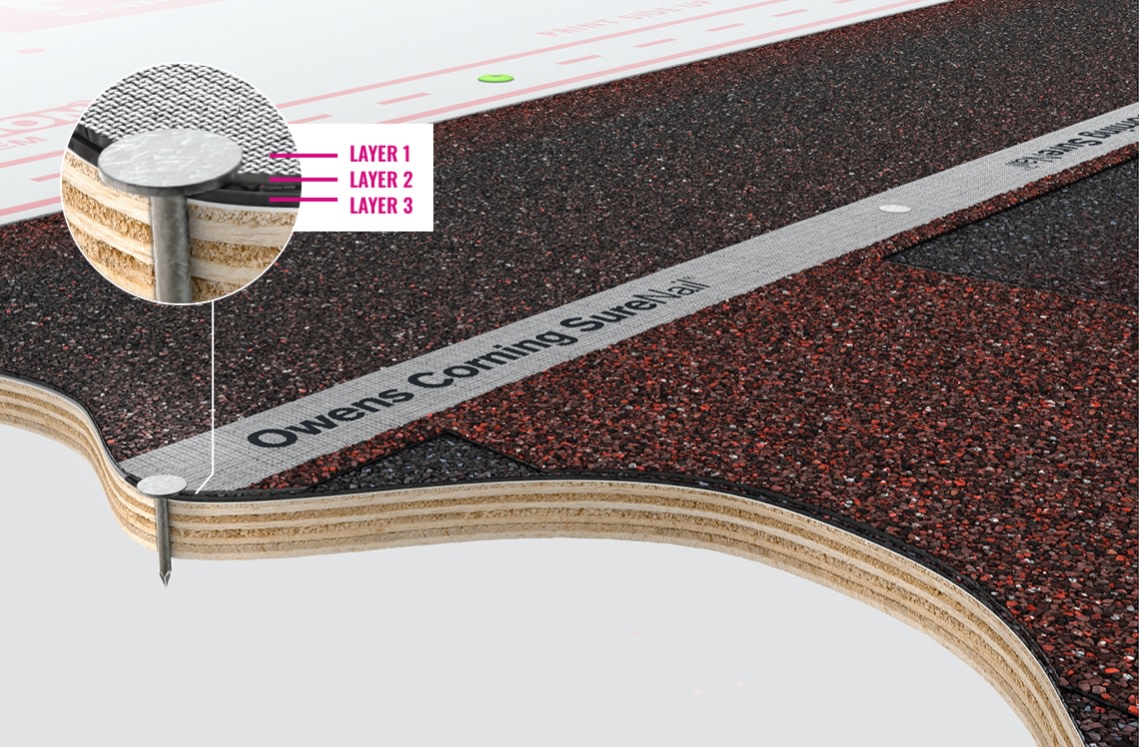
Against roofing alternatives such as GAF, CertainTeed, and TAMKO, Owens Corning offers Duration shingles with that visible reinforced nailing zone. It also markets a Total Protection Roofing System of coordinated components. The pitch extends beyond a square of asphalt to the way the roof goes together.
The color came before the cat
Owens Corning began in 1938, when Owens-Illinois and Corning Glass Works incorporated a new fiberglass company. Its origin story includes an experiment with glass building blocks that revealed a way to produce glass fibers commercially. The business grew by finding useful things to do with those fibers.
In 1956, pink was added to distinguish a new all-fiber insulation product. Installers began asking for the pink insulation. There is a pleasing sequence here: a visible difference helped people identify a product; recognition then became a marketing asset. In 1980, the Pink Panther joined the advertising. The cat had found a remarkably suitable day job.

The lesson is available to any business selling something customers seldom admire once installed. Give people a feature they can recognize and a reason to care about it. A memorable color helps a product get remembered. A contractor still has to want another package.
The customer holding the knife
Consider insulation from the installer’s position. Someone must carry it, cut it, fit it around obstructions, and clean up afterward. The homeowner wants a comfortable room. The installer also wants a manageable afternoon. Those needs overlap without being identical.
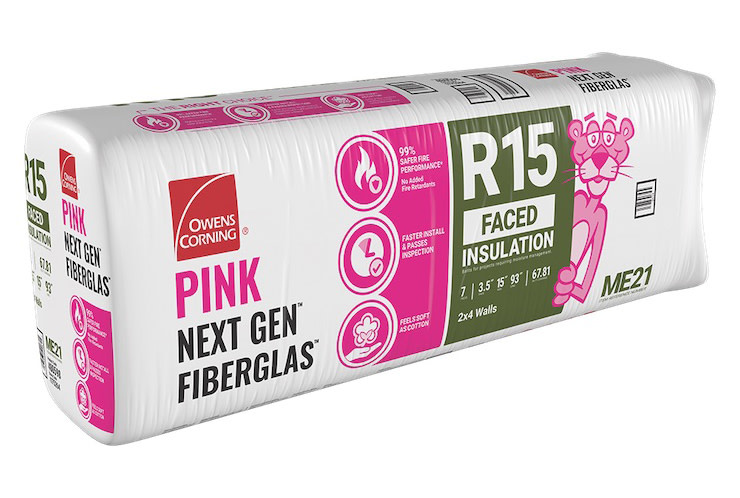
Owens Corning’s 2021 PINK Next Gen launch addressed that second customer directly. It emphasized cleaner cutting, less dust, improved stiffness, and recovery after compression. The company claimed installation up to 23% faster than its existing products. That is a company comparison under specified conditions, rather than a promise that every project finishes 23% sooner.
“Contractors today have high performance expectations and extremely tight timelines.”
Joe Wagner, insulation marketing director · 2021 product launch
The range includes batts and rolls with no added formaldehyde. Elsewhere in the insulation portfolio are mineral wool and cellular glass products for different applications. Alternatives include Johns Manville, Knauf, and ROCKWOOL. The useful comparison depends on the assembly, required thermal performance, moisture conditions, price, and installation method.
A $3.9 billion change of address
Masonite brought interior and exterior doors into the portfolio in May 2024. The approximately $3.9 billion transaction extended Owens Corning’s reach into another branded building product. Management’s stated logic was to combine commercial, operating, and innovation capabilities across complementary businesses.
The other half of the decision was subtraction. Owens Corning completed the sale of glass reinforcements to Praana Group on April 30, 2026. Management described a sharper focus on North American and European building products and an exit from capital-intensive businesses. The company was choosing where it wanted its next investments to earn their keep.
$110 million lower
Agreed enterprise value of the glass reinforcements sale
Enterprise value, not cash proceeds. Terms amended April 15, 2026.Focus had a transaction cost: the agreed enterprise value fell from $755 million to $645 million as market conditions changed. Meanwhile, the 2025 annual results described five facility closures and consolidations in the Doors improvement effort. Buying adjacent products creates work before it proves an advantage.
The cost that would not go away
There is an earlier chapter that belongs in this story. Legacy asbestos liabilities led Owens Corning into Chapter 11 in 2000. It emerged in 2006 after a compensation trust was established for people harmed by exposure to its asbestos-containing products. The company’s own reporting says other attempts to resolve the situation had failed.
That history changes how one should read a building-materials company’s promises. Products remain in buildings for decades. The consequences of a formulation can outlast a sales campaign, a management team, and an economic cycle. Product stewardship belongs beside efficiency in any assessment of the business.
Look at the joint
For buyers, the practical starting point is the connection between product and installation. Ask a roofer to explain the complete assembly and warranty conditions. Compare insulation by its specified use. A visible nail line cannot compensate for ignoring fastening instructions; insulation cannot deliver its intended performance when fitted badly.
The same discipline applies to the corporate story. Shared customers and purchasing scale offer possibilities, but weak housing demand, deferred remodeling, or raw-material inflation can still hurt. Through October 2026, the new portfolio remains a proposition to judge over time. The interesting place to watch is the joint: between the materials, between the businesses, and between the product designer and the person holding the tool.