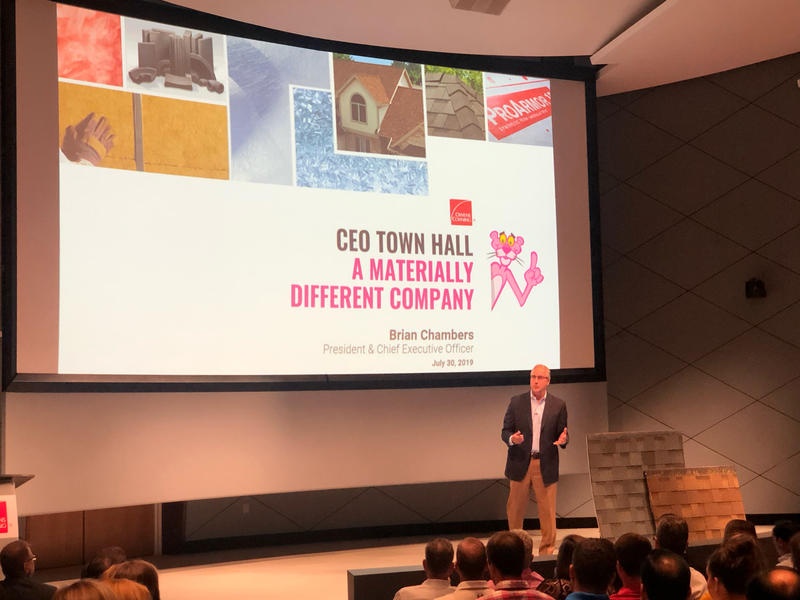
At a CEO town hall in July 2019, Brian Chambers stood beside a display of roofing shingles. Behind him, a screen announced “A Materially Different Company.” The Pink Panther, that unusually well-employed cartoon cat, appeared on the slide. Chambers had been chief executive of Owens Corning for only a few months. The shingles were an appropriate supporting cast.
He had spent years running the roofing business before taking charge of the whole company. A colleague sharing the town hall photograph joked that promotion could take the leader away from shingles, but could hardly take the shingles away from the leader. It was a small office joke with a surprisingly long shelf life. Roofing would remain central to the company Chambers set out to build.
The more revealing part of his story, though, is what happened to everything around it. Under Chambers, Owens Corning bought a door manufacturer and sold its glass reinforcements business. By 2026, the outline was easier to draw: roofing, insulation, and doors, concentrated primarily on residential markets in North America and Europe. A house has many parts. His company was choosing which ones deserved its attention.
The return ticket
Chambers first joined Owens Corning in 2000, after commercial and operational work at Honeywell, BOC Gases, and an international engineering firm. His early years at the Toledo company included management assignments in roofing. This was an education conducted among products, distribution channels, and customers, with the practical questions that accompany all three.
Then the corporate map changed beneath him. In 2007, Owens Corning sold its siding business to Saint-Gobain. Chambers moved with the divestiture and led Saint-Gobain’s North American distribution business. He returned to Owens Corning in April 2011, this time in Engineered Solutions within composites. His route to the top included a period working on the other side of a sale.
The sequence matters because his later decisions would involve both buying and letting go. It would be too tidy to claim those years supplied a private revelation. What they demonstrably supplied was experience across different materials businesses and the organizations that bring their products to market. His career had room for the factory and the distributor.
In 2013 he became vice president and general manager of roofing; in 2014, president of the business. Roofing revenue grew 16 percent in 2017. When Owens Corning named him president and chief operating officer effective August 2018, the promotion followed several years of responsibility for a business whose results the board could examine. Mike Thaman, then CEO, described him as a respected, proven leader.
- 2000Joins Owens Corning
- 2007Moves to Saint-Gobain
- 2011Returns to composites
- 2019Becomes CEO
- 2020Adds board chair
A customer has a business to run
Before he became CEO, Chambers posted on LinkedIn about hosting Owens Corning’s Platinum Preferred Contractors at a Las Vegas conference in March 2018. His sign-off was brisk: “Let’s go!” The subject was telling. A manufacturer can discuss its customers as an abstraction. A contractor conference puts faces, schedules, and businesses into the picture.
Years later, addressing investors in May 2025, he described conversations with customers across roofing, insulation, and doors. Their appreciation extended beyond the products themselves. He pointed to employees’ knowledge, the brand, commercial expertise, technology, reliability, and service. The proposition was broader than a collection of things to buy. It included the help that makes those things easier to sell and use.
That is a useful way into Chambers’s version of focus. Putting three product categories together only gets a company so far. The harder task is making its capabilities useful across those categories. A distribution relationship, a familiar brand, or a workable customer program may travel farther than the particular product that first established it.
At the scale of a public company, these ideas acquire corporate names and presentation slides. At the scale of a customer’s working day, they face a simpler examination: does this supplier make the job easier? Chambers’s account of the business repeatedly returns to that customer relationship. It gives his strategy a practical point of reference, even when the language around it becomes elaborate.
How to challenge an expert
There is a quieter clue to his leadership in the way colleagues describe working with him. In a 2023 conversation, Owens Corning technology leader Steve Zerby called attention to Chambers’s ability to be challenging while respecting the opinions of the company’s experts. Zerby had worked at three Fortune 500 companies. He regretted that his time under Chambers’s leadership would be shorter than under some others.
Annie Baymiller, who would become Owens Corning’s chief information officer, connected the company’s digital ambitions to support from Chambers and the leadership team. Together, those observations suggest a particular working relationship: management asks more of the specialists and gives their expertise a hearing. They are colleagues’ assessments, rather than a license to invent what he is like over breakfast.
The distinction is useful. A public executive’s character is often assembled from the same handful of flattering adjectives. Here, the concrete detail is the combination of pressure and respect. Asking a knowledgeable person a difficult question is easy. Keeping that person willing to answer the next one takes a little more skill.
“Sometimes we don’t know how to get there.”
Brian Chambers, on setting demanding goals, 2021
A $3.9 billion door opens
On May 15, 2024, Owens Corning completed its acquisition of Masonite, the maker of interior and exterior doors and door systems. The implied transaction value was approximately $3.9 billion. Masonite brought a business serving both repair and remodeling work and new construction. At closing, it operated 64 manufacturing and distribution facilities and employed more than 10,000 people globally.
For Chambers, the deal added a new building products platform beside roofing and insulation. It also came with a public promise: approximately $125 million in annual run-rate cost synergies. Translated from transaction language, the combined company expected recurring savings from operating together. The amount was a target, and targets have a habit of becoming questions at the next investor meeting.
By August 2026, Owens Corning reported that it had achieved $135 million of enterprise run-rate cost synergies, exceeding that original commitment. That is one measurable part of the acquisition story. It should sit alongside the harder conditions facing the business, rather than take their place. Integrating a purchase and finding demand for its products are related jobs, each with its own difficulties.
The business he let go
The companion move was a sale. On May 1, 2026, Owens Corning announced the completion of the sale of its glass reinforcements business to Praana Group. For a chief executive whose own career had included composites, the transaction was a substantial change in the company’s boundaries. Chambers described it as another step toward a more integrated building products business.
The terms had been revised before closing. An April agreement reduced enterprise value from $755 million to $645 million, removed seller notes, and increased upfront cash proceeds. Owens Corning said changing market conditions had affected the business. Focus, in this instance, arrived with negotiated terms and a lower headline valuation. Strategy still had to meet a buyer across a table.
The intended destination was clear: a company concentrating its commercial and operating capabilities on branded building products in selected geographies, with less capital tied up in the businesses it was exiting. Whether that produces the resilience Chambers seeks will be tested over time. The sale establishes what he chose to pursue, and what he was prepared to relinquish.
The promise has a postcode
Chambers’s responsibilities extend beyond the Owens Corning boardroom. He joined Lincoln Electric’s board in February 2022 and serves on its Audit and Finance Committees. His other roles include the National Association of Manufacturers board and executive committee work with the Ohio Business Roundtable and Harvard’s Joint Center for Housing Studies policy advisory board. Manufacturing, Ohio, and housing recur in that list.
Toledo also appears in the company’s community commitments. During his tenure, the Owens Corning Foundation committed $6 million to racial equity and social justice in its headquarters city, with housing, education, workforce development, and inclusive communities among the priorities. Those commitments give a local dimension to a role otherwise measured in international operations and quarterly results.
In 2021, Chambers received 3BL Media’s Responsible CEO of the Year award for ESG Transparency. He shared the credit with colleagues. His description of accountability included a candid admission: “Sometimes we don’t know how to get there.” The larger point was that setting a demanding goal obliges the organization to find a route. The award recognized transparency; the continuing work is to make promises inspectable.
The next roof, the next quarter
The latest results offer a useful check on the narrative. In the second quarter of 2026, Owens Corning recorded $2.756 billion in sales from continuing operations, roughly level with the comparable quarter. Adjusted EBITDA was $660 million, down from $703 million. A more focused company still has to contend with demand, costs, and the uneven economics of construction.
Sales steady. Earnings under pressure.
Chambers was also changing the team responsible for execution. Jonathan Collins became chief financial officer effective August 10, 2026, while Todd Fister moved into the president and chief operating officer role. Both report to Chambers. The appointment assigned separate leaders to finance and the operating work of integrating the company more closely.
By then, seven years had passed since the town hall with the shingles. Chambers had become board chair in 2020, added doors to the portfolio, and overseen the exit from glass reinforcements. The outline of his ambition was visible in those decisions: make a narrower collection of businesses work better together. The next chapter will be judged by what happens inside that outline. Somewhere, one imagines, there is still room on the stage for a shingle.