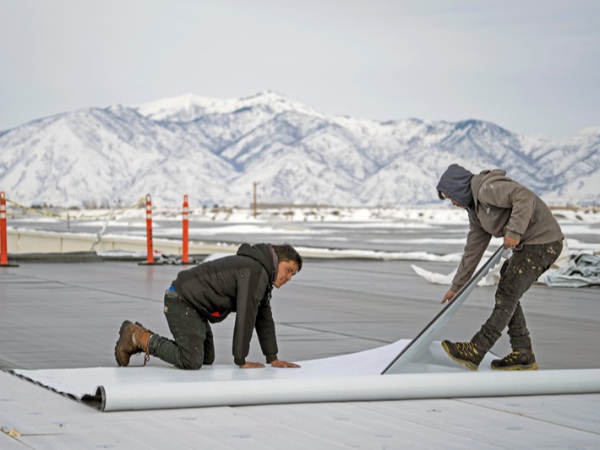
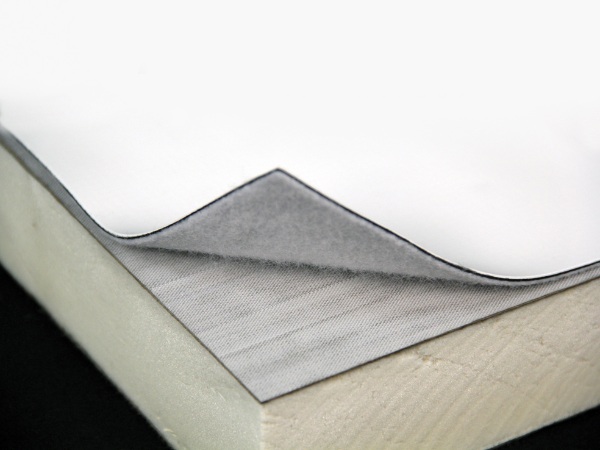
The surprising thing about Carlisle’s RapidLock roofing system is what the crew no longer has to do. No stirring bonding adhesive. No waiting for it to reach the right condition before laying the membrane. A specialized backing meets a compatible insulation surface using VELCRO Brand technology. The attachment method will feel familiar to anyone who has fastened a shoe. The setting is considerably less forgiving.
- Carlisle has concentrated its portfolio on roofs and the wider building envelope.
- Its sales pitch connects material performance with the contractor’s working day.
- Acquisitions bought breadth; research and process improvements must now earn their keep.
There is a useful way to read this product. A roofing contractor needs a finished, compliant assembly, delivered by a crew with a finite number of hours. A material that removes a waiting period changes that calculation. Carlisle has organized much of its current identity around the space between a product leaving the factory and a building owner getting a functioning roof.
01 / The company that learned to shed
In 1917, Charles S. Moomy bought $4,000 in machinery and started making bicycle inner tubes. Montgomery Ward had agreed to buy them. His partner, rubber broker James T. Johnstone, invested $30,000. That beginning has the pleasing specificity of an actual business: equipment, a buyer, and enough money to start.
The first serious threat was financial. During the Depression, Carlisle’s business deteriorated despite an attempt to help Montgomery Ward by paying half its excise taxes on inner tubes. Debt negotiations and emergency financing helped keep Carlisle alive. Product ingenuity alone could not protect it from a customer base under strain.
Over the following decades, Carlisle became a diversified industrial company. Its more recent transformation moved in the other direction. In 2021, it paid $1.575 billion in cash for Henry, adding products that control water, vapor, air, and energy around a building. In May 2024, it completed the sale of Carlisle Interconnect Technologies to Amphenol in a $2.025 billion transaction.
The two transactions describe the boundaries of the new business. Henry brought more ways to protect a structure; interconnect manufacturing served a different set of applications. The useful question for anyone studying the pivot is whether the remaining businesses can serve the same project more completely. That is a test customers can apply.
The stated rationale was to direct investment toward higher-return building products and simplify the portfolio. It was a sequence of purchases and disposals, rather than a single conversion moment. Descriptions that still lead with aerospace wiring or medical interconnects now tell readers about businesses Carlisle has sold.
02 / What a roof actually buys
Today, Carlisle Construction Materials supplies single-ply roofing, insulation, and architectural metal systems. Carlisle Weatherproofing Technologies extends the offering into waterproofing, air barriers, coatings, and other protective materials. The building envelope is the boundary that separates indoor conditions from outdoor weather. A weakness at that boundary can let water in or conditioned air out.
Consider the decisions inside one purchase. Insulation addresses thermal performance. A membrane deals with weather exposure. Air and vapor barriers manage other routes through the enclosure. Specifying them together requires attention to their interfaces. Carlisle’s broader portfolio gives it more products to propose within that connected set of decisions.
The customers occupy different points in the same project. Distributors need availability. Contractors need materials their crews can install correctly. Architects and specifiers need documented performance. Owners need protection and manageable operating costs. Carlisle sells physical products through those relationships, supported by technical guidance, training, and warranties.
“Everyone here is worried about labor”
Mike DuCharme, then Carlisle Construction Materials marketing vice president, at the 2018 International Roofing Expo
RapidLock gives this proposition a concrete form. Carlisle claims up to 80% labor savings against traditional bonding adhesive installation, and up to 25% against a traditional FleeceBACK system. The comparison concerns installation labor. It does not mean the entire roofing bill falls by 80%.
Buying a roof still requires a project-specific specification and an installed-price comparison. Compatible boards, membrane, wind requirements, details, and crew practices matter. British Columbia’s roofing association, for example, places conditions on accepted RapidLock assemblies and requires Carlisle design review above a stated height. Familiar fastening technology does not make a commercial roof a do-it-yourself purchase.
03 / A factory habit becomes a strategy
Carlisle’s operational counterpart is the Carlisle Operating System, or COS. Implementation began in 2008, drawing on lean enterprise and Six Sigma principles. The company describes a discipline of reducing waste and variation across processes. Its current formulation puts people, process, and productivity together.
For another business, the transferable lesson is fairly prosaic: identify a customer’s expensive delay, remove steps, and measure the result. Then examine whether the factory and delivery process introduce delays of their own. That is our reading of Carlisle’s approach. Copying an acquisition budget would be considerably harder.
The same logic has a limit. Saving time on an installation step matters most when that step constrains the job. Where another task controls the schedule, the benefit may be smaller. Buyers should establish the comparison before assigning a dollar value to a productivity claim.
Nor is the competitive field empty. Johns Manville offers EPDM, TPO, and PVC roofing systems; GAF competes in commercial single-ply roofing too. A buyer can use these alternatives to test Carlisle’s proposition: compare complete assemblies, ask which installation steps differ, and price the labor alongside the material. A cheaper roll is only one part of that exercise. Carlisle’s case rests on the combination of its products, service, and installation methods. System breadth and technical support are also features of competing suppliers.
04 / The bill for the next idea
Carlisle reported $5.02 billion in 2025 revenue, scarcely above 2024. Its adjusted EBITDA margin fell from 26.6% to 24.4%. Those numbers temper any easy story about focus automatically producing growth. Research expense nevertheless increased from $35.4 million to $47.1 million.
+33.1% in a year of nearly flat sales.
Vision 2030 calls for research investment reaching 3% of sales and 25% of revenue coming from new products. These remain targets. In July 2026, Carlisle reported its first commercial shipment of ThermaThin 7 insulation, designed to deliver thinner roof assemblies. Second-quarter sales rose about 8%, though management also reported customer buying ahead of price increases.
That quarter supplies a useful constraint: raw-material and freight inflation outpaced pricing realization, compressing adjusted margins despite higher revenue. Installation improvements cannot neutralize every input-cost shock, weak construction market, or price-sensitive bid. In August, Carlisle announced its fiftieth consecutive annual dividend increase. Behind that long streak sits a recurring assignment: choose where to invest, then prove the next product deserves a place on the roof.