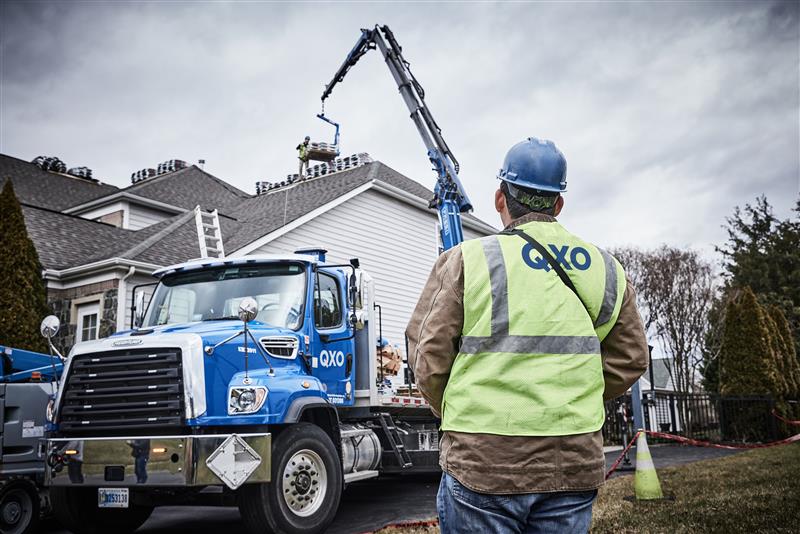
A roofing crew can have the right people, the right weather, and a homeowner ready to pay. Then the materials fail to arrive. The day becomes a scheduling problem. That ordinary vulnerability helps explain an unusual company: QXO, which has assembled a building products business through three acquisitions with announced values totaling roughly $30 billion. The proposition is easiest to understand from the driveway, looking up at an unfinished roof.
- Buy the network: Beacon brought roofing and waterproofing; Kodiak added lumber; TopBuild added insulation and installation.
- Serve the trade: customers are contractors, homebuilders, and commercial and industrial projects.
- Remove the waiting: ordering, delivery updates, account tools, and software connections support the physical supply business.
- Prove the economics: acquisition scale is real; the promised integration gains still require execution.
A truck is the test
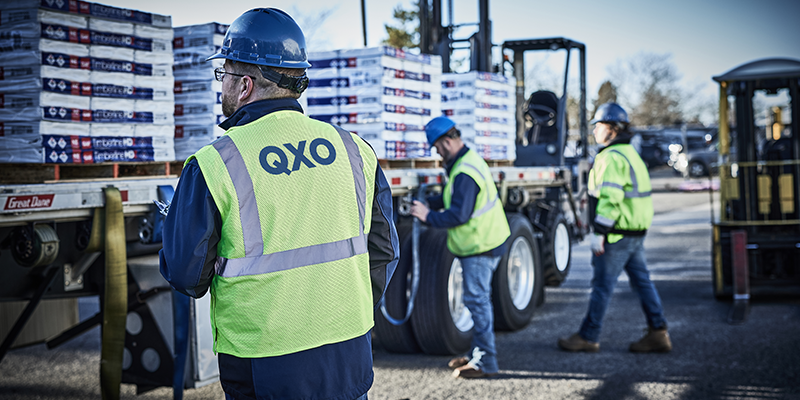
QXO occupies the space between manufacturers and the people who build, repair, and insulate buildings. It buys materials, holds inventory, sells through branches and digital channels, and gets orders to customers. Following TopBuild, it also installs insulation. Roofing, waterproofing, siding, lumber, trusses, and insulation give it several ways into the same construction project.
Its network now reaches all 50 U.S. states and seven Canadian provinces, with about 1,150 locations and roughly 28,000 employees. Those figures describe reach. A contractor experiences something smaller: whether a nearby branch has the required product, whether the delivery arrives, and whether the paperwork matches. The company’s national ambitions meet a local test every morning.
The first answer was no
Brad Jacobs established the venture in 2023. The public vehicle, formerly SilverSun Technologies, took the QXO name in June 2024 after a $1 billion investment closed. More capital followed. Jacobs Private Equity supplied $900 million of the founding investment; Sequoia Heritage and other investors supplied the balance. The acquisition machine had money before it had a building materials network.
Money did not make every seller cooperative. In September 2024, French electrical distributor Rexel rejected QXO’s preliminary proposal of €28.00 to €28.40 a share. Rexel’s board said the offer undervalued the business. An early route to scale had closed.
Beacon resisted, too. It rejected a $124.25-a-share proposal before ultimately agreeing to $124.35. The extra ten cents is an irresistible detail, but it cannot explain a board’s entire decision. What changed publicly was the transaction: a contested approach became an agreed acquisition, completed on April 29, 2025, at approximately $11 billion. QXO finally had its operating base.
The software already on the job
For a contractor, the useful question is what can happen before the next truck leaves. QXO’s app supports ordering, branch contact, account management, delivery tracking, bill payment, and manufacturer rebates. Its delivery tools offer scheduled-day notices, real-time notifications, confirmation photos, and management of several orders. Each feature addresses a familiar interruption: another call to find out where something is.
The connections matter as much as the app. Customers can order from a QXO branch through AccuLynx or buy an EagleView measurement report through QXO.com. That approach meets contractors inside tools they already use. It also makes the digital offering part of materials purchasing, rather than a separate software adoption project.
When Beacon became QXO, customers were told to keep their existing usernames and passwords. Online ordering and project-management features would remain available even as the PRO+ name disappeared. There is a useful lesson here for any acquisition: preserve the routines customers rely on while changing the organization behind them. A rebrand should not become the customer’s homework.
Buying scale, borrowing know-how
Kodiak, acquired for approximately $2.25 billion in April 2026, widened the product range into lumber and related materials. TopBuild followed in July, after a deal announced at approximately $17 billion. Installation brought QXO further onto the job site and broadened its exposure to projects such as data centers. These acquisitions changed what the company could offer, as well as its size.
“By 2030, we expect to generate at least $300 million in annual synergies”
Brad Jacobs · TopBuild closing announcement · July 2026
Procurement, pricing, and cross-selling are central to that forecast. The logic is straightforward: a larger buyer can negotiate across more purchases, and branches can offer customers more products. QXO also said it would spread TopBuild’s operating practices across the group. Buying a business can mean acquiring a method worth copying, alongside warehouses and customer relationships.
That distinction belongs in the accounts. QXO reported $3.246 billion in second-quarter 2026 sales and a $55 million net loss. Adjusted EBITDA was $272 million, a separate, non-GAAP measure. The quarter included Kodiak but excluded TopBuild, which closed the following day. Acquisition dates make simple year-over-year comparisons slippery; adjusted earnings do not erase a reported loss.
The next order is the verdict
QXO competes with ABC Supply, SRS Distribution, and local specialists in roofing; lumber brings other rivals, including Builders FirstSource. Its proposed advantage combines a broader basket, purchasing scale, installation expertise, and connected ordering. None guarantees the next sale. Local availability and service still give a smaller competitor ways to win.
Nor can software create construction demand. Weak building activity, financing costs, supplier pricing, integration delays, or poor execution can undermine the plan. QXO’s own disclosures identify those risks. Its $50 billion annual revenue ambition is a target, and the $300 million synergy figure remains a forecast. Both depend on work beyond signing agreements.
Contractors can start with a practical comparison: ask the local branch about stock, delivered cost, timing, and the tools that fit their workflow. Business builders can copy the same discipline. Connect improvements to an existing customer task. Then measure whether that task gets easier. For QXO, the revealing moment comes after the acquisition announcement, when someone places another order.