A lumberyard can change owners without changing the name above its door. For James Drexinger, that apparently small distinction has been part of a substantial business proposition. The local name carries something that a newly assembled national company cannot purchase by ordering fresh stationery: years of familiarity between the people selling building materials and the people arriving to buy them.
In June 2021, American Construction Source bought Tanco Lumber, a Missouri business with locations in Branson West and Forsyth. It was the platform’s tenth acquisition. Tanco would retain its name. Drexinger, then ACS’s chief executive, emphasized the relationships the business had developed across southern Missouri and northern Arkansas over more than two decades. The purchase added to a national network while keeping a recognizable local face.
That combination makes a useful starting point for his career. Drexinger has worked across manufacturing, sourcing and distribution, moving between the machinery of a large business and the particular needs of its customers. His public record is full of acquisitions and appointments. Beneath those transactions runs a less glamorous question: after the ownership changes, what makes someone come back?
A career on both sides of the counter
Before the chief executive appointments came a long education in how building products move. Drexinger spent 13 years at Armstrong World Industries in finance, sales management and marketing leadership positions. He later became a senior vice president and general manager at plumbing products manufacturer NIBCO. The sequence gave him experience with the financial, commercial and operating sides of a business, well before he was asked to knit several businesses together.
At Wolseley Investments North America, he served as vice president of sourcing, business groups and marketing from 2007 to 2009. At Stock Building Supply, he was executive vice president and chief supply chain officer from 2009 to 2012. In January 2012, he became divisional president and general manager of Stock’s South Division, overseeing operations in Texas, Arkansas and Georgia.
His formal education included a bachelor’s degree at Lehigh University and an MBA at Shippensburg University. His LinkedIn education record also lists Harvard Business School in 2001. The career that followed put the business-school subjects into physical form: products to source, sales to make, branches to run and customers with building schedules of their own.
There is an appealing lack of abstraction in this work. A sourcing decision eventually becomes something another person must sell, deliver or install. Drexinger’s successive roles placed him at several points along that journey. They help explain the emphasis on operations that would accompany his later appointments.
Buying a business, keeping its memory
In September 2018, Angeles Equity Partners and Clearlake Capital Group formed American Construction Source around the acquisition of Meek’s Lumber Company. Drexinger was appointed CEO of both Meek’s and ACS. Meek’s had been serving customers since 1919, with operations spanning Arkansas, California, Missouri and Nevada.
The transaction made room for the family whose name was on the business. Charlie Meek remained on the executive team, responsible for business development, customer relationships and acquisition opportunities. Carrie Meek stayed on the board. Alongside the investors and the incoming chief executive were people carrying the company’s institutional memory.
That arrangement gave practical substance to Drexinger’s emphasis on local relationships. A family business brings knowledge that seldom fits neatly into a transaction spreadsheet. Who understands the customer? Who can explain the peculiarities of a market? Keeping experienced people involved is one way to keep those answers available after a sale.
“a people business built on relationships and trust”James Drexinger, discussing ACS in 2020
By 2020, Drexinger was describing cultural fit and leadership depth as considerations in acquisition decisions. Local operations also had budgets for community activities, ranging from customer events and training to charities and athletics. The operating philosophy allowed a large company to remain involved in small, specific places. Even a national balance sheet occasionally needs to know which local team is playing on Saturday.
The acquisitions were specific. So were the choices.
ACS’s expansion did not consist of repeating one transaction indefinitely. In February 2020, buying Homewood Holdings added eight facilities in California, Washington and Arizona. It expanded the company’s Sacramento presence and carried the network into additional western markets. The appeal was geographic as well as financial: a broader footprint built from businesses already operating in those communities.
That July, Weaver Lumber in Redding, California, joined ACS. Weaver kept its local name. Drexinger drew attention to the family’s business and its history of more than 50 years. The seller, Brent Weaver, pointed to the platform’s operating expertise and experience integrating businesses. Both sides were describing the work that would have to continue once the deal announcement was over.
Then came a revealing variation. In January 2021, ACS acquired Wisconsin’s Builder’s Resource Group. That business would operate under Arrow Building Center, an existing ACS brand in Minnesota and Wisconsin. Preserving every acquired name was plainly not an automatic rule. The choice depended on the established businesses and markets around it.
In April, Foley Lumber and Milaca Building Center joined the network in Minnesota. Both retained their names. Drexinger acknowledged the Kotsmith family’s business and customer relationships stretching back 90 years. The owners emphasized the possibility of more products and services, supported by technology investment and national scale. The bargain offered continuity alongside additional resources.
Seen together, these purchases show more than an appetite for acquisitions. They show decisions about what to combine and what to leave recognizable. That is a recurring management problem in Drexinger’s story. A company can centralize buying power and investment while still needing the local knowledge that made an acquired business worth buying.
The sale to US LBM closed on July 6, 2021. In fewer than three years, ACS’s investors had completed ten transactions and more than doubled revenue. The company had become the industry’s seventh-largest lumber and building materials distribution business. Those were collective results, involving the investors, leadership team, local operators, salespeople and associates. Drexinger’s role was to lead the assembled business.
A different inheritance in Ohio
On June 7, 2022, Drexinger became CEO of Associated Materials, succeeding Brian Strauss. Strategic Value Partners had acquired the company that March. He arrived at a business with an established manufacturing and distribution network, selling vinyl windows, cladding, metal siding and trim. His assignment now involved renewing an existing operation rather than assembling a young platform from acquisitions.
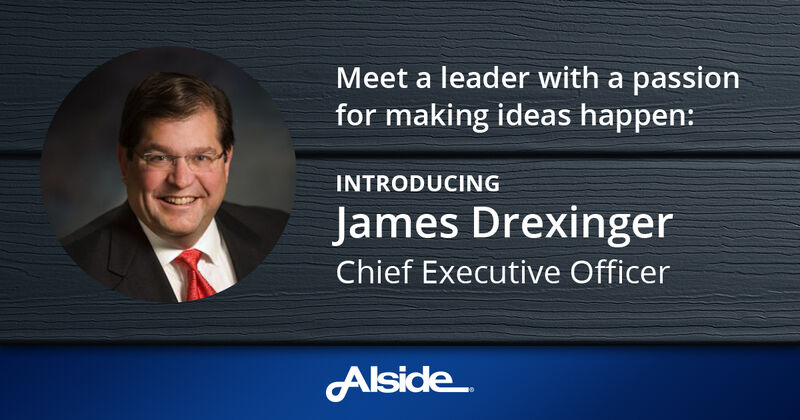
Associated Materials’ history reaches back to Alside’s founding in 1947 and enamel-baked aluminum siding. Over time, the portfolio expanded through products and brands, including Gentek and Revere. Drexinger took charge during the business’s 75th anniversary year. In his arrival remarks, he paired recognition of that history with the need to invest in and renew parts of the organization.
By April 2024, the company had committed more than $100 million to people, equipment, digital technology and changes in working methods. The planned upgrades covered its major product categories. Drexinger’s stated reasoning included an expectation that homeowners would be more likely to remodel in the coming years. It was an investment thesis about future demand, with factory work required in the present.
The details were usefully concrete: laser, camera and welding equipment; automated insulating-glass assembly; automated color readings during siding production; and lean processes. These are changes a customer might never see directly. Their purpose lies in the product and service the customer eventually receives. A window’s weather seal has little interest in the eloquence of the strategy presentation.
The delivery promise becomes measurable
Technology also entered the operating story. In its third-quarter 2024 business update, Palantir reported that Associated Materials had implemented more than ten business use cases in nine months. It reported an increase in on-time, in-full delivery from 40 percent to 90 percent. The example was presented alongside Duane Massie, Associated Materials’ executive vice president of IT.
The measure combines two requirements: the order arrives when promised, and everything ordered arrives together. For a contractor arranging the next stage of a job, that combination matters. The reported result belongs to the company’s technology and operating teams; it also illustrates the kind of service problem addressed during Drexinger’s tenure.
The current manufacturing business describes tools for quoting and ordering, trackable deliveries, visualization and demand forecasting. Their usefulness can be judged at the working end of the relationship: can a customer get a quote, plan an order and understand when it will arrive? That brings the technology discussion back to the same customer confidence Drexinger emphasized in the lumberyard business.
Three businesses, a sharper division of work
In January 2025, Associated Materials announced three distinct businesses under its parent company. Frank Natoli became CEO of Associated Materials Innovations, the manufacturing operation. Dan Watkoske became CEO of Alside, with its U.S. supply-center network. Philippe Bourbonniere continued as president of Gentek Building Products in Canada. Drexinger remained CEO of Associated Materials, LLC.
The structure separated responsibilities while keeping the businesses under one umbrella. Manufacturing could develop its distributor customer base; Alside could broaden its offering; Gentek would continue serving Canada. For Drexinger, the next stage involved leading a parent company whose businesses had more clearly defined operating remits.
The transformation also involved difficult consolidation. The company’s Fife, Washington, plant closure affected 150 jobs, with layoffs beginning in January 2025. Investment and reorganization therefore carried consequences beyond new equipment and revised reporting lines. A full account of the period has to hold those consequences alongside the company’s plans for growth.
Across these chapters, the recurring issue is how much to bring together and how much to keep distinct. At ACS, it appeared in the choice of local brands and the role of family operators. At Associated Materials, it appeared in investment across a shared business and then in the decision to give its operations separate leadership. Drexinger’s career offers a practical study of that judgment. The names on the doors matter. So does what happens when someone walks through them.