The easiest way to understand UNLESS Collective is to look under a shoe. Most sneakers are petrochemical layer cakes: synthetic upper, plastic foam, plastic reinforcement, synthetic thread and enough adhesive to make the whole sandwich nearly impossible to separate. UNLESS looked at that familiar object and gave itself an impolite constraint: no plastic anywhere. Then it promised to take the shoe back when the customer had finished walking it into the ground.
This is what the Portland company actually does. It sells streetwear and casual footwear made from plant- and mineral-based inputs, then routes worn products toward repair, recycling or processing into soil inputs. The catalog includes cotton tees, hoodies, workwear, shorts and shoes. The idea extends to the unphotogenic bits - cotton thread, natural labels, water-based inks, corozo-nut trims and compostable packaging. “Zero plastic” is not a fabric claim here. It is a bill-of-materials rule.
The customer is not a monk with three beige shirts. UNLESS aims at people who like skate, surf, outdoor and workwear, and who would rather not receive a lecture with their hoodie. Its phrase “Don’t feel bad” captures the commercial bargain: buy something desirable, use it hard and return it when it is done. Current prices make the positioning clear. Tees have sold around $55, hoodies around $119, and UNLESS or Under Armour shoes around $99 to $129. This is premium casualwear, not a low-cost replacement for fast fashion.
The recycled-plastic hangover
Founder Eric Liedtke arrived at this problem by first helping scale the more popular answer. During 26 years at Adidas, where he became brand president, he worked with Parley for the Oceans on shoes containing yarn made from recovered plastic. The line became a billion-dollar business. It also left him with an uncomfortable observation: recycled plastic is still plastic. It can shed, become unusable after further cycles and persist after the marketing story ends.
That changed his mind. Liedtke left Adidas in 2019 and formed UNLESS in 2020 with apparel and creative veterans including Tara Moss, Maarten Teijsse and Paul Gaudio. Their question moved one step upstream. Instead of asking where to find better plastic, they asked how to remove it. The pandemic-era company started small, launched its first clothing collection online in 2021 and used Portland as both workshop and stage. At its Union Way shop, a decomposing hoodie sat in the window like a cheerful retail threat.
“We set out with everything from the end first.”Eric Liedtke, co-founder and CEO
What failed first: the boring parts
Cotton cloth was not the breakthrough. The early failures lived where modern apparel quietly depends on oil. Elastic waistbands want synthetic stretch. Performance foam wants plastic chemistry. Screen prints often use plastisol. Sneakers want glue. Removing one synthetic component can expose three more in the process used to join, coat or finish it.
The sneaker became the cleanest demonstration because it was the nastiest problem. UNLESS connected with Natural Fiber Welding, an Illinois materials company founded by chemist Luke Haverhals. Together they assembled what was code-named the Impossible Shoe. Clarus recycled cotton formed the textile base. Mirum replaced synthetic or animal leather overlays. Pliant natural rubber became the outsole, Tunera natural foam handled cushioning, and coconut fiber covered with linen formed the insole. Cotton supplied the laces and lining.
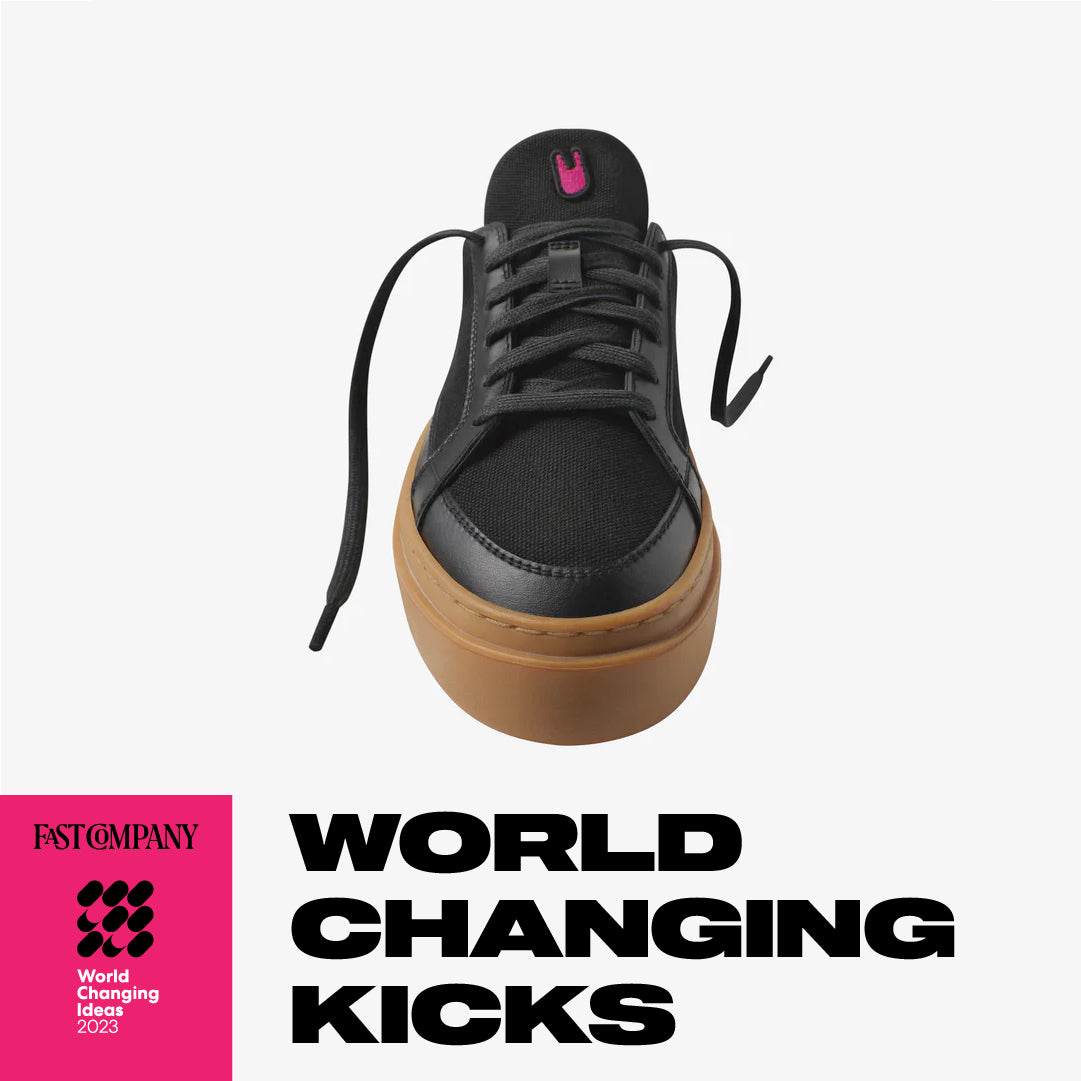
Putting it together without conventional glue was, by Liedtke’s account, “super difficult.” Old-school side stitching helped. So did new rubber chemistry. Later development inside Under Armour still encountered limits: natural mechanical stretch and curing an outsole are hard, and Liedtke has acknowledged that some newer experiments use limited adhesive. That admission matters. A useful materials company shows the seam where the ideal meets manufacturing instead of photoshopping it out.
The product is a loop, not a leaf icon
The $139 proof object
Renamed the Degenerate, the lifestyle sneaker debuted in late 2022 at $139. It was not designed for running or elite performance. It was designed to feel and last like an everyday skate-influenced shoe, then become processable when worn out. The initial low-volume run sold out; Liedtke later said the shoe remained sold out for more than a year. UNLESS did not disclose unit volume, so the sellout proves appetite, not mass-market scale.
The company paired the object with reverse logistics. A customer could return a used pair, receive credit toward another purchase, and let UNLESS decide whether repair, reuse, recycling or decomposition was the best next step. For shoes, the company worked with material partner Natural Fiber Welding and industrial composter Agromin on grinding products into soil inputs. The grinding is important. “Biodegradable” does not mean a whole sneaker vanishes politely beside the basil.
This was also the point of difference. Allbirds has explored regenerative wool and lower-carbon footwear. On offers a subscription and return system for recyclable shoes. For Days built take-back around clothing. Patagonia made repair culturally legible. UNLESS chose the narrowest, hardest position: remove plastic from both obvious and hidden components, and design biological end-of-life from the beginning. Competitors often optimize carbon, recycled content or durability. UNLESS optimizes the destination.
Editorial scorecard / relative emphasis
A brand, a lab and a buyer
UNLESS made money the ordinary way first: selling limited product drops through its Shopify store and, for a time, a Portland shop. Collaboration added reach. Mammut and UNLESS produced biodegradable hoodies and tees, including a 2023 International Mountain Day capsule whose profits went to Protect Our Winters Switzerland. Artists supplied graphics. Natural Fiber Welding supplied chemistry. The partnerships let a small team borrow distribution, credibility and specialized manufacturing without pretending to own a global factory network.
Then the partner became the owner. Under Armour acquired 100 percent of UNLESS on August 8, 2024. The disclosed consideration was $10.3 million: $9.8 million in cash and $500,000 held back under the merger agreement. Under Armour said the deal did not materially affect its fiscal 2025 revenue or net income. In other words, this was not a purchase of scale. It looked like a purchase of capability, a working brand and Liedtke, who joined Under Armour’s leadership while continuing to lead UNLESS.
The arrangement answers the startup’s biggest structural problem. A team of roughly ten can prove a shoe. It cannot cheaply rewrite global performance apparel chemistry. Inside Under Armour, UNLESS can reach deeper R&D, larger chemical partners, more factories and an established retail channel. Products now include the York shoe, Earthness hoodies, plant-based shorts and socks. A Milan Design Week installation displayed the product cycle with dirt and worms. In 2026, an Earth Essentials capsule with artist Nathaniel Russell brought plant-based Pima cotton pieces into Under Armour stores, while SXSW commissioned 350 plant-based filmmakers jackets.
The acquisition did not buy meaningful revenue. It bought permission to experiment at a larger scale.
What a founder can steal
The replicable part is not “make a compostable sneaker.” It is the sequence. UNLESS began with a hard constraint that forced decisions: zero plastic waste at end-of-life. It published ingredients. It chose a single proof object whose complexity made the claim credible. It found a materials partner before pretending to be one. It attached an incentive to the return path. Finally, it made the unpleasant afterlife visible and a little funny.
Ban one thing clearly
“Less bad” produces fuzzy choices. A hard material rule exposes every hidden dependency.
Pick the ugly problem
A complex sneaker made the system believable in a way another organic tee could not.
Design the return first
Credit, shipping and processing are product features, even if nobody photographs them.
Make the lecture wearable
Streetwear, dirt jokes and artists carried a technical story without turning it into homework.
The expertise sits at the junction of footwear development, natural-material chemistry, brand storytelling and circular operations. That explains where UNLESS fits in the market. It is too small to be a mass apparel alternative by itself and too consumer-facing to be merely a materials supplier. It is a regenerative product lab wearing a streetwear brand, now attached to a sportswear company with enough reach to test whether the lab can matter.
Where the loop can snap
The model does not work under every condition. It struggles when a product needs extreme stretch, waterproof membranes, ultralight foam or sport-specific energy return that natural alternatives cannot yet match. It weakens when plant-based inputs cost too much, suppliers cannot scale consistently, or manufacturing partners quietly reintroduce synthetic binders. A lifestyle shoe is a sensible opening move partly because it avoids the highest performance bar.
The afterlife is another choke point. Products do not become circular because a diagram points back to the farm. Customers must return them. The company needs economical collection and sorting. A processor must accept the material, grind it and control conditions. Soil outputs need a real use. Shipping individual worn products can add cost and emissions. UNLESS has demonstrated the route, but it has not published return rates, processing volumes or unit economics that prove the route works at Under Armour scale.
Copy this only when...
You can trace every component, offer a credible collection path and name the processor waiting at the other end. If your customer will not return the product, your local waste system cannot handle it, or performance requires permanent synthetics, the circle is still a pitch deck.
That caveat does not make the experiment trivial. It makes it legible. UNLESS took a giant, vague problem - fashion’s dependence on petroleum - and reduced it to a series of solvable annoyances. The waistband. The ink. The foam. The glue. The return label. Then it built a desirable object that made those annoyances visible to a buyer with $10.3 million and a global shelf.
Fashion loves a fresh beginning. UNLESS built its company around the ending. That is the sharper business idea: choose what your product should become after the customer is finished, then make every upstream decision answer to it. The result may be a hoodie, a shoe or, if the processing works, a surprisingly expensive bag of good dirt.