Fashion prefers the first day. The lights are flattering, the shoes are spotless, and nobody asks what the hoodie plans to do with eternity. Eric Liedtke asks. His latest chapter began with an unfashionable question: once a garment is stained, stretched, forgotten, donated twice and finally refused, where does it go?
For most sportswear, the answer is some variation of nowhere useful. Synthetic fibers, foams, threads, prints and glues are built for endurance. They perform magnificently and linger awkwardly. Liedtke's response was to build UNLESS Collective in Portland around a severe rule: use plants and minerals, avoid plastic, and design every product so it can safely return to natural systems. The company's cheery shorthand is “make good dirt.” Few corporate missions improve when placed beside a worm bin. This one does.
The curious part is who chose the dirt. Liedtke had already spent more than a quarter-century climbing Adidas, from a cross-training product job in Portland to Brand President and a seat on the German company's Executive Board. He had learned the machinery of global desire. Then he left at the end of 2019 and returned to Oregon to start again with a handful of industry friends, small orders and materials that factories were not accustomed to handling.
A reporter learns to build shoes
Liedtke was born in Dayton, Ohio, in 1966 and studied journalism at the University of Wisconsin-Madison. He did not go directly from the student newsroom to a sneaker empire. He entered advertising and found himself, as he later described it, one of the people in suits carrying papers between creative teams and client-service people. The proximity to making was not enough. He wanted to decide, build and improve something tangible.
Adidas gave him the opening in 1994. He joined as Global Line Manager for Cross Training in Portland, then moved through footwear marketing and brand leadership. In 2006 he relocated to Herzogenaurach, Germany, as Senior Vice President of Global Brand Marketing. By 2011 he ran Adidas Sport Performance categories globally; three years later he joined the Executive Board with responsibility for Adidas and Reebok.
His tenure at the top coincided with a useful expansion of what a sports brand could mean. Performance remained central, but the playing field widened into music, streetwear, mobile screens and environmental responsibility. Collaborations with Kanye West, Pharrell Williams and Beyoncé placed Adidas inside culture rather than merely alongside it. Boost became a footwear platform. The five-year plan Liedtke helped drive was credited by Under Armour with adding more than $8 billion in revenue.
“I like broken things. Because broken things give you an opportunity to create something new.”Eric Liedtke
There was another collaboration, quieter in celebrity terms and louder in consequence. Parley for the Oceans introduced Liedtke to the damage created by plastic and to the role apparel plays in it. At the United Nations in 2015, Adidas and Parley showed a concept shoe whose upper used yarns and filaments reclaimed from ocean waste. The reaction demonstrated that environmental work did not have to sit in the philanthropy drawer. Product could turn concern into participation, and participation could build affection for a brand.
The trouble with a better bottle
Recycled plastic was a beginning, not a destination. Liedtke came to see it as an improved version of the same material system. A bottle turned into a shirt is still plastic; time and wear do not grant it a graceful exit. UNLESS would work backward from that exit. If the final product needed to become harmless biological material, every thread, stretch component, print, dye, button, sole and adhesive had to answer to the ending.
The product brief, backward
Starting during Covid made a strict brief stricter. Factories were busy supplying an online-shopping boom. UNLESS was a startup requesting low quantities, unusual materials and more difficult assembly without the synthetic threads everyone knew. Liedtke has recounted the pitch with dry amusement: the factories did not, in fact, rush to say yes. The team searched for the few material innovators and domestic manufacturers willing to solve the fiddly parts.
That is where the company becomes more instructive than its slogans. “Plastic-free” is not a fabric selection. It is a systems problem disguised as a sweatshirt. Cotton can compose the body, but ordinary stretch often comes from synthetics. Inks and dyes introduce another chemistry set. Shoes bring foams, glue, rubber and plant-based leather into the argument. Packaging and end-of-life logistics wait patiently at the door. The ambition survives only if the boring pieces cooperate.
Liedtke's product standard adds another difficulty: virtue is not permission to make an unappealing garment. He insists that consumers should not have to trade taste for values. Streetwear gave UNLESS a practical first territory. Skate, snow and cold-water surf sit near the edge of culture, but their lifestyle pieces can be built with available natural materials while the harder science of high-performance apparel catches up.
The startup enters a larger locker room
In August 2024, Under Armour acquired UNLESS and hired Liedtke as Executive Vice President of Brand Strategy. The transaction gave the small Portland company access to the resources, suppliers and performance problems of a global sportswear business. It gave Under Armour a materials platform with a stubborn point of view and an executive who had already helped reposition one large athletic brand.
His remit expanded quickly. In 2025 he served as Brand President. In February 2026 he became Chief Marketing Officer and Executive Vice President of Strategy. On June 1, he transitioned to strategic advisor to Under Armour's CEO and executive leadership team. Titles moved; the regenerative experiment kept appearing in public.
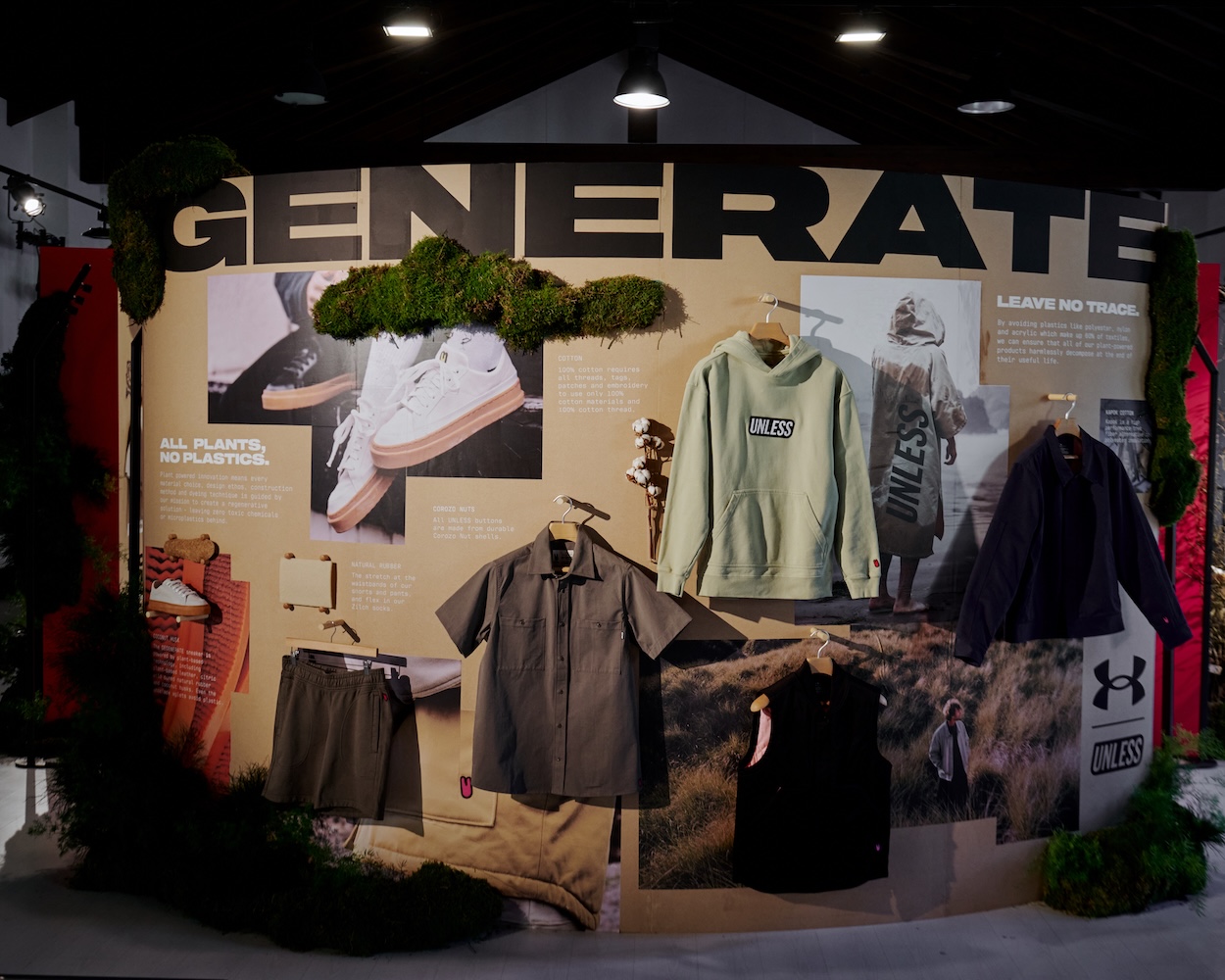
At Milan Design Week in April 2025, the partnership presented apparel and footwear using materials including cotton, natural rubber latex, coconut husks and plant-based leather. A decomposition display supplied the memorable visual: worms working through clothes that had been designed to become something else. Liedtke used the occasion to invite designers into the unsolved parts of performance, including alternatives for polyurethane foam, glues, stretch, prints and dyes.
By SXSW in March 2026, the idea had acquired a new costume. UNLESS produced the festival's first Filmmakers Jacket, while Under Armour made official staff jackets. At the UNLESS pop-up, visitors could look at the finished item and a version decomposing behind glass. A director's jacket is normally a credential, a souvenir and perhaps a mild status signal. This one also doubled as a small lecture on material mortality.
“We're not focused on creating generational wealth, as much as we're focused on creating generational change.”Eric Liedtke
Portland as workshop, not backdrop
Liedtke's return to Portland matters beyond scenery. The city contains an unusual concentration of footwear designers, developers, suppliers and alumni from Nike, Adidas and the wider outdoor industry. In 2024, Liedtke and former Nike sustainability chief Noel Kinder joined the board of Made in Old Town, a nonprofit project building a footwear and apparel innovation district in Portland's historic core.
The proposal treats proximity as productive infrastructure. Designers, material libraries, sample rooms and small-scale manufacturing can live close enough to replace weeks of overseas back-and-forth with a walk across the building. For Liedtke, whose startup learned how much innovation depends on willing suppliers, the connection is obvious. Grand material shifts are assembled from short conversations, available machines and people prepared to try the inconvenient sample.
There is a neat circle in the geography. Portland is where he joined Adidas in 1994 and where he returned to question the materials beneath the industry that trained him. Herzogenaurach taught him scale; Portland supplied the workshop. Under Armour now connects the two impulses: a large organization trying to recover sharper brand instincts, and a small collective trying to make its methods travel.
A useful kind of unfinished
Liedtke does not speak as if every problem has been solved. He lists missing plant-based performance components plainly. That candor makes the project more credible, and more interesting. Regenerative fashion is not a victory label pasted onto a hangtag. It is a technical agenda, with partial answers, failed samples and a suspicious amount of attention paid to socks.
The durable lesson from his second act is not that every founder should start a compost heap. It is that the end of a product belongs in the original brief. Software has deletion. Marketplaces have waste. Hardware has drawers full of obsolete cables. Apparel has landfills and fibers that outlive their owners. The exit is part of the experience even when the marketing department has gone home.
Liedtke spent the first stretch of his career learning how to make millions of people want a shoe. Now he is trying to make the shoe's disappearance desirable too. The first task is familiar to fashion. The second asks the industry to admire an object for leaving gracefully. Somewhere between the launch party and the compost pile sits a better definition of performance.