For one month, Jordan Brand behaved as if it had misplaced itself. Its social feeds went dark. Outside Chicago's United Center, black bars appeared over the shoes of the 12-foot Michael Jordan statue. Inside NBA 2K25, players temporarily lost access to the Air Jordan 1. Millions of followers received no tidy explanation, only a strange absence where one of sport's most familiar symbols had been.
This was marketing by subtraction, a rare maneuver in a business usually paid to add. The campaign, called Unbannable, asked people to imagine sneaker culture without the shoe that helped create it. When the lights came back on, the point had already landed. A missing icon casts a remarkably long shadow.
At the center of the operation was Caitlin Sargent, Jordan Brand's chief marketing officer. She described roughly six months of nights, weekends and daily scripting behind the apparent surprise. Her team built a sequence across social media, public space, gaming and film, then trusted curiosity to do some of the carrying. It was a large machine engineered to look like a mischievous thought.
“I like to understand the insight and almost take it to the edge.”Caitlin Sargent
The phrase is a compact description of Sargent's method. The insight supplies the floor. The edge supplies the electricity. Get either wrong and a legacy campaign becomes a history lesson with expensive lighting. Get both right and a 1985 shoe can briefly feel like a fresh provocation.
The local who took the long route
Sargent grew up in Portland as one of six adopted children. Nike was not an abstract corporate giant. It was part of the Oregon landscape, close enough to appear as a possible destination before it became a two-decade career.
Her route there began in retail. After studying business administration and marketing at George Fox University from 2000 to 2004, she worked as an assistant store manager at Mervyns in Glendale, Arizona. The job offers a useful first chapter for a marketer who would later manage symbols seen around the world. A sales floor is where brand strategy meets fluorescent light, limited patience and the question every deck politely avoids: will somebody actually choose this?
Sargent joined Nike in 2006 as a department manager and moved through specialist, manager, director, planning and senior director jobs. By 2021 she was vice president of Nike Men's Brand Marketing for North America. In February 2024, Nike promoted her to lead marketing for Jordan Brand. The career has fewer dramatic exits than careful accumulations. She learned the institution by moving through it.
People who worked or studied with her describe an unusual mixture: optimism without passivity, organization without creative stiffness. A university classmate remembered warmth and an absence of ego. A former colleague emphasized her patience, energy and ability to pair pragmatic execution with an appetite for white space. Those are testimonials, naturally affectionate, but they match the public work. Sargent's campaigns reach for spectacle while revealing a considerable fondness for calendars.
How to inherit a feeling
Michael Jordan's competitive mythology once arrived live, game by game. Many younger consumers inherited the artifacts instead: a silhouette, a number, a shoe, a few grainy clips and a confidence that seems to lean forward. Sargent's problem is not awareness. It is translation. How does a brand preserve the voltage of a story after the audience stops sharing the original memory?
Her answer begins with emotion. She has called Jordan Brand a feeling and described the anniversary work as an effort to restore emotive storytelling. This avoids the museum trap. Six championships matter, but feeling can travel where statistics cannot. Defiance, possibility and self-belief can belong to a teenager who met Michael Jordan first through a parent, a resale app or a video game.
The Air Jordan 40 campaign made the balance visible. Its “Too Easy” film mixed professional players, ordinary hoopers and the theatrical bounce of “It's the Hard Knock Life,” turning a pickup game into something close to a musical. The casting moved between the NBA and WNBA, while the new shoe pointed ahead. Anniversary marketing often wears a tuxedo and stares backward. This work arrived in basketball shorts, remembered the old tune and invited the latest model onto the court.
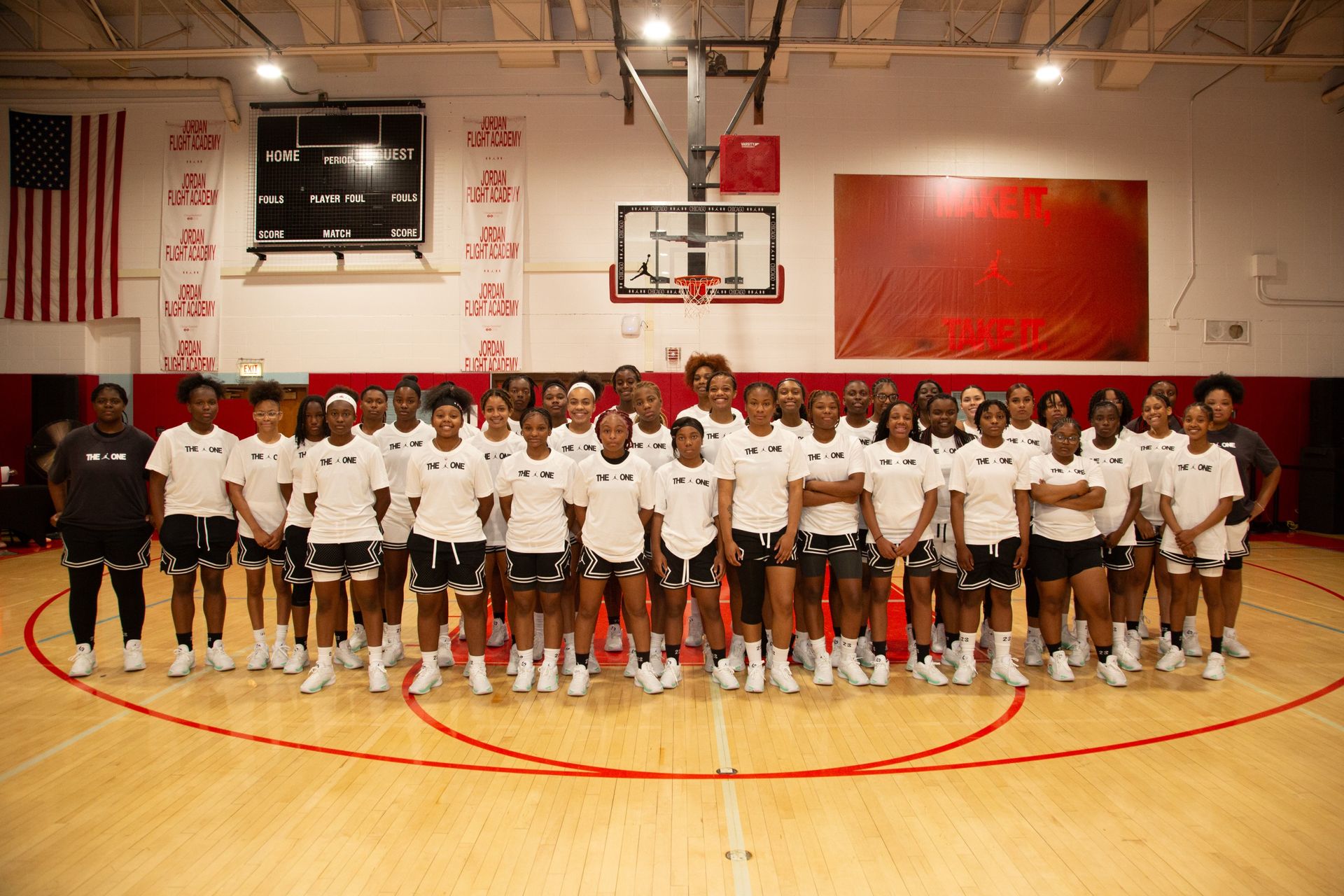
Our Turn, introduced in 2024, made that participation explicit. The new brand voice came with a global one-on-one basketball tournament, gathering young players connected to cities across North America, Europe and Asia. The language was impatient by design. Greatness would not ask permission. A legacy built around one famous player's flight now offered the runway to many.
Unbannable took the opposite route to the same destination. Instead of inviting the audience in directly, it removed the furniture and waited for people to notice. The team blacked out social feeds serving more than 35 million followers, intervened in a famous statue and entered the logic of a basketball game. Each piece made the audience briefly responsible for completing the story. The eventual film could explain the counterfactual, but the public had already rehearsed it.
There is a lesson here for anyone with a heritage brand and a nervous legal department. Respect does not require reverence. History stays alive when it can withstand play. Sargent's campaigns do not discard the archive; they let the archive cause trouble in the present.
The audience gets a pen
That philosophy becomes more consequential in Jordan Brand's work with women. Sargent has said the company should elevate women who already know who they are, then give them the resources and platform to lead. In practice, that means creative control rather than decorative casting. She points to Teyana Taylor's involvement in product design, campaign casting and the expression of her own sharp, independent style.
The product process is listening too. The Heir Series 2 was developed with insights from women basketball players, while the 2026 Generational Greatness campaign revisited a 1991 Jordan advertisement through women in sport and culture. Sargent called the current moment for women a once-in-a-generation convergence across both fields. Her language makes the strategic wager plain: women are not waiting at the edge of sneaker culture. They are leading parts of it.
“We are a reflection of the community we serve.”Caitlin Sargent
Reflection alone, in her telling, is incomplete. A company can also supply product, distribution, narrative space and long-term backing. The most credible work may happen away from campaign premieres, through mentoring, community activity and grassroots investment. Sargent phrases it neatly: the things that happen in the dark matter most.
Her own civic work gives that idea a local address. She serves on the board of Big Brothers Big Sisters Columbia Northwest, which creates one-to-one mentoring relationships for young people. It is an unflashy connection between her corporate talk about the next generation and an organization devoted to helping that generation build confidence and ambition one relationship at a time.
Discipline in a pair of sneakers
Marketing mythology prefers the flash of inspiration. Sargent's account of Unbannable is full of less photogenic nouns: work, hustle, days, weekends. The campaign was methodically scripted, even as it tried to provoke an organic reaction. This is the comic bargain of modern brand building. To create a moment that feels loose, a large group of people must become exceptionally punctual.
The same tension runs through Sargent's career. She is responsible for a symbol associated with flight, yet her public record is grounded in long tenure, internal progression and team credit. On LinkedIn, she celebrated the small squad behind a historic story and later shared Jordan Brand's recognition as Footwear News' 2025 Brand of the Year. The voice is collective. Even the bravado has a production schedule.
Jordan Brand faces ordinary commercial pressure alongside its extraordinary cultural inheritance. The useful signals are mixed: revenue declined in Nike's 2025 fiscal year, while Sargent reported that engagement had tripled from the start of 2025 into early 2026. Her response has been a brand reset that tries to serve existing devotees and invite younger consumers, especially women, into the orbit. Nostalgia remains in the room, but it no longer gets every chair.
This may be Sargent's most interesting aspiration: to make a famous individual's legacy feel personally available without making it generic. The Jumpman cannot mean everything. It can, however, keep finding new people prepared to supply their own definition of greatness.
A blacked-out statue eventually returns to normal. A social feed switches back on. The game restores the missing shoe. The campaign's deeper question remains: what would culture lose if this symbol disappeared, and who gets to decide what it becomes next? Caitlin Sargent's answer is still being written, carefully, day by day, near the edge.