There is a peculiar problem reserved for famous brands. Everybody recognizes the name, the sign, the uniform. Then comes the awkward second question: what does it mean now? Brett O'Brien arrived at Foot Locker North America in September 2025 to work on that second question. His brief covers the retailer's identity, marketing strategy, and e-commerce business. The first two words of the job are the easy ones. The third is where the trouble, and the opportunity, live: make people care.
O'Brien had spent the previous quarter-century inside PepsiCo, learning how ordinary products become fixtures in extraordinary moments. Mountain Dew was never merely citrus soda when it was flying over a skate ramp. Gatorade was more persuasive beside an athlete at the point of sweat than it could ever be in a conference-room slogan. A bag of chips acquired a different social life during a match or a Super Bowl party. The products were tangible. The real work was assigning each one a role in people's lives.
Foot Locker offered the inverse puzzle. The cultural role already existed, sedimented through five decades of basketball, music, neighborhood stores, release-day anticipation, and those referee-striped employees. Yet the brand had gone quiet. The new owner, DICK'S Sporting Goods, had completed its acquisition and installed a fresh North American leadership team. O'Brien was asked to help an institution speak again without sounding like an uncle borrowing slang at a cookout.
The apprenticeship in occasions
His career began far from a sneaker wall. After graduating from Georgetown in 1995, O'Brien spent four years at Advantage International Sports Marketing, now Octagon. He created events for the Senior PGA Tour and Lexus Golf Champions for Charity and consulted on sports marketing for Northwest Airlines. It was practical instruction in how commerce fits around a game without smothering it.
An MBA at Northwestern's Kellogg School of Management followed. In 2001, he joined PepsiCo. The early assignments ranged across juice drinks, multicultural marketing, music, and programs aimed at younger consumers. The variety mattered. O'Brien later advised aspiring marketers to build a "Batman Tool Belt" of skills. The image is playful, but the lesson is serious: collect useful capabilities before the emergency announces which one you need.
1995-1999
2000s-2012
2012-2025
2025-now
At Mountain Dew, that belt got a workout. O'Brien helped lead DEWmocracy, a program that invited consumers into product development and flavor selection. He also worked around the Dew Tour, where a former partner remembered his willingness to alter the event mix, trust his judgment, and listen. That combination - conviction with open ears - would become a durable operating style.
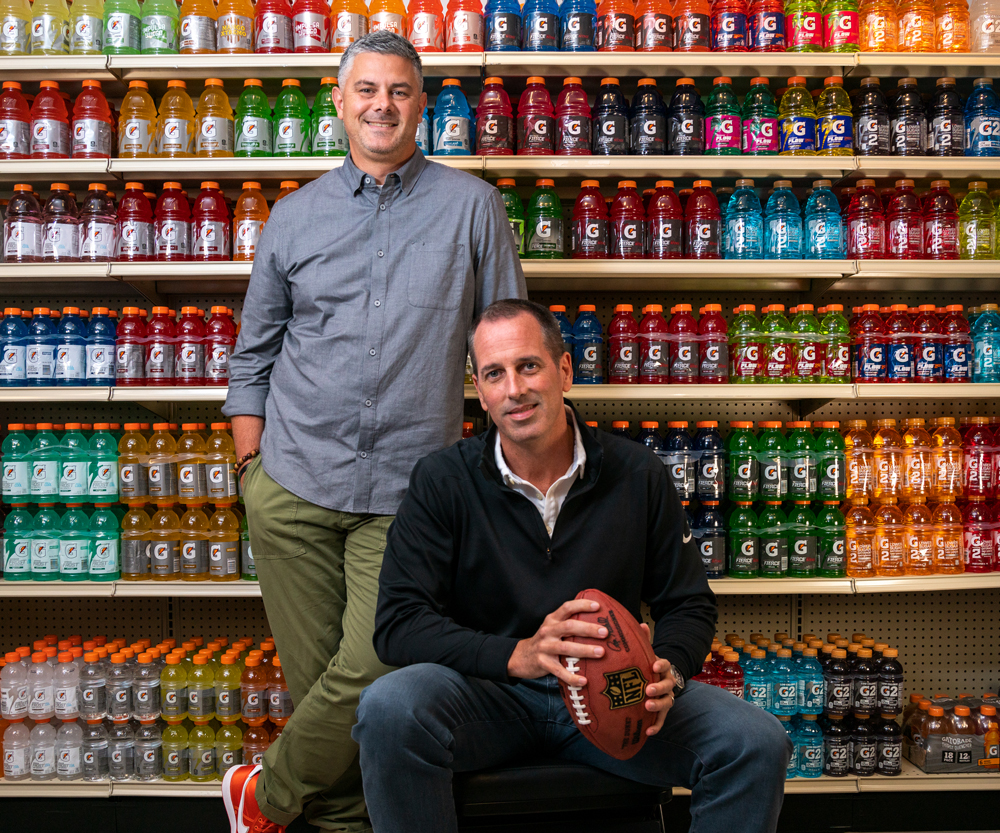
A brand meets people at the point of sweat
In 2012, PepsiCo named O'Brien senior vice president and general manager of Gatorade North America. The promotion widened his view beyond communications. Product development, retail strategy, consumer marketing, and the business itself came into frame. He would spend roughly a decade around the sports-and-fitness portfolio, where the simplest discipline was also the most demanding: serve the athlete.
He described that focus with comic bluntness in 2020: "Our focus is not even primarily on athletes - it's 100%." The phrasing is memorable because it eliminates the soft middle. A brand that says it belongs to athletes has to behave as if athletes will notice every shortcut.
“People get emotional when they talk about their first sneakers.”Brett O'Brien
The Gatorade years also show O'Brien's instinct for systems. League partnerships put the brand on professional sidelines. Sports science gave the relationship substance. Community initiatives tried to reduce barriers to play. Marketing was not a decorative layer placed on a bottle. It joined product, expertise, access, and distribution into one argument.
That general-manager experience explains why his current Foot Locker remit includes e-commerce. O'Brien is not being asked to make a handsome film and disappear before the sales meeting. The story has to survive a phone screen, a product launch, a store visit, and a conversation with an associate. Culture may provide the electricity. Operations must keep the lights on.
Chapter threeSnacks, sport, and the long game around game day
O'Brien moved to the chief marketing role at Frito-Lay North America in 2022, overseeing a portfolio that included Lay's, Doritos, Cheetos, Tostitos, and Fritos. Here the athlete was no longer the only center of gravity. The fan, the couch, the watch party, and the shared bowl all mattered. His formulation was to expand a major sports moment rather than spend the entire idea on one commercial.
“Do things on TikTok, do things in the metaverse,” he suggested while discussing Super Bowl work, so the event could extend beyond a single spot. Strip away the fashionable platform names and a useful principle remains: design the campaign as a world with several doors. People enter culture differently. A film may start the conversation, but participation, food, retail, social media, and live experience allow it to continue.
By 2024, PepsiCo had put O'Brien in charge of a Sports & Entertainment Center of Excellence spanning sports, entertainment, gaming, and influencers. It was a capstone role, and also a clue. His career had traveled from individual brands toward the connective tissue between brands and culture.
The fame-to-feeling gap
Recognition answers “Have I heard of it?” Meaning answers “Why is this part of my life?” O'Brien's Foot Locker assignment lives in the distance between those questions.
The striped-shirt advantage
Foot Locker's most interesting asset may not be a celebrity, a media buy, or a coveted release. It may be the person in the striped shirt who knows why this colorway exists and remembers what happened when the last one dropped. O'Brien calls the Stripers the heartbeat of the business. He talks about visiting stores and hearing associates explain that they already spent their time around sneakers, so working there felt natural.
This is frontline research with a pulse. An algorithm can sort a product grid. A knowledgeable associate can give the product a genealogy, place it inside a local memory, and tell a customer why a small design choice carries weight. The uniform works because expertise fills it. O'Brien says he cannot spend enough time with that crew.
His own professional network follows the same pattern: people close to the action. At Gatorade, sports-marketing leader Jeff Kearney managed relationships stretching from grassroots play to the major leagues. At Frito-Lay, O'Brien worked across brand teams and with athletes, entertainers, leagues, and creative partners. At Foot Locker, the circle now includes Stripers, sneaker companies, NBA and WNBA players, musicians, filmmakers, and customers. These connections are not decorations around the campaign. They are how a retailer learns whether an idea sounds native before the public gets a vote.
Industry recognition arrived along the way: an Advertising Age Digital A-List mention in 2010, Event Marketer's Brand X Award in 2011, and 40 Under 40 honors from both Advertising Age and Sports Business Journal in 2013. Awards freeze a moment; O'Brien's more revealing habit is revision. The Dew Tour could change its events. A Super Bowl idea could spill into several platforms. A store employee could overturn a theory carried in from headquarters. Listening, in his version of leadership, does not mean surrendering judgment. It means giving judgment better material.
The first major expression under his leadership arrived in May 2026. Hoops Lives Here made basketball a year-round Foot Locker platform rather than a seasonal media burst. The opening commercial imagined NBA and WNBA players including Paolo Banchero, Chet Holmgren, Payton Pritchard, and Jewell Loyd literally living in a store. One makes a smoothie at the register; another prepares for a tunnel walk. The joke is visual, but the strategy is plain. Basketball lives beyond the court, in clothes, conversation, routine, and identity.
O'Brien's plan extended through broadcasts, stores, e-commerce, social platforms, athlete appearances, and community court programs. He also pointed to rising crossover demand for signature shoes from women players, bought by both men and women. Culture is more unruly than an old retail taxonomy. The smart operator notices before relabeling the shelf.
“Culture is going to move on and your brand will be left behind.”Brett O'BrienThe next chapter
Nostalgia with somewhere to go
In August, Foot Locker widened the aperture. It Always Will Be Foot Locker moves through decades of sneaker culture in a two-minute film narrated by Method Man. Moses Malone, Andre Agassi, Run-D.M.C., Larry Johnson's Grandmama, Allen Iverson, Jordans, Stan Smiths, and a future Caitlin Clark release share the reel. The retailer appears throughout, less as inventor than host.
That distinction saves the work from chest-thumping. O'Brien readily says Foot Locker did not create sneaker culture. His claim is that the stores gave it a home. A 36-part short-form series called Sole Stories, created with Hartbeat, is designed to let people describe their own first pair, favorite pair, and the pair that escaped. The archive becomes an invitation instead of a velvet rope.
O'Brien is a sneaker enthusiast himself and a loyal Boston sports fan, two facts that make the assignment feel neatly cast without magically solving it. Affection helps a marketer recognize the codes. It does not exempt the brand from earning its place. He keeps returning to identity, emotion, associates, and community because product access alone is a fragile advantage.
There is an appealing consistency to his route. Golf events taught him to build around an occasion. Mountain Dew taught participation. Gatorade taught disciplined service to a core user. Frito-Lay taught him to enlarge the fan experience. PepsiCo's central sports role taught coordination across a portfolio. Foot Locker now asks him to use the entire utility belt at once.
The work is young. Two campaigns do not settle the future of a retailer navigating new ownership, changing tastes, crowded e-commerce, and fickle attention. They do reveal a theory. Heritage supplies proof. Employees supply authority. Basketball supplies a living culture. The customer supplies the memory. Marketing's job is to connect them without squeezing the life out of any one part.
A famous sign can remain visible for years while its meaning fades by degrees, almost too quietly to notice. O'Brien's wager is that Foot Locker can reverse the process, one story, one store, and one pair at a time. Recognition brought the brand this far. Feeling is supposed to carry it forward.