The Tampa Bay Buccaneers were the worst team in football when they hired ChappellRoberts. This is not the customary first sentence of an agency case study. Agencies prefer the client after the makeover: the champagne, the trophy, the graph pointing northeast. But the losing matters. In 2015, the Buccaneers had the next season's first draft pick and a problem no media plan could conceal. Winning was unavailable as a promise.
So the agency made a smaller, smarter promise. It gave the city something to do regardless of the score: Siege the Day. The line escaped the stadium and moved onto murals, street poles, newspapers, websites and the long concrete tunnel to the field. It lasted three seasons, the team's longest consecutive campaign at the time, and ChappellRoberts reports that digital spending returned five times its cost through ticket sales.
That assignment contains the whole ChappellRoberts story in miniature. Begin with the uncomfortable fact. Find an emotion that does not depend on wishful thinking. Compress it into language people can carry. Then buy enough of the right attention to make the idea behave like business.
“If you can't summarize the idea in 5-7 words, the message probably won't land.”ChappellRoberts, on creative work in 2026
Before it sold feelings, it learned to integrate
The company began in 1978 as a Tampa public-relations firm founded by Deanne Roberts. In 1992 it acquired a local advertising agency and started becoming what the trade now calls integrated. Colleen Chappell arrived in 2002 from the client side and expanded the B2B and consumer practices. By its fortieth anniversary, the agency said it had grown fourfold.
Today the menu is broad: brand strategy, advertising, research, media, web and mobile development, and a video and content studio. The breadth is not unusual. The arrangement is. The researchers, brand strategists, buyers, designers, developers and producers sit inside one independent company, so the audience finding can survive the trip from a survey table to a billboard and from a billboard to a conversion report.

The customers explain the model. AdventHealth and Florida Cancer Specialists bring complicated choices and regulated claims. DTCC brings the dense language of financial infrastructure. The Tampa Bay Rays and Buccaneers bring fans who can detect an impostor at fifty paces. Feeding Tampa Bay and the Crisis Center bring missions where a hollow phrase costs more than attention. Real-estate developers bring the blunt requirement of leads that turn into homes.
The product is a useful kind of recognition
ChappellRoberts' most distinctive work makes a person recognize a place, a relationship or a private fear before they notice the advertiser. For the Rays' 2024 Nike City Connect launch, the raw materials were not generic baseball Americana. They were Tampa Bay's skate culture, the Sunshine Skyway, Perry Harvey Sr. Park and the St. Petersburg Pelicans of the Florida State Negro League. The agency and its collaborators called the idea Grit x Glow.
The campaign recruited local creatives, athletes, businesses and residents, then let a uniform carry the regional story. The Rays later called it the most successful retail launch in team history. The work also collected an American Advertising Federation Mosaic Award, seven Gold ADDYs, two Silver ADDYs and three local Best of the Bay awards. The award count is impressive. The retail record is the cleaner proof: people bought the story and received a jersey.
The same move appears in quieter settings. Tidewell Hospice needed families to seek help before the final crisis. A list of services would have been accurate and emotionally useless. Research instead led to the relationship between a wife-caregiver and a social worker. The resulting commercial used no voiceover. “The Bucket List” won a regional Emmy in 2023, plus a Platinum Hermes and two Silver Telly Awards.
“We could have talked about the organization's service offerings, but instead focused on the heart of the families the organization serves.”Matt Boswell, partner and chief creative officer
A food bank outgrows its noun
Feeding Tampa Bay's problem was architectural and linguistic. In 2025 it moved into a new facility offering job training, health exams, financial and educational assistance, fresh food and hot meals. “Food bank” remained true, but it had become too small. ChappellRoberts recast the organization as a hub of opportunity and made “feeding” a verb that could take a new object: feeding possibility.
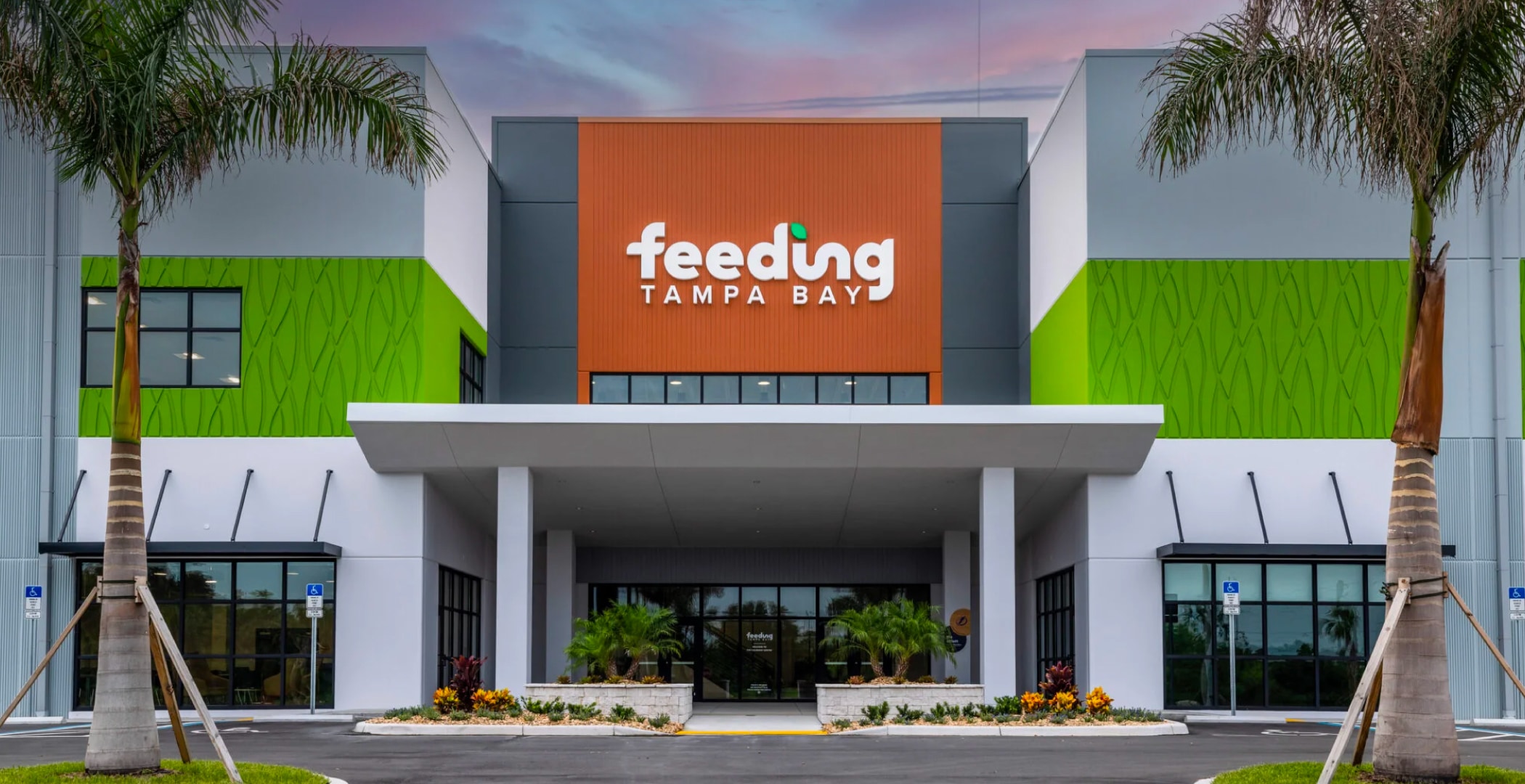
The visual system borrowed from looking toward the sky: brighter colors, a path becoming a sprout, and language about beginnings rather than scarcity. It is a revealing choice. Many nonprofit campaigns trap their subjects inside the problem. This one pictured the next step. The agency reports a 29 percent increase in total unaided brand awareness.
What another team can actually copy
You cannot copy Ybor City's roosters, the Skyway or a fan base's memory. You can copy the sequence. ChappellRoberts repeatedly resists choosing the format first. It identifies the audience tension, finds the compact thought that resolves it, recruits credible participants and only then decides whether the idea belongs on television, a wall, a jersey or a search-results page.
Name the awkward truth
The team is losing. Families delay hospice. A food bank has become much more than its category.
Find the human tension
Belonging despite a score, love amid uncertainty, or pride in a place outsiders flatten.
Compress the idea
“Siege the Day.” “Grit x Glow.” “Feeding Opportunity.” If the phrase needs a paragraph, keep working.
Attach it to behavior
Pick the measure before the media: ticket sales, patient calls, awareness, appointments, leads or retail demand.
This is also how the agency appears to make money: not by selling a single software product or a preset package, but by scoping a mix of strategy, creative, media, digital and production around a client problem. It does not publish a rate card. That matters because the work shown publicly depends on immersion, access and distribution, all expensive in different ways. A slogan alone is cheap. A slogan discovered through research, embodied in production, placed across channels and measured against revenue is not the same purchase.
Reported outcome index
The succession was part of the work
The firm's other long campaign was itself. Christine Turner joined early in her career and stayed through account leadership, strategy, branding and new business. She became the agency's first executive vice president, then president in 2021, then CEO and partner in 2023. Colleen Chappell described the transition as a long-term succession plan, which is the corporate equivalent of admitting that continuity requires production.
The culture around that handoff is unusually specific for an agency. In 2019, ChappellRoberts expanded vacation and personal time, work-from-home flexibility, parental leave, professional development and paid opportunities to volunteer. Its five values favor honesty, creativity, courage, intelligence and fun. Turner puts the management theory more plainly: “People that are happy will produce creative, great work.”
The necessary conditions
The method depends on access to real customers, leaders willing to hear an uncomfortable finding, a measure tied to behavior and enough distribution for the idea to accumulate meaning. Remove those conditions and specificity turns into decoration. A five-word line cannot rescue a vague brief or an invisible media plan.
This is where ChappellRoberts sits in the market: larger and broader than a design boutique, smaller and more place-literate than a global agency network, with particular fluency in healthcare, sports, nonprofits, real estate and civic brands. Its strongest competitive advantage is not that it knows Tampa Bay. It is that after nearly five decades, it knows what to do with knowing a place.