A basketball campaign in Morocco has a small but revealing complication: which language should it speak? For the Basketball Africa League’s Kalahari Conference event, Webloo used three. Arabic, French, and English appeared in a campaign that also reached beyond the browser, into television, radio, billboards, and community outreach. A person buying a ticket might meet the same event in several different places before deciding to go.
That is a useful place to begin with Webloo, a creative and digital agency whose service menu stretches from brand positioning to software engineering. The interesting question is what holds those jobs together. In its sports work, the answer is quite concrete: give someone a reason to care, then make the next action possible.

A ticket has a surprisingly long backstory
Webloo describes a twelve-week BAL assignment involving paid advertising, influencers, media engagement, group sales, and community outreach. Its campaign account names Rabat and Casablanca as locations for outdoor and broadcast activity. The team localized content, adjusted advertising budgets, and developed a sales funnel alongside promotional materials.
Notice how quickly the brief becomes larger than an advertisement. Someone must choose the audience. Someone must make the invitation intelligible. Someone must connect that invitation to a purchase. Group sales require a different approach from reaching an individual scrolling through a feed. The practical lesson is to describe the route to the event before choosing the media that will announce it.
This is also where the word “global” acquires some useful weight. International work can demand very local decisions: a language, a city, a community, a way of buying. Webloo’s case is interesting because it supplies those details. Its reported improvements in engagement and sales are qualitative claims, so the revealing evidence here is the work itself.
- 01Find the audiencePaid media + local outreach
- 02Make the invitationContent + influencers
- 03Connect the channelsBroadcast + outdoor + digital
- 04Give fans a next stepTicket funnel + group sales
Editorial map of the published scope, not a measured conversion funnel.
The shirt needs a shop
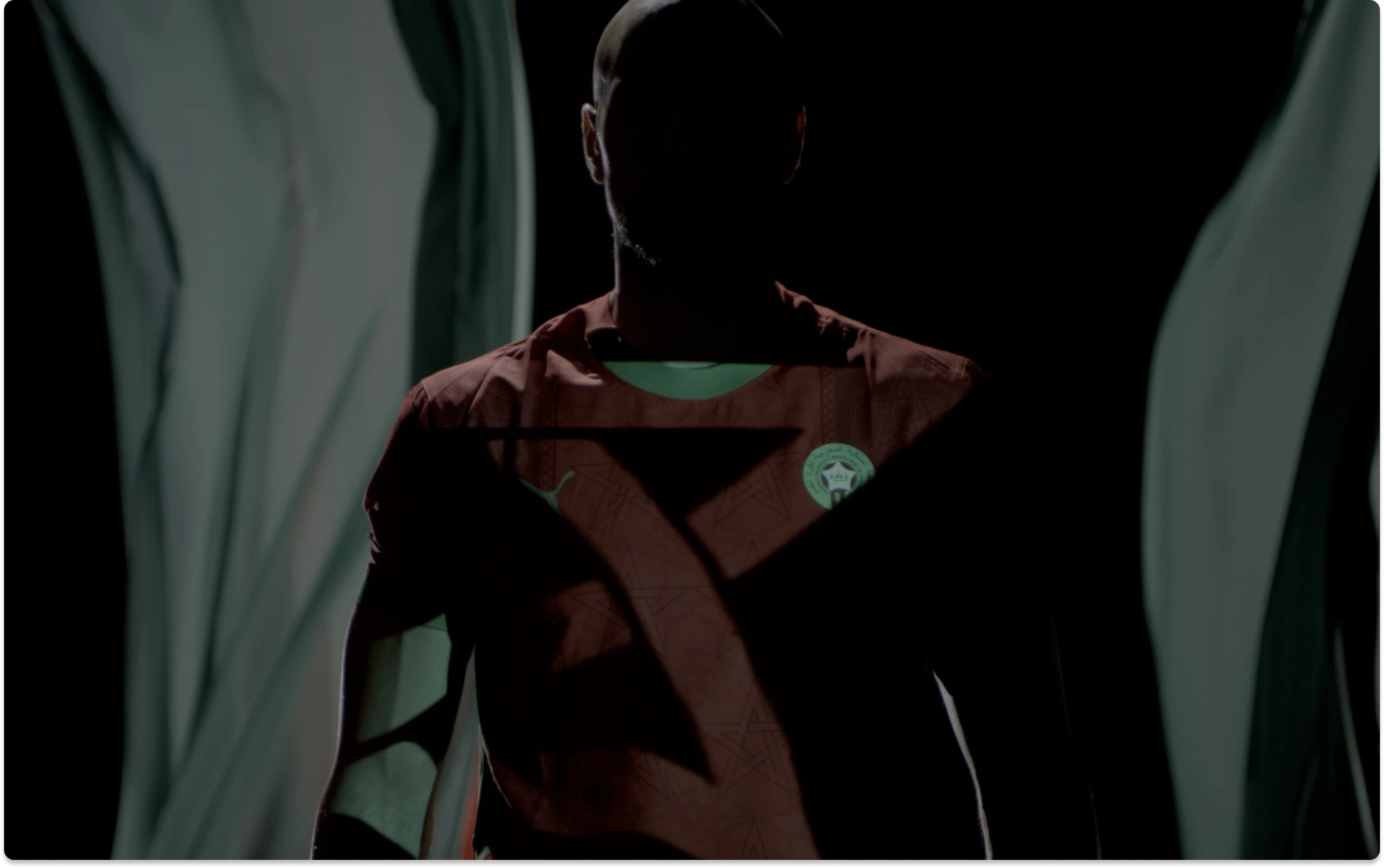
Another Webloo project moves from the basketball court to Moroccan football. The Royal Moroccan Football Federation, or FRMF, commissioned work that the agency describes as a six-month assignment. It included website development, e-commerce implementation, brand guidelines, content production, social media management, and messaging. At the center was the federation’s official online merchandise store.
The FRMF case study describes a place where supporters could buy jerseys and other merchandise, with content and branding built around it. This gives Webloo’s breadth a recognizable purpose. The photograph that creates desire and the interface that accepts an order belong to the same customer experience, even when different specialists make them.
For a prospective client, that suggests a better brief than “we need a new website.” What should a supporter, shopper, or patient be able to finish? Buying a shirt is a task. So is understanding a service, finding the right product, or completing an assessment. Starting with that task makes the design and engineering requirements easier to see.
Follow the order into the back office
The least glamorous words in Webloo’s portfolio may be among the most informative: ERP automation. Enterprise resource planning systems sit behind business operations. They are an unexpected neighbor for art direction on a creative agency’s menu, but their presence explains the company’s position in the market.
Webloo’s Aventon Bikes brief lists e-commerce implementation, ERP automation, and website design, with a stated turnaround of twelve weeks. The electric-bike company needed work across the visible shopping experience and the systems supporting it. The agency presents the assignment as a combination of commerce and design, rather than treating the website as a finished picture.
Its VShred account puts similar emphasis on order processes and inventory. Webloo says it implemented e-commerce and ERP automation to improve those operations. The implications are practical: a checkout is connected to things a customer cannot see. A persuasive product page can only carry part of the transaction.
For buyers comparing suppliers, Webloo sits at the intersection of a branding studio, a development firm, and a marketing agency. Its distinguishing proposition is the combination. A specialist studio remains a sensible alternative for an isolated identity project; a development firm may suit a tightly defined build. Webloo’s offer becomes easier to understand when the assignments depend on one another.
What the invoice is buying
Healthcare client Ryan G. Nazar reported choosing Webloo after evaluating seven firms and holding deeper discussions with three. By July 2025, Practical Healthcare had spent $30,000 on an ongoing engagement. The work included a Health Personality Quiz, Values Compass, and Health Charter. His account describes an internal shortage of bandwidth and product expertise, plus an agency process involving designers and engineering from the beginning.
Practical Healthcare’s reported spend by July 2025. An ongoing engagement, not a package price.
Clutch lists a $10,000-plus project minimum and $100-$149 hourly rates. Two longer engagements occupy the $200,000-$999,999 band. Scope and duration matter when comparing those figures.
The economic proposition is therefore a team and a body of commissioned work. Webloo also advertises agency and venture models. For a buyer, the useful next move is to separate the initial deliverable from ongoing support, then agree who will approve each stage. A large menu of capabilities becomes valuable only when the contract makes their responsibilities clear.
The creative agency with a DevOps engineer
Founder and CEO Mehdi Naourass’s 2023 anniversary announcement described Webloo as a creative project born from his business and creative interests. It reported more than 150 projects worldwide and outlined plans to expand into Morocco and the UAE. The announcement also emphasized e-commerce partnerships and investment in development capabilities.
The public team roster makes that combination tangible. Copywriters and designers appear alongside full-stack developers, a senior DevOps engineer, film and production roles, and project managers. The company lists locations in California, Dallas, North Macedonia, and Morocco. Its work requires people who can make an image and people who can make an application behave.
“If you can read this, the font choice was a success.”
Nikita Stojanoski
Graphics & Web Designer, Webloo team page
That line from the team page is a welcome interruption to agency vocabulary. It is modest, funny, and a usable test. An interface has to communicate. A sentence has to be understood. The company’s stated mission connects storytelling with technology and the end-user experience; the font joke makes the same concern wonderfully specific.

Write the brief backward
There is a useful exercise to borrow from this portfolio. Start with the action a customer needs to complete. Work backward through the interface, the explanation, the message, and the channel. That exercise produces a connected brief without requiring every company to buy every service.
Webloo offers research and positioning, UX and product design, applications and integrations, and paid and organic marketing. Its marketing menu includes search, social, influencers, affiliates, connected television, Reddit, and Amazon. Selecting among them should follow the audience and the task. The BAL campaign’s language choices are more instructive than simply counting its channels.
As a commissioning principle, this approach depends on a client able to make decisions, provide domain knowledge, and own the underlying operation. It can become unnecessarily elaborate for a small, self-contained job. More disciplines create more decisions to coordinate, even when one agency supplies them.
The reason to examine Webloo is the unusually concrete way its projects travel across those disciplines. A basketball invitation becomes a ticket purchase. A football story becomes a merchandise store. An e-bike shop reaches into order systems. For a business trying to connect those pieces, the question to bring to the first meeting is simple: what must our customer be able to finish?
Take a closer look
Explore Webloo, its project portfolio, journal, and contact page.