The housecleaning business cards arrived on Sharene’s front porch, each making a small bid for her attention. She was considering hiring someone, so she kept two. One was readable enough, although its wording about chemicals gave her pause. The other suggested a level of care that made her imagine the same care being applied to her home. A designer had become a prospective customer, and a scrap of printed marketing had done its work.
Sharene described that encounter in an October 2009 Pi Design blog post. It was an everyday observation with a commercial point: people begin judging a service before they experience it. The anecdote establishes a preference, not a measured sales result. Its appeal is precisely its modest scale. No grand brand launch was required. Someone had left a card at a door.
That makes a useful introduction to Pi Design, the Camarillo studio led by founder and principal designer Sharene Lewis. Its portfolio moves from business cards to websites, annual reports, photography and video. The connecting question is easy to understand: when a potential customer encounters a business, what does the presentation lead them to expect?
A dance brand, from the clothes to the checkout
The most revealing assignment in the portfolio is Covet Dance. In its website case study, Pi Design describes developing the brand, designing its merchandise, handling photography, and building and maintaining an online store for wholesale and retail customers worldwide. That is a much deeper involvement than supplying a logo and sending over a folder of files.
Each part gives the designer a different problem to solve. Merchandise needs an identity people want to wear. Photographs must let customers see what they are buying. A catalog needs to make a collection comprehensible. The shop must carry that presentation into a place where a purchase can happen. Seen together, these are successive encounters with the same business.
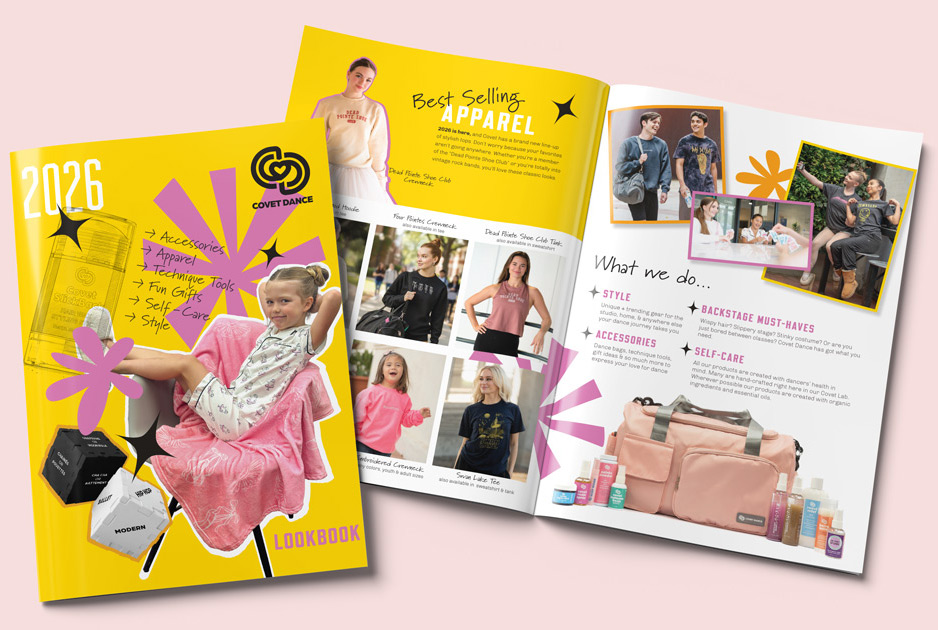
The 2026 lookbook makes the physical side of that relationship visible. Its yellow cover, pink accents and crowded product spreads belong to a retail world where a printed piece can sit alongside an online store. The portfolio also includes Covet Dance email work and fashion video. A visitor can follow the same client across formats instead of guessing how a single attractive image might translate elsewhere.
For a business commissioning design, that is a useful way to examine an agency. Look for several applications of one client’s identity. A compelling homepage is one thing; a recognizable family of materials asks a different set of questions about judgment, repetition and restraint.
The pocket folder has company
Pi Design’s work list puts apparently distant clients next to one another. AeroVironment appears with a pocket folder and email newsletter. Joffrey Ballet School appears with printed promotional materials. Studio Channel Islands has both a brochure and a website in the archive. The variety matters because it shows the studio working with different kinds of information, audiences and occasions.
The PDRMA portfolio adds another rhythm: annual reports identified as 2023, 2024 and 2025. An annual report is an edition-based assignment, with the year built into the object. Seeing successive editions offers a buyer something a lone showcase cannot: the opportunity to compare how a studio approaches a recurring communication task.
Another small project deserves attention. Pi Design’s Decore-ative Specialties booklet is described as a tool for training employees on software, with the company’s branding maintained throughout. The audience here is inside the business. It is a reminder that graphic design also has to help people navigate instructions, not merely persuade them to buy.
These examples place Pi Design in the market for custom creative services. Its offering includes brand identities, print collateral, websites, photography and moving images. The appeal suggested by the portfolio is continuity across those jobs: a client can bring another communication problem to a team already familiar with its visual language.
Fifty feet of technical-product storytelling
Print gives the portfolio much of its texture, but a Santec testimonial supplies a rather larger canvas. Kate Torrence describes commissioning videos for screens more than 50 feet across. She praises the questions asked during the process and the way Heber brought interest to a technical product. This is a client’s assessment, published by the studio, and it offers a specific glimpse of the brief.
Screen size described by Santec’s Kate Torrence for a Pi Design video assignment.
Large displays make an instructive companion to the business card. One gets a passing glance at close range; the other has to communicate at an entirely different scale. In both cases, the useful design question begins with how someone will encounter the material. Dimensions are part of the brief, not a final export setting to consider after the composition is finished.
Other testimonials emphasize an ongoing working relationship. Sun Air Jets’ Alex Fisher calls Pi Design part of the company’s marketing team. Lee Strategy Group’s James Lee describes using the studio as a primary design vendor for more than a decade. These accounts support the picture of a recurring service relationship, although they are endorsements rather than independent measurements of commercial performance.
“Pi Design is an integral part of our marketing team.”
Alex Fisher, Sun Air Jets · company-published testimonial
The useful pause before production
Pi Design names four stages in its working process: Discover, Define, Develop and Deploy. Research and requirements come first. Concepts follow, with client and designer agreeing on a direction before implementation. Reviews and approvals continue during production. The sequence is straightforward; its practical value lies in when decisions get made.
Delivery then depends on the medium. For print, the studio describes overseeing the schedule and conducting press checks. For websites, it describes quality assurance, moving the work into the live environment and checking data interchange. The approved design has to survive its journey into use.
A buyer can copy the underlying discipline without copying a single visual idea. Put the audience, intended action, required formats and decision-maker into the brief. Ask what must be agreed before production begins. Then identify how the finished piece will be checked in the place it actually has to work.
That approach asks something of the client, too: attention, timely decisions and a willingness to discuss the brief. A company that simply needs a standard template filled tomorrow should weigh that narrower task against a custom engagement. A business with specialized software requirements should evaluate technical capability separately from visual appeal. Those are purchasing distinctions, not judgments about the quality of a portfolio.
The people behind the very precise percentage

Lewis holds a bachelor’s degree in industrial design from California State University, Long Beach, according to the company’s team page. That background adds context to a practice whose work crosses objects, print and screens. The biography also makes an unusually precise joke about her expectations: 113.1415 percent. Pi gets its decimal places in.
The same page introduces graphic designer Joel Dualan through a joke about wanting to leave programming behind, only to find his technical skills useful at the studio. Brooklyn Juve is listed as a social media strategist and content creator. Together, the biographies put recognizable tasks behind the service menu: design, web implementation and the steady work of creating material for social channels.
The voice is deliberately informal. Elsewhere in the archive, a 2015 post shows Heber’s hand-lettering process, and another shares Vanessa’s pumpkin pie recipe. Neither establishes a workplace policy or a business advantage. Both make the studio feel inhabited. A visitor encounters people with interests beyond their project categories.
Buy the assignment, then judge the fit
For a prospective client, Pi Design is most legible through an actual assignment. A retailer can examine the Covet Dance work. An organization preparing an annual report can compare the PDRMA editions. An arts organization can look at the museum and studio websites alongside the ballet materials. The next conversation can start with a relevant example instead of an abstract request to make the brand look better.
Budgeting should follow that same specificity. Define the deliverables, rounds of revision, photography needs, production responsibilities and any continuing website work before comparing proposals. A catalog, a store and an ongoing stream of content place different demands on a studio. Treating them as interchangeable units of design makes the purchasing decision less useful.
The practical comparison is between ways of getting the work done. An independent designer may suit a tightly defined visual task. An internal team brings daily access to colleagues and decisions. A specialist web studio can be assessed against a particular technical brief. Pi Design’s portfolio invites consideration when the assignment crosses several of these boundaries and the buyer wants to discuss them together.
That makes the initial conversation consequential. Bring examples of existing materials, explain which ones still work, and identify where customers get confused. A useful proposal should connect the requested work to that specific problem. The result can then be judged against the brief: whether the information is clearer, whether the materials feel related, and whether the finished output meets the agreed requirements.
Pi Design’s business is grounded in those tangible outputs. Its strongest argument is the distance it travels within a client’s visual world, from the thing being sold to the materials that introduce it. The business card on the porch remains a fitting place to end up: a small object, carrying a surprisingly large expectation.