Beside a bank of elevators on a BioMarin campus, a wall turns purple, then pink, then orange. Across it are dates, medical milestones and a diagram of the company’s reach. Someone waiting for the lift can take in a little corporate history without opening a document. The elevators supply the pause. The designers supply something worth looking at.
The installation is part of Dragonfly Design Group’s work for the biotechnology company. Its team designed and installed large graphics across walls and windows, giving scientific achievements a physical presence in the workplace. There is something pleasingly practical about the location. A history that people might otherwise have to seek out now shares their route through the building.
That is a useful introduction to Dragonfly. The Los Angeles studio works across graphic design, websites, motion, presentations and print. Its portfolio invites a more specific description: it helps a message travel. A communications brief may arrive as an idea, but it leaves as the several things an audience will actually encounter.
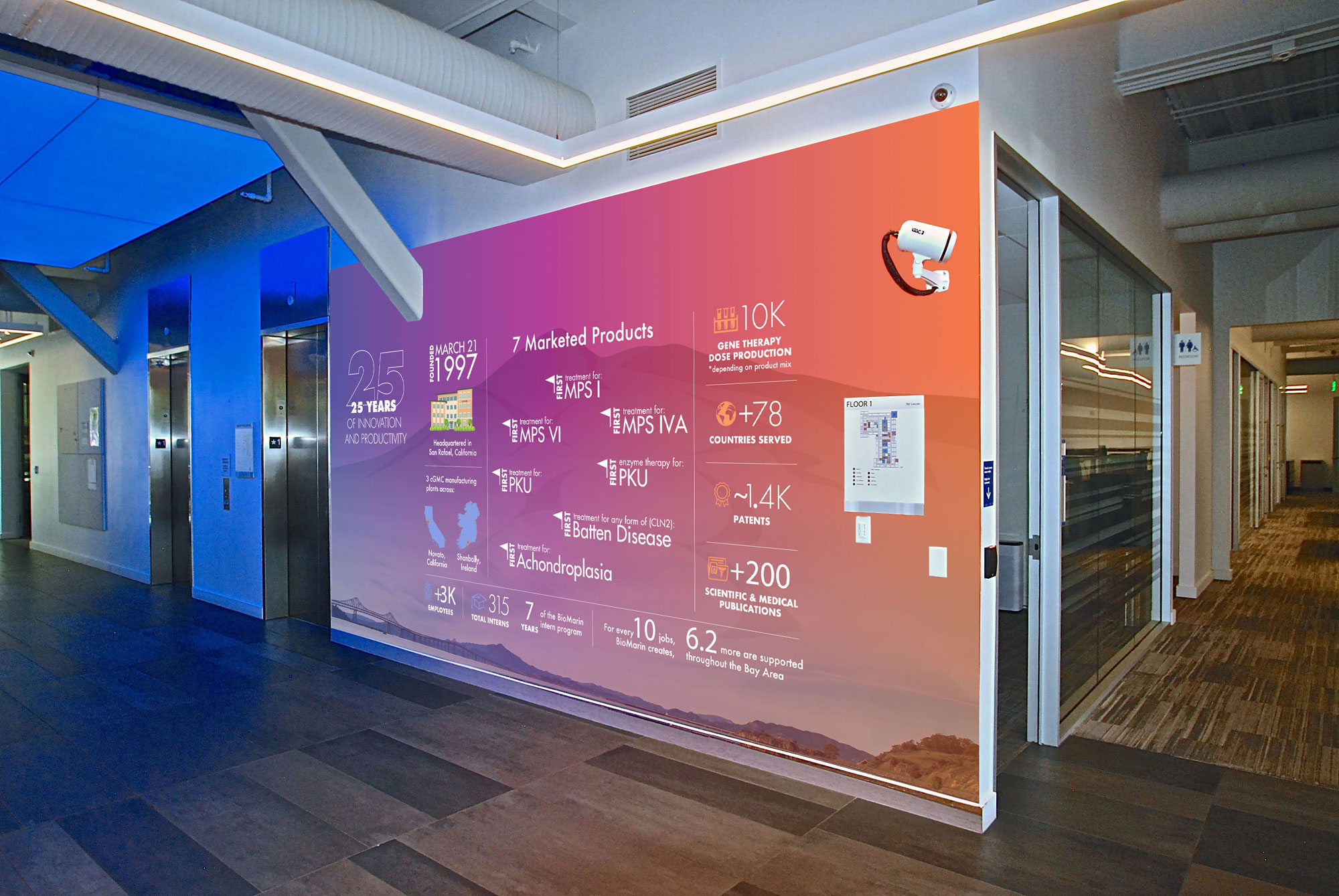
A company history beside the elevator
Consider another BioMarin assignment: celebrating approval of a rare-disease treatment. Dragonfly’s brief called for a giant window billboard, lobby banners, hats, an email invitation and artwork for digital monitors. The audience was inside the company. The occasion was a shared achievement.
Each object asks a slightly different question. Will the lettering work at the scale of a window? What survives on a hat? What belongs in an invitation? A brand can look coherent in a presentation and become surprisingly awkward once it has to occupy a building. In this project, Dragonfly carried the announcement across both the screens and the physical surroundings of the celebration.
worth sharing.
This is the practical argument for a studio with several disciplines. The client has one occasion to manage, even when that occasion produces a collection of files, materials and installation tasks. Dragonfly’s examples suggest a business built around those connections. Its creative work keeps company with production work.
The show that lost its room
A more unruly example begins with an awards event forced online by the pandemic. The original gathering could no longer happen in person. The client’s instruction, as Dragonfly tells it, was short: “Make it FUN!”
The studio built an opening video around a theatrical stage, animated leadership appearances and an original vocal track. Employees supplied homemade lip-sync clips. A rap worked the company’s drug names into its lyrics. The presentation used coordinated animated breaks; live presenters received physical backdrops and boutonnieres. Colleagues then gathered for a Zoom after-party with animated red-carpet backgrounds.
The detail to linger over is the boutonniere. Even after the room went away, the designers were still thinking about what a presenter would wear inside the camera frame. The change of venue had changed the production brief. The response reached into animation, music, slides and physical objects, all in service of the same gathering.
“Make it FUN!”
The client’s brief for an awards event moved online
The lesson here is about participation. Staff members became part of the opening entertainment, supplying material from home. For an internal celebration, that choice makes sense: the people watching have a reason to recognize the people on screen. A different audience would need a different invitation to care.
The agency behind the agency
Dragonfly’s customers include communications professionals with clients of their own. Merryman Communications, a healthcare marketing and public relations agency, hired the studio to refresh its identity for its tenth anniversary. Dragonfly reports that the work received a PRSA-LA PRism Award for Reputation/Brand Management and became a National SABRE Awards finalist.
That relationship helps locate Dragonfly in the market. A PR team may know the audience, the message and the moment, while needing a design partner to make the material. An internal communications department can have much the same need. The studio can occupy that production role without requiring the client to become an expert in every medium involved.
Its work also reaches smaller organizations. Kit Cole Consulting appears in the web portfolio, and Cole publicly credited Dragonfly with both her redesigned website and a video. Wilshire Grand Center is another listed website project. These are different clients with different settings, connected by the need to turn an identity into something people can use or watch.
Dragonfly sells commissioned services. Its menu includes custom WordPress development, hosting and maintenance alongside print, presentations and video. For a buyer, the choice is partly organizational: keep the work within an existing team, assemble individual specialists, or give several related deliverables to one studio. The portfolio makes the last option tangible.
The founder who stays through production
Peter Godefroy, Dragonfly’s founder and president, describes a role that begins with evaluating a client’s communications needs, budget scenarios and timetable. After a concept is approved, he and a project manager oversee revisions, art direction, final production, print supervision and digital publication. The promise includes attention to the work after the exciting presentation is over.

The team page gives that range names and jobs. Paul Rickey is creative director; Aaron Trask leads video production and animation. Tania Leach works as an art director and creative lead in Valencia, Spain, while Frank Haubrich handles interactive development and web production from Germany. The roster spans creative direction, design, programming and production across time zones.
Those details support an interpretation of Dragonfly’s appeal: continuity. A client can keep discussing the same project while the work moves between specialties. That is particularly useful when the deliverables are related but the production requirements are different. A slide, a website and an installed graphic share a brand; they do not share a file specification.
Two deadlines, one useful lesson
For a glimpse of the studio’s working assumptions, read its job request form. It asks whether the content is ready, whether brand guidelines apply and whether the deadline is same-day or next-day urgent. It asks for a time zone. It also separates the first-draft deadline from the final deadline.
Presentation questions get more granular: is the deck already in a template, does it contain many charts, are purchased images needed, and can designers see work before the complete deck arrives? These are the kinds of questions a buyer can copy immediately. They make the brief more useful before anyone opens a design application.
Put both dates on the calendar. Include the time zone.
A recent company account of a four-day explainer shows the same attention to constraints. Dragonfly says it simplified the illustration and animation approach, spent two days producing the storyboard and the remaining two on animation, using AI in parts of the process. The account describes a scope decision: choose a visual approach that can be completed within the available time.
The useful principle is modest. Decide what the audience needs to understand, establish what has to be delivered, and make room for review. Speed depends on choices made before production as well as during it. Back at the BioMarin elevators, the finished wall looks like a single object. Getting a message to that point is the work Dragonfly is selling.
See the work in its own habitat
Explore Dragonfly’s website, its project portfolio and video work. Follow the studio on LinkedIn or Instagram, or start with the project request form.
A closer look: BioMarin campus graphics · The streamed awards show · Merryman’s identity refresh · Kit Cole’s project post