On a tennis court, the smallest sounds are often the most revealing: the pop from the center of the strings, the scrape of a shoe before a change of direction, the hush that says everyone has noticed the point getting interesting. Carolyn Pollock’s new job begins with a similar act of attention. As chief marketing officer of Wilson Sporting Goods, she is responsible for hearing what athletes make of a company whose equipment has been part of games for more than a century.
Her brief is global brand and consumer engagement. In corporate language, that means strengthening brands and product stories, deepening consumer connections, and making marketing investments work harder. In plain language, it means answering a lively question: how does a familiar name remain personally relevant when its products range from a child’s first ball to equipment used on professional courts and fields?
Pollock offered her own answer after her first week at Wilson in 2026. She wrote that she wanted to put the customer at the center and build stronger connections with athletes, “from the pros to the rest of us who just love the game.” The sentence contains her whole approach. Prestige matters. Participation matters more. A brand becomes real when somebody uses it.
The scientist who chose the moving target
Marketing was not the obvious destination. Pollock earned a biology degree with a specialization in genetics at the University of British Columbia. She loved bioscience and knew she did not want to become a doctor. Her wonderfully practical reason was that she could not handle the sight of blood. Genetics gave her the discovery without the operating room.
The timing mattered. Human-genome research was moving so quickly that, as she later recalled, students relied on current papers rather than textbooks. The curriculum could not be bound before the field changed again. Pollock was drawn to that newness, to knowledge still arriving. Looking back, she recognized a pattern: much of her career has involved stepping toward things that are not finished yet.
She began in consumer marketing at Unilever and Labatt Breweries, part of Interbrew, then held leadership roles at eBay and Timbuk2. The categories changed, but the education accumulated: packaged goods discipline, a marketplace built on trust, and a San Francisco bag brand with a strong sense of tribe. Rather than settle into one corporate ladder, she built range.
A decade of borrowed problems
For more than ten years, Pollock worked as a consultant and interim leader. Her assignments included large companies such as Meta, eBay, and Dolby, as well as Thumbtack, Dashlane, One Kings Lane, and other growing businesses. She later became a managing partner at RevelOne. Consulting gave her an unusual advantage for an operator: she learned to enter a room without pretending the room was simple.
She has described the habit as getting to the nub of a problem without becoming tangled in everything orbiting it. She also carried a client-service mentality into leadership. The customer is the first client, but the team matters too. “Good ideas come from anywhere,” she has said, a conviction reflected in her emphasis on creating room for contributions from associate managers through vice presidents.
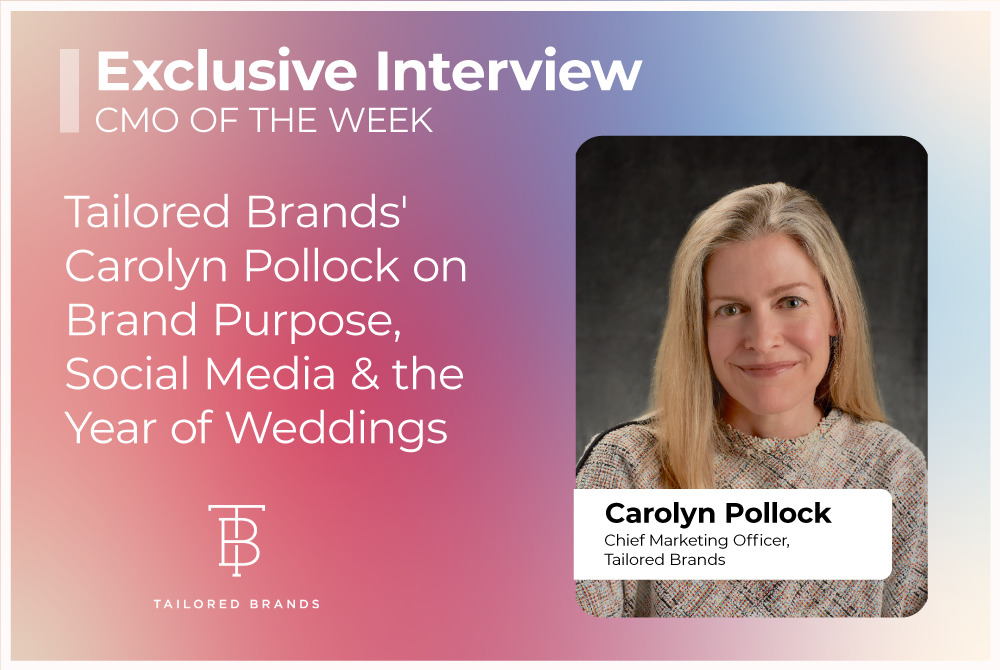
One of those consulting clients became the defining operating chapter of her career. In 2020, Tailored Brands named Pollock chief marketing officer across Men’s Wearhouse, Jos. A. Bank, Moores, and K&G. The appointment arrived just as retail entered a period when suits, weddings, proms, offices, and stores all became uncertain at once.
The tuxedo, the church, and the spreadsheet
The work was not a tasteful brand exercise conducted at a safe distance. Tailored Brands went through Chapter 11 during the pandemic. Pollock’s team had to rethink the marketing mix while the business itself was being remade. Broadcast-heavy spending shifted toward a more balanced combination of television, online video, search, social, display, and affiliates. Customer behavior, not channel tradition, set the route.
There was still room for human drama. During the wedding rush of 2022, supply chains tightened and rental inventory sometimes arrived close to the ceremony. Pollock told of store managers personally driving tuxedos to churches. That little journey is her party metaphor made literal. An advertisement may promise confidence for an important moment. Somebody still has to deliver the jacket before the vows.
Pollock later said the company emerged operationally stronger and that the discipline forced by restructuring would stay with her. When she announced her departure after five years, she credited the team with guiding the brands through the pandemic and bankruptcy into three company performance records. She also pointed to a rebuilt marketing-technology roadmap, stronger budget efficiency, and continuing gains in return on investment.
The figures matter because Pollock does not present brand and performance as rival religions. She has used media-mix modeling and matched-market tests to build confidence in upper-funnel spending, then fed results back into future choices. Emotion earns a place at the table. Measurement keeps the seating chart honest.
One good experience versus 50 emails
Pollock’s definition of brand begins with relationships. People do not value a friend because that friend reliably supplies 20 percent off. They value challenge, interest, laughter, and trust. Brands, in her account, also gain strength through emotion and consistency. The difficulty is that the human part is stubbornly hard to compress into a dashboard.
Her skepticism toward easy metrics is clearest on traffic. A marketer can buy eyeballs and send a great many people toward a store or website. If they are the wrong people, volume is an expensive decoration. Quality and conversion have to travel together. The same logic shapes her view of loyalty: one singular, meaningful experience can outweigh 50 emails. Frequency is not the same as a relationship. Anyone with an overenthusiastic inbox already knows this in their bones.
The Pollock playbook
- Start with what the customer is already inclined to do.
- Connect brand, performance, technology, creative, and experience.
- Measure what can be measured without pretending it is everything.
- Give teams enough room for ideas to come from anywhere.
- Make the experience as good as the invitation.
The case for the generalist
Modern marketing can resemble a row of neighboring workshops whose occupants rarely borrow one another’s tools. Brand strategists, performance specialists, technologists, analysts, and creative teams develop their own dialects. Pollock worries that the CMO can become the only person responsible for connecting the dots. She advises younger marketers to consider lateral moves, not only promotions within a specialty, and learn how the whole mix works.
Artificial intelligence makes that breadth more valuable. Pollock co-led Tailored Brands’ AI Council and was named to the 2025 AI Trailblazers Power 100. Yet her public comments on AI are notably grounded. The point is not novelty. The point is financial and customer impact, built on sound data. AI can generate creative at a volume no brand manager could review one item at a time. That requires a clear foundation, useful constraints, and a willingness to surrender a little control.
She makes the same argument about creators. A rigid script can drain the authenticity from the person hired to interpret a brand for an audience. Set what the brand stands for and whom it serves, then permit some movement inside those lines. It is a scientist’s compromise: control the conditions, observe honestly, and do not bully the result.
A century of equipment, one athlete at a time
Wilson is a fitting next laboratory. Founded in Chicago in 1914, the company spans tennis, baseball, basketball, football, golf, volleyball, pickleball, padel, and more. Its portfolio includes DeMarini, EvoShield, Louisville Slugger, ATEC, and a distribution agreement with Luxilon. It sells equipment, apparel, footwear, and accessories through a web of retail, direct-to-consumer, wholesale, and team relationships. It has scale, history, and quite a lot of leather.
The challenge is not awareness alone. Sporting equipment holds two kinds of value at once. There is the measurable object: weight, material, tension, shape, durability. Then there is the private association: the glove broken in over a summer, the basketball heard late into the evening, the racquet present for the first serve that finally behaved. Specifications invite purchase. Memory creates affection.
Pollock’s career has prepared her for that junction. Packaged goods taught consistency. eBay taught systems and trust. Consulting taught diagnosis. Tailored Brands made customer moments operationally urgent. Genetics gave her an early comfort with incomplete knowledge. At Wilson, all of it converges around people who play, whether a stadium happens to be watching or not.
She has said Wilson has room to grow brand love globally. Love is a brave word for a spreadsheet, which is precisely why it is useful. It cannot be purchased by the ton or summoned by sending the fifty-first email. It grows when the message, the object, and the experience agree with one another.
A century-old company can talk endlessly about its past. Pollock appears more interested in what that past permits next. The job is to listen for the clean hit, notice who is holding the racquet, and make sure the promise travels all the way through the strings.