Company File / Footwear / New York
Margaux
The shoe brand that refused to make women choose between a shoe that fits and a shoe they love.
The shoe brand that refused to make women choose between a shoe that fits and a shoe they love.
It is a small, almost suspicious moment. A customer lands on margauxny.com, picks a flat, and is asked something most shoe sites never bother to ask: how wide is your foot, really? Narrow, medium, or wide. She answers. A fit concierge stands by if she hesitates. The shoe arrives, and it fits - not “close enough,” not “they’ll stretch,” but fits.
That quiet competence is the whole company. Margaux is a New York footwear brand that handcrafts women’s shoes in a family-owned factory in Spain and sells them directly to the people who wear them. It carries roughly US 3 to 14 across three widths - one of the broadest size ranges in the business - and treats that range not as a charity drive but as the point. The brand is female-founded, women-led, and unbothered by the idea that a beautiful shoe and a comfortable one might be the same object.
Most footwear brands sell shoes. Margaux sells fit, and happens to make the shoes gorgeous on the way there.
“We’re intent on creating a more inclusive luxury footwear industry.”Alexa Buckley, Co-Founder
For decades the deal was simple and quietly insulting. You could have a shoe that looked the part - and limp home. Or you could have one that felt fine - and looked like it had given up. Style or comfort. Pick one. Add the fact that “women’s size” usually meant a single width built for an imaginary average foot, and the math got worse for anyone narrow, anyone wide, anyone real.
The industry called this normal. It was, in fact, just unexamined. Shoes are one of the few products sold to half the planet that routinely ignore the actual shape of the customer. Margaux’s founders noticed the gap not in a boardroom but in fitting rooms, as customers themselves, coming up empty.
“There’s a certain magic in striking the perfect balance of form, fit and function.”Sarah Pierson, Co-Founder
FIELD NOTE: The radical idea here is not technology. It is measuring the foot before selling the shoe - a courtesy the industry somehow filed under “optional.”
Alexa Buckley and Sarah Pierson met by chance at a college cab stand - the kind of origin story that sounds invented until you meet the people. They became roommates, then best friends, then, straight out of Harvard, business partners. Buckley has cited Sheryl Sandberg’s commencement question as the nudge: what would you do if you weren’t afraid? Apparently the answer was “start a shoe company at 22 with no factory and a lot of opinions about ballet flats.”
They launched Margaux in 2015. The bet was not that they could design a prettier shoe - plenty of people can - but that fit and width, treated seriously, were an underserved market hiding in plain sight. They spent years with technical designers and European manufacturers engineering shoes that delivered tailored fit without surrendering form. Then they found a family-owned factory in Spain’s traditional shoemaking region and stayed - a partnership now roughly a decade deep.
Co-Founder & Co-CEO. The voice behind Margaux’s push for a more inclusive luxury footwear industry.
Co-Founder & Co-CEO. Obsessed with the balance of form, fit and function in every last seam.
CAPTION: They met at a cab stand. Most great partnerships start somewhere less photogenic, so we’ll allow them this one.
Buckley and Pierson found Margaux in New York, built around a single complaint: there were no shoes that were both beautiful and comfortable.
The brand settles into a family-owned factory in Spain, engineering multi-width fit and what becomes its signature flat, The Demi.
Margaux raises a Series B led by Ames Watson, part of roughly $10.3M raised across its life, to scale the catalog.
A refreshed identity and new primary logo arrive as the line broadens beyond flats.
Boots, sandals, heels and collaborations (including one with Alex Mill) widen the range without losing the fixation on fit.
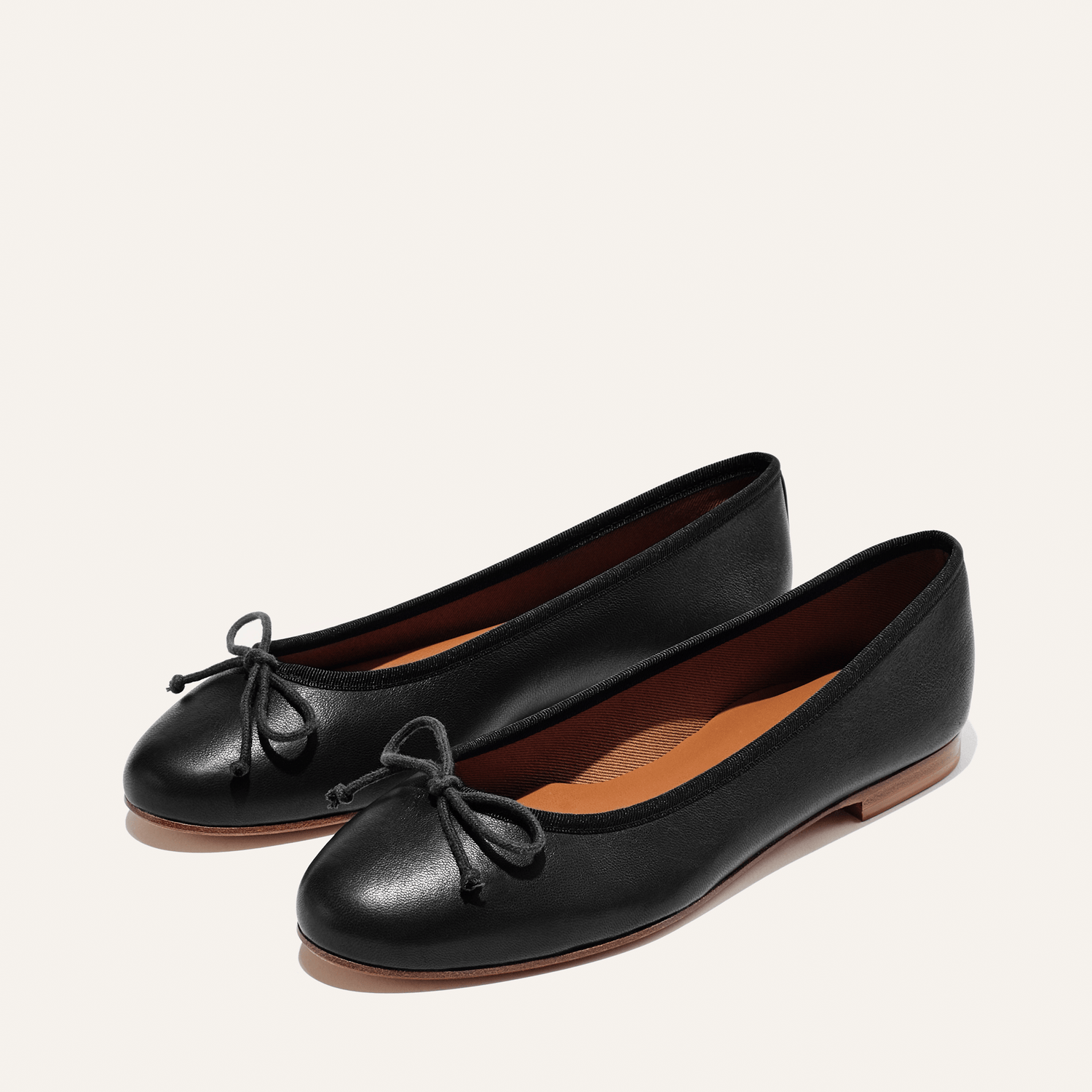
Margaux’s bestseller looks like a classic French ballet flat - rounded toe, an adjustable cord bow, soft Italian nappa leather. Charming, unremarkable from across a room. The trick is what you don’t see: 5mm of plush foam padding, a structured insole, and the choice of narrow, medium or wide. It is a shoe designed to disappear on the foot, which is the highest compliment a shoe can earn.
Around it sits a full catalog - loafers, semi-ballerinas, heels, sandals, boots like The Downtown Boot - all designed in New York, all handcrafted in Spain, nearly all offered across widths. Margaux is one of the very few shoe brands to bother with that last part. The competition treats width as a niche. Margaux treats it as table stakes.
“The shoe Vogue is obsessed with.”On The Demi, Margaux’s signature flat
CAPTION: 5 millimeters of foam does not sound like a competitive moat. Wear them for ten hours and report back.
Skeptics should look at the numbers, not the adjectives. The Demi alone has gathered more than 1,400 reviews at roughly a 4.8 average - the kind of figure you cannot manufacture with a clever campaign. Customers do not write paragraphs about shoes that merely look nice; they write them about shoes that fixed a problem they had stopped expecting anyone to solve.
Investors noticed too. Margaux has raised roughly $10.3M across its life, including a 2022 Series B led by Ames Watson, with earlier backing from firms including Darco Capital, D.Luxury Brands, Jackalope Ventures and Feenix Venture Partners. The thesis was never “another shoe brand.” It was “fit is a market, and almost nobody is serving it well.”
METHOD: Bars are directional, drawn from public review signals on margauxny.com. Read them as “people are genuinely happy,” not as a lab report.
Margaux organizes itself around four plain commitments: put people first, partner closely with its family-owned Spanish factory, take environmental responsibility seriously, and support women. None of that is unusual to say. What’s less common is the follow-through - a factory running on 100% renewable energy, components sourced locally, and a stated focus on ethical labor and sustainable wages.
The size range belongs in the same column. Offering US 3 to 14 across three widths is operationally annoying and commercially generous; it means more inventory, more complexity, more ways to get it wrong. Margaux does it anyway, because the alternative is telling a chunk of customers that their feet are the problem. The brand declined to send that message.
“Go comfortably, stylishly, and confidently.”Margaux’s standing invitation to its customers
Personalization is the direction every consumer brand swears it’s heading. Margaux has been quietly doing the unglamorous version of it for a decade: not an algorithm guessing your taste, but a company asking the width of your foot and then actually making the shoe. As more shoppers refuse to accept “close enough,” the brands built around real fit will look less like a niche and more like the baseline.
Return now to that customer at her laptop, choosing a width without thinking twice. A few years ago that moment would have been remarkable. Margaux’s ambition is to make it forgettable - to render “a shoe that fits the first time” so normal that no one writes a 4.8-star review marveling at it. The company exists to put itself out of the surprise business.
A great shoe should fit, look good, and last. Margaux’s real product is treating that as obvious.