Profile / Footwear / Vol. 01
Joe Vernachio
A 37-year product lifer running the wool-shoe brand the public market once loved, now learning how to love it again.
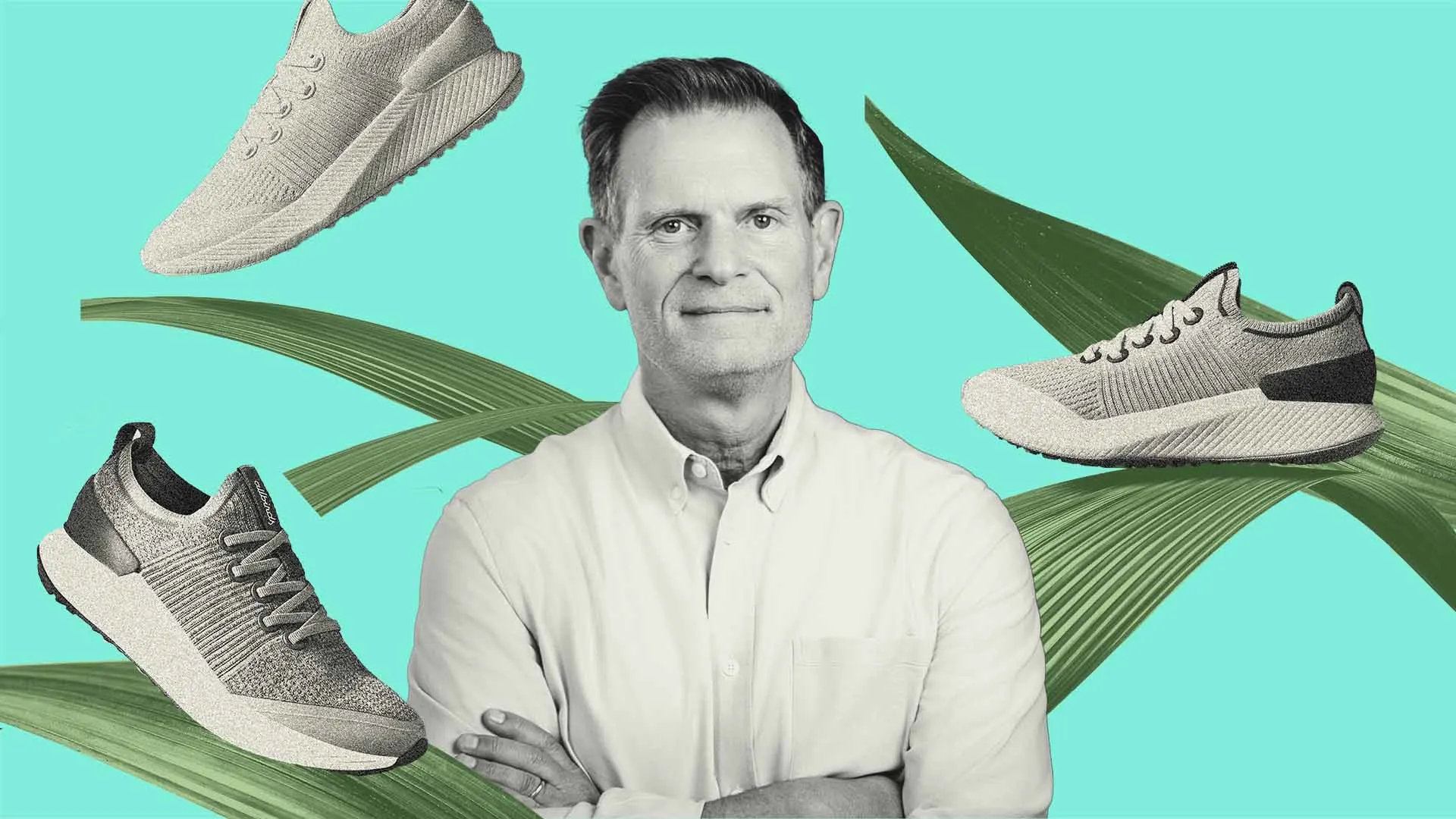
Joe Vernachio - the quiet operator, mid-stride.
A 37-year product lifer running the wool-shoe brand the public market once loved, now learning how to love it again.
Walk into the Montgomery Street office on a Tuesday and Joe Vernachio is probably looking at a shoe. Turning it over. Pressing the foam. Talking, in that specific way product people talk, about what is wrong with it and what would be better.
He runs Allbirds now. Has since March 15, 2024, when the board handed him the corner office and a seat at the table, and the co-founder who built the company stepped aside. The press release used the word "veteran." It was being polite. Vernachio had been making and selling shoes and jackets and gear in this industry since the late eighties, when most of his current direct reports were not yet alive.
The pitch, both for the job and for the turnaround, was continuity. He had been Allbirds' Chief Operating Officer for three years. He had quietly run the unglamorous half of the business - inventory, distribution, the painful, necessary transition to a distributor model overseas. He knew where the bodies were buried because he had buried some of them himself.
The arc of his career bends toward the cold. Paul Smith's College in the Adirondacks, a small forestry school next to a chain of lakes the locals know by number. An associate's degree in Forest Sciences and Biology. From there, the route looks improbable on paper. A 1987 job as a product manager at Chouinard Equipment - the climbing-gear company Yvon Chouinard had built before it split into Black Diamond. Then Patagonia, as a product line manager, when Patagonia was still a place a product line manager could be a single person.
Then Nike. Twelve years there, working in product development and category management, helping launch the company's branded outerwear program. Then Roots Canada, four years, vice president of product for the 120-store retail chain that put a beaver on a sweatshirt and sold it to half of Toronto. Then Spyder Active Sports, six years as COO and senior vice president of product and sourcing. Then The North Face, seven years as global vice president of product and operations. Then Mountain Hardwear, where in 2017 Columbia Sportswear made him president. Four years. The brand went from declining sales and losses to growth and profitability. He left as a guy who fixed things.
Allbirds hired him as COO in June 2021. The company had gone public that same year on a story about wool and sugarcane and a different way to make a shoe. The stock peaked, and then it did not. Inventory piled up. International expansion got complicated. Stores opened, stores closed. By 2023 the company had given Vernachio commercial and international oversight in addition to operations. By March 2024 it gave him everything.
The plan he has been describing on earnings calls is uncomplicated, which is a different thing from easy. Three focus areas: product, marketing, experience. Sharper. More focused. A modern lifestyle footwear brand. "Those who already know Allbirds will see a sharper, more focused brand," he told analysts. "And for those discovering us for the first time, they'll find a modern lifestyle footwear brand that connects on a rational, emotional and cultural level." Whether it works is, of course, the question.
The fall 2025 lineup, in his telling, is the inflection point. "Our fall '25 lineup will bring a much broader range of products and colors than the year before, and we can't wait to get them on people's feet." On the same call he added, more carefully, that "it's undeniable that the products we've introduced over the past several quarters are the strongest we've delivered since the early days of the brand. The team has done an outstanding job creating a line that will serve as the foundation for years to come." That is a CEO talking about his own line. Of course it is the foundation for years to come. The interesting question is whether the customer agrees.
To make room, Allbirds has been doing the unglamorous half again. Exiting unprofitable retail doors. Closing remaining U.S. stores as part of the turnaround. "This is an important step for Allbirds, as we drive toward profitable growth under our turnaround strategy," Vernachio said when the closures were announced. "We have been opportunistically reducing our brick-and-mortar portfolio over the past two years. By exiting these remaining unprofitable doors, we are taking actions to reduce costs and support the long-term health of the business." Translation: the brand will live on shelves it does not own, and on screens.
There is a type of executive who comes up through finance and learns to talk about product. Vernachio is the opposite. He came up through product and learned to talk about finance. You hear it in the way he describes the next collection - by silhouette, by colorway, by what the foot does - before he gets to the gross margin implications. He helped launch Nike's outerwear. He sourced for Spyder. He turned around Mountain Hardwear by editing the line and tightening distribution. The instinct is to make the thing right, and then sell the thing.
The thing, in this case, is a shoe brand that once felt new and now has to feel new again. The original Allbirds wool runner was a category-creator, the sneaker that snuck into the Silicon Valley uniform and then walked out into the world. It got copied. The brand expanded into apparel and back out of apparel. It tried performance running. It tried fashion. It went public. It got humbled. It has spent the last several quarters trying to remember what it was originally good at.
That is the brief Vernachio inherited. Refocus. Edit. Tighten. Ship. He has said publicly, more than once, "never let a crisis go to waste." It is the kind of line CEOs say in interviews. In his case, given the resume, it is also probably what he actually thinks.
Read that list a second time. Each entry is a brand that someone, somewhere, has tattooed on themselves. Vernachio has had a hand in nine of them. He helped Nike start making jackets. He sat at Roots when Roots was the most Canadian thing in Canada. He ran Mountain Hardwear when it needed running. The North Face years, 2011 onward, put him in Alameda as global VP of product and operations, the title that means you fly to factories more than you sit at your desk.
None of this guarantees anything about Allbirds. Turning around a public company is a different test from running a private brand inside a strategic owner. The capital markets are louder. The board is bigger. The clock is faster. But you would struggle to design a CV better suited to the brief.
Strip the language away and the project is small. Build a smaller number of better shoes. Tell the story more clearly. Sell them in places where Allbirds is welcome and stop subsidizing places where it is not. Spend less. Make more per pair. Repeat until profitable. The detail is in the execution.
The product team, in his telling, has been busy. New silhouettes. Broader color range. More volume on the items that actually work. The marketing has shifted toward "rational, emotional and cultural" - which is the kind of phrase that means almost anything until you see the campaign, at which point it means something specific. The experience side is largely about wholesale, e-commerce, and the diminished store footprint. Three legs of a stool the company has been re-engineering in public.
And underneath all of it, the sustainability premise remains. Allbirds was built on merino wool, sugarcane-based foam midsoles, eucalyptus tree fibers, recyclable packaging and a B Corp certification. The brand became famous for telling you the carbon footprint of every shoe right on the tongue. Vernachio has not, by any public account, walked away from that. He has reframed it. Sustainability without product-market fit is a press release. Product-market fit without sustainability is everyone else.
The improbable through-line, if you want one, is forests. Paul Smith's College sits on a lake in the Adirondacks and trains the kind of student who wants to know what's growing where. Forest sciences. Biology. Vernachio took an associate's degree there and walked into Chouinard Equipment, the company a climber had built to sell pitons and ice tools to other climbers. From climbing gear to climbing apparel to outerwear to footwear, the connecting tissue is materials. What things are made of. Whether they last. How they feel against skin. How they decompose, or do not. He has been working that problem since 1987. Wool sneakers were always going to find him.
By the time this is published, the fall 2025 product slate will have either landed or not. The remaining U.S. stores will have closed. The new wholesale partnerships will have shipped their first orders or returned them. Wall Street will have either started to price in a turn or decided not to. Vernachio's job is to keep the company alive long enough for the product to do its work. He has done this before, at smaller scale, at Mountain Hardwear. He is doing it again here, in front of an audience that includes the public markets, a couple thousand employees, and every person who ever paid $98 for a pair of wool runners and then quietly bought a second pair.
It is, by any measure, a real test. A 37-year career narrowing down to a single thesis: that a product person, given enough rope, can re-teach a brand how to behave. The shoes will tell us.
"As our three key focus areas of product, marketing and experience come to life, the changes we have made will be impossible to miss."
"It's undeniable that the products we've introduced over the past several quarters are the strongest we've delivered since the early days of the brand."
"This is an important step for Allbirds, as we drive toward profitable growth under our turnaround strategy."
"Never let a crisis go to waste."
He has an associate's degree in Forest Sciences and Biology from a small college on a lake in upstate New York. The footwear came later.
His 1987 hire was at Chouinard Equipment, the climbing-gear company built by the founder of Patagonia. He went to Patagonia next. The pattern was set early.
He attempted Everest in the autumn season, which is unusual. Conditions were colder and windier. The Icefall took close to a month. He did not summit. He talks about it cleanly.