The most consequential object in the Cross Colours story may be a belt. In the late 1980s, Carl Jones and Thomas “TJ” Walker rode the New York subway from Harlem to Brooklyn and watched young men cinch enormous trousers around smaller waists. A pair built for a 38-inch body might be hanging from a 30-inch frame. The fashion business could have read that as bad fit. Jones and Walker read it as product research.
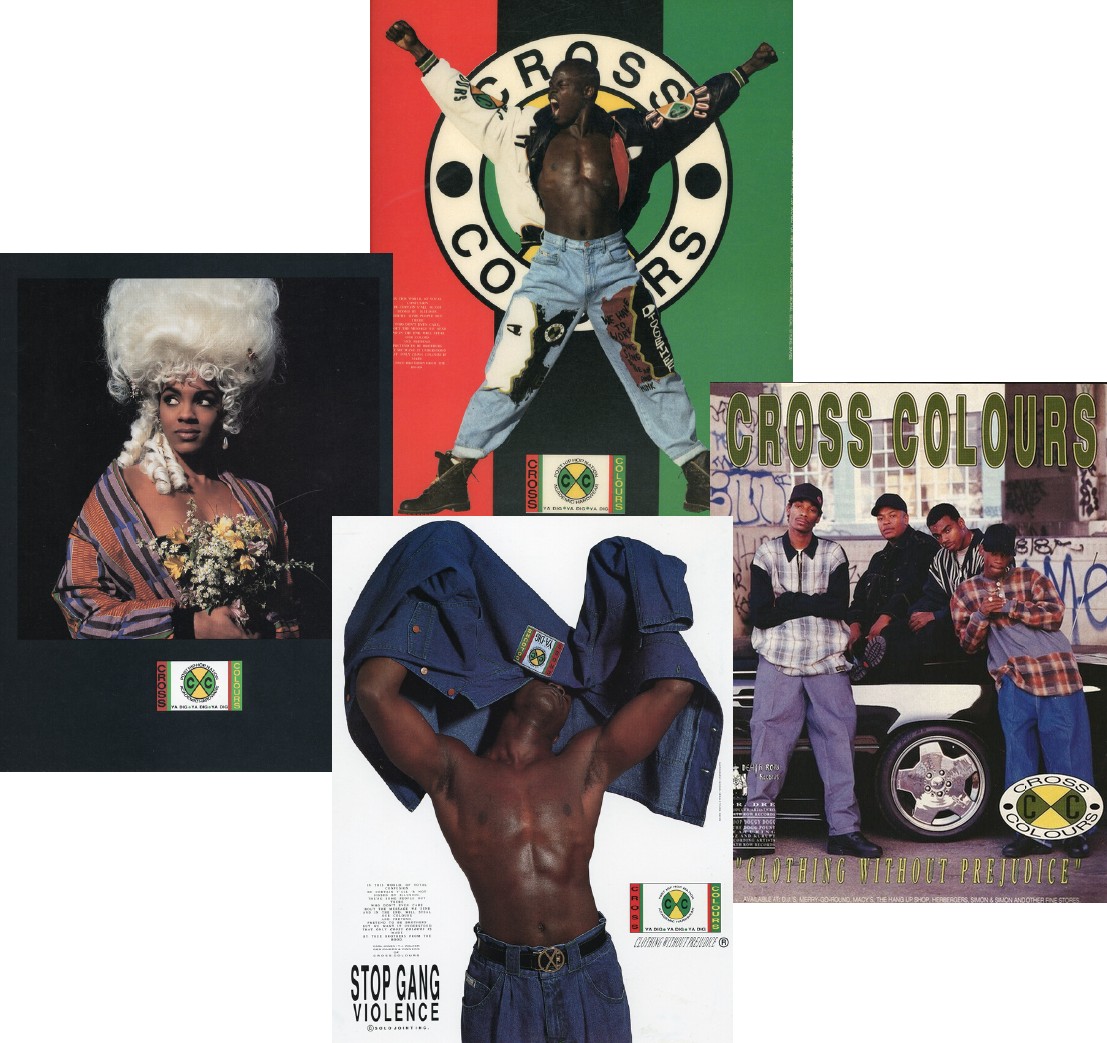
They returned to Los Angeles with a peculiar specification: preserve the volume, fix the waist. A size-38 body on a size-32 waistband led to an oversized jacket, which demanded an oversized shirt. Soon there was a system - loose silhouettes, hard blocks of red, black, green and yellow, African references, and statements such as “Stop D Violence,” “Educate 2 Elevate” and the durable company line, “Clothing Without Prejudice.” Cross Colours did not ask a trend forecaster to invent a customer. It noticed that the customer had already invented the clothes.
The booth that brought the street indoors
The name arrived by detour. “Cross Culture” was unavailable, so the founders chose “Colours,” using the British spelling partly to distinguish the label from Colors, the 1988 film about Los Angeles gangs. The altered name still carried their intended idea: unity across the lines that sorted people.
The clothes needed buyers. For the MAGIC menswear show in Las Vegas, Jones and Walker had three months to make samples and a reason for anyone to find them among thousands of booths. Contemporary reporting says they took a $175,000 bank loan; Jones sold a Ferrari and motorcycles and eventually leaned on an American Express card. In the company’s later account, his own total exposure reached $300,000.
They built a booth from corrugated metal, put it on casters and covered it with the grammar of a city street. The location was poor. The display was not. The founders remember roughly 80 people waiting outside and close to $20 million in orders by the end. A 1994 Los Angeles Times reconstruction records different show totals at different moments - $5 million at an early event, then $40 million during a peak week in 1992 - but agrees on the essential shape: the orders arrived at a speed the company had not been built to absorb.
“We treated our products like currency and factored it into our advertising costs.”Carl Jones, on the brand’s early product seeding
Influence before the invoice
Retail buyers had worried that the collection was too Afrocentric. Cross Colours found a second jury. Its team delivered clothes to the wardrobe department of The Fresh Prince of Bel-Air. Will Smith liked them. Within days he was on television wearing them, and record companies began sending artists to the label. Cross Colours gave away piles of product to dancers, actors and musicians, recording the garments as advertising.
That move is often described as influencer marketing before influencer marketing. The phrase is accurate but too tidy. The trick was not free merchandise. It was alignment. Cross Colours was already making the shapes young artists wanted, speaking about the communities they came from, and producing a palette a viewer could identify on a boxy television. The wearer supplied fame; the garment supplied recognition. TLC, Tupac Shakur, Snoop Dogg, Mary J. Blige, Stevie Wonder and the casts of In Living Color and The Fresh Prince turned repeated recognition into a category.


The customers were broader than celebrity. Cross Colours was designed explicitly for Black youth at a moment when mass-market apparel treated that audience as peripheral. The label solved a practical problem - how to buy the exaggerated silhouette as designed - and a representational one. Its makers put their own faces on hangtags. The message did not hide in a corporate responsibility report. It rode on the outside of the jacket.
What failed first was the machinery
Success stories like a clean villain. Cross Colours offers a messier and more useful set of failures. A dispute with Spike Lee’s company ended in a settlement that limited how long Cross Colours could use certain labels already in inventory. A former production executive told the Times that the company made too many garments to consume those labels. Retailers began sending clothes back.
Counterfeiting bit into demand. A truck carrying samples to the 1993 MAGIC show broke down, making the new collection late. The booth had been moved away from the main floor, confusing appointments. When the samples arrived, salespeople encountered earth tones, slimmer shapes and less of what made Cross Colours look like Cross Colours. Meanwhile, the sprawling internal operation had grown faster than its planning systems.
Four fault lines beneath the color
A qualitative reading of the 1993 pressure points, not audited company data: demand remained visible while production, concentration and a less recognizable collection raised the risk.
Then Merry-Go-Round, the 1,400-store chain that had been a major account, entered bankruptcy. The founders say millions of dollars in product could neither be paid for nor recovered to sell elsewhere. Operations shut down. The retailer’s collapse was the terminal blow, but it landed on a company already carrying returns, disputes and the cost of speed. The caution is specific: a huge order is not the same as a healthy distribution system. Revenue concentrated in one buyer can turn shelf space into credit risk.
Twenty years later, the customer called
Jones and Walker went in different directions. Jones built another clothing business; Walker taught. In 2014 they reunited because consumers were asking for Cross Colours again. That detail matters. They did not revive the label only because the 1990s had become photogenic. A generation too young to have bought the first run had inherited the look and the arguments printed on it.
A limited capsule of tees, fleece and a snapback gives the return a credible streetwear partner.
California African American Museum examines the brand’s garments, media and ephemera as Black fashion history.
A 30-piece Boyz N the Hood collaboration and a Nordstrom New York pop-up connect memory to new distribution.
A Black History Month editorial miniaturizes the look; a licensing agent is hired to carry the brand into more categories.
The current company sells graphic tees, denim, hoodies, leather jackets, hats, footwear, underwear, skate decks and basketballs online. It operates from accessible products - many artist tees are listed around $46 - to collector pieces, including leather jackets around $400. CXC Atelier sits at the crafted edge, producing limited wearable art with hand painting, embroidery, dyeing, leatherwork and reconstructed denim in Los Angeles. Wholesale retail, direct e-commerce, licensed imagery and collaborations now spread the risk that one giant customer once concentrated.
The part worth copying
Copying Cross Colours’ red, black, green and yellow would be easy and mostly pointless. The transferable work happened before the palette. The founders observed an improvised behavior, preserved what the wearer meant, and repaired what manufacturing could improve. They made the product recognizable at a distance. They seeded it with people who were credible to the intended customer. And they attached a sentence to it that could survive a season.
The subway offered better product research than a generic trend forecast.
Fix the waistband, not the oversized intention that made the styling interesting.
Give product to people whose audience, values and visual world already match.
Inventory discipline and diverse distribution matter before the crowd arrives.
This playbook fails when observation becomes extraction - when a company copies a community’s surface without serving it, hiring from it or sharing credibility with it. It also fails when the product is not visually distinct, when gifting substitutes for customer demand, or when operations cannot finance and fulfill a sudden wholesale wave. Cross Colours had cultural permission because Jones and Walker were designing from within the audience they addressed. That condition cannot be bought with a celebrity post.
The striking thing about Cross Colours is that the slogan outlived both the first company and the decade usually used to package it. The colors can be called retro. The proposition cannot. Make the ignored customer the center, make the values visible, and make the product good enough to carry both. Then, if the orders come, make sure the machinery is less improvisational than the pants that started everything.
Official channels, archive and interviews