The five seconds that launched Fuego happen at the edge of a dance floor. Street shoes off. Dance shoes on. Regular sneakers grip too hard when a salsa dancer turns; traditional suede soles spin nicely but should not meet a wet sidewalk. So a dancer carries a second pair, performs a tiny costume change and gets on with the night. Kevin Weschler found this ritual absurd. More importantly, he found it specific.
Weschler, a Miami native then living in Williamsburg, Brooklyn, had bought a Groupon for nearby salsa lessons. He got hooked. His knees did not. Ordinary sneakers resisted pivots, while the formal-looking dance shoes he found were not shoes he wanted to wear around town. At Wharton, where he was studying business and entrepreneurship, the annoyance became a brief: make a minimalist sneaker that looked normal, felt comfortable and could travel from pavement to parquet without the shoe-bag intermission.
Fuego launched in 2019. Today the Miami company sells low-tops, high-tops, split-soles and wedges, plus kids' sizes, apparel and accessories. The storefront generally prices adult shoes from roughly $150 to $180 before promotions. Fuego says dancers wear them in more than 120 countries. That reach is notable for a product aimed not at “people who like sneakers” but at people who can explain the difference between a pivot and a turn.
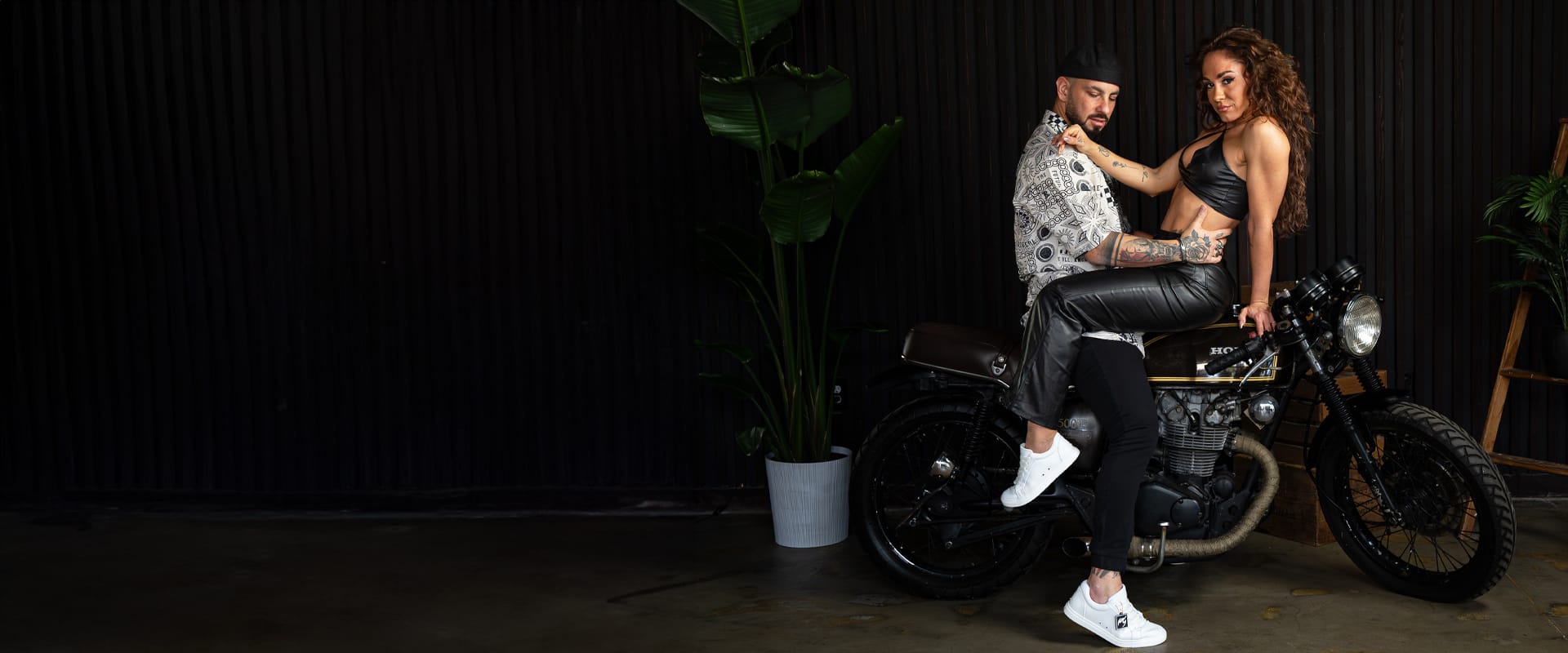
The product is a compromise. That is the point.
A running shoe wants dependable traction. A suede dance sole wants glide. Fuego lives between those jobs. Its patented FlowTec outsole uses a custom compound and two circular pivot zones - one below the ball of the foot, another at the heel - to reduce rotational resistance without turning every step into a skating accident. The current white low-top product page lists an 8.4-ounce weight, a cushioned insole, ventilation holes, water-resistant upper and sole, stitched construction and vegan materials.
The two-circle trick
The forefoot pivot handles most turns. The heel circle supports direction changes. The surrounding tread keeps enough contact for starts, stops and the walk home.
This is what Fuego actually did: it packaged a mechanical tradeoff as freedom from context. The sneaker is not claiming to out-glide every suede sole or out-grip a court shoe. It is designed for the class, the social, the outdoor festival and the commute between them. The customer buys fewer transitions. For teachers, traveling dancers and anyone performing on unpredictable floors, that can matter more than peak performance on one pristine surface.
A product demonstration disguised as culture
Fuego's marketing works because dance makes footwear technology visible. A creator spins on concrete, stops cleanly and walks away. In a few seconds the viewer sees the hostile surface, the movement and the ordinary sneaker silhouette. No exploded diagram is required. The company's Instagram, TikTok, YouTube channel and FuegoTV library turn salsa, bachata, hip-hop, ballroom, shuffle and fitness clips into an endless series of use-case demonstrations.
Collaborators supply a second layer: permission from practitioners. Krump dancer BDash designed a model that later appeared in a performance on The Ellen DeGeneres Show. Actress and dancer Jade Chynoweth worked on a low-top whose knit used recycled plastic bottles and included a raw jade stone. Derek Hough co-designed limited-edition low-top and split-sole versions. More recently, Fuego has shown Miami HEAT Dancers rehearsing and performing in the shoes. Each partnership is distribution, but it is also product sorting. Different dancers show different tribes where the sneaker fits.
What $150 is really buying
The price only makes sense against the workaround. A casual beginner can dance in a smooth-soled sneaker already in the closet. A studio regular can buy a dedicated shoe and protect its suede in a bag. There are also cheaper canvas shoes, rival dance sneakers and do-it-yourself suede patches. Fuego asks customers to pay for consolidation: one presentable pair that can handle the walk to class, the lesson, the social afterward and an outdoor set on Sunday. That is why “no shoe change” may be a stronger sales line than any claim about foam density.
The audience is broader than salsa, even if salsa created the company. Hip-hop dancers usually start with street sneakers and gain a shoe shaped around turns and fast footwork. Ballroom and bachata dancers gain a flat, casual option. Fitness instructors get cushioning without a deeply lugged sole fighting rotational choreography. Travelers avoid sacrificing luggage space to specialist footwear. Children can use the same basic silhouettes in youth sizes. Fuego is effectively bundling these adjacent jobs into one catalog, then letting each style's creators explain the relevant benefit.
That puts the company in an interesting market pocket. Capezio, Bloch and other established dance labels bring decades of studio authority. Taygra, SwayD, Yami, SpinSole and Pulse address overlapping sneaker buyers. Meanwhile, Nike, Adidas and fashion brands own far more mindshare but generally optimize their shoes for other sports or everyday wear. Fuego cannot win that contest on general sneaker fame. It can win a search for “shoes I can wear to a salsa social without changing in the bathroom.” Search intent this narrow is a moat until a larger brand decides the category matters.
The company's visible technology stack reinforces the economics of a modern niche brand: a Shopify storefront, global payment options, email and SMS retention, customer-service software, review tools and paid-media tracking. That infrastructure is rentable. The scarcer assets are the sole design, the dancer relationships and years of footage showing the product in use. Manufacturing makes the item; community evidence lowers the cost of explaining it.
The direct-to-consumer machinery underneath is familiar: Shopify checkout, paid social, email automation, affiliates, ambassadors, reviews and installments. The unusual part is how coherently it all points back to movement. Fuego even asks prospective ambassadors which styles they dance and how they want to partner. A good creator program is not merely a pile of reach; it is a map of customer subcultures.

What failed first - and what changed
The founding insight arrived cleanly; the first shoe did not. Dorm Room Fund's account of its 2020 investment says professional and recreational dancers liked the initial design more than Weschler expected. That response did not freeze the product. It pushed a revised version with greater flexibility, breathability, durability and comfort. This is a more useful origin story than the polished myth of getting it right on sketch one: demand was validated before the shoe was finished.
Then studios closed. A dance-footwear company launching into a pandemic sounds like a short obituary. Instead, dancers moved into homes, parks and streets. The “any surface” claim became more relevant. Fuego says it picked up steam in 2020 because its shoe could follow the customer out of the studio. The event did not create the product, but it widened the definition of the dance floor.
Capital followed in stages. Dorm Room Fund announced an early investment in February 2020. Dealroom lists a $1.4 million seed round in 2021, a $760,000 round in 2022 involving Robin Hood Ventures and a $2.5 million financing in January 2024 associated with New World Angels. Public estimates differ on the company's total funding, and Fuego has not disclosed revenue or valuation. Those omissions are worth respecting. A global customer map is not an income statement.
Find the costume change
Look for a recurring workaround customers accept as normal: the second pair, extra adapter, duplicate export or manual handoff.
Make proof entertaining
Choose a demonstration where the environment, action and result can be understood before a viewer reads the caption.
Recruit the teachers
Fuego's collaborators are not generic celebrities. Their dance styles act as customer segments with built-in credibility.
Win the messy middle
The product does not maximize slip or grip. It solves the mixed-surface day. Be precise about the job your compromise improves.
Where the playbook stops working
Fuego is not a universal answer. Dancers who work only on maintained studio floors may prefer the glide and articulation of suede or leather. Some reviewers want more flexibility, a wider fit or different durability; others report delivery delays. Anyone with an injury or unusual gait should choose footwear with a qualified professional, not a marketing promise. “Any surface” still requires judgment when concrete is wet, dirty or abrasive.
The business model has limits too. Creator-led commerce works when the product creates observable before-and-after motion and when a community already gathers around teachers and performers. It is weaker for products whose benefit appears after months, cannot be shown safely, or varies so much that a short clip misleads. At roughly $150, the sneaker also needs trust, sizing confidence and responsive exchanges. A viral spin cannot repair a poor fit.
Still, Fuego occupies a clever place in footwear. It sits below the vast lifestyle sneaker market, beside legacy dance brands and above the home hack of gluing suede to an ordinary sole. Its expertise is not simply making shoes. It is translating the mechanics of dance into an object that can be worn at lunch. The company turned an awkward five seconds into a product, then turned the product into content. Founders can copy that sequence. The flame logo is optional.