The first Thursday Boot Company store began, in a sense, before anybody had leased one. Customers had already made the decision. They found the young footwear company's Flatiron office in New York, climbed upstairs and knocked. A business conceived for the internet had acquired a fitting room by accident. People wanted to feel the leather, see the colors away from a screen and discover whether a size really fit. They had not read the channel strategy. They simply showed up.
Alicia Martinez Haile was in the useful position of hearing this behavior in its native language. As Thursday's customer-care leader and a member of its early team, she worked where product claims met feet, weather, uncertainty and returns. Every direct-to-consumer company has analytics. Customer care receives the unruly footnotes: the reason behind the abandoned cart, the hesitation hiding inside a sizing question, the particular shade of disappointment when an object does not resemble its photograph.
Haile recognized that the visits to Flatiron were not interruptions. They were evidence. The office became an informal retail space in 2017, and the appetite was measurable. It generated revenue in the six figures, drawing nearby workers and residents through word of mouth and the company website. A boot buyer might begin online, but the decision still benefited from a chair, a mirror and another human being.
“I pushed for the store.”Alicia Martinez Haile, 2018
A store hiding inside a service question
The line is only five words, which may be why it is so good. It has none of the perfume that usually accompanies a corporate expansion. Haile did not describe a grand theory of channels or an experiential footprint. She had watched people come in because they wanted to try the product on, touch it and feel it. Their question was practical. Her response was structural.
Thursday had launched in October 2014 under Connor Wilson and Nolan Walsh. Walsh later recalled that Alicia Martinez was among the friends hired shortly after launch, part of an early group assembled when the company was still proving that a versatile, durable boot could be sold at a relatively low markup. Public company profiles now identify her as a founding partner, with titles that have included chief of customer care and director or chief of customer experience. The nouns vary slightly. The work remains close to the customer.
The signal moved in three steps
Customer care is often presented as a soft function, a tidy phrase for the hard daily business of fixing things. Yet its strategic advantage is almost embarrassingly concrete. Marketing learns which promise attracted a shopper. Customer care learns where the promise became confusing. Product teams see aggregate demand. Customer-care teams hear the sentence a person uses when the product does not quite fit into life.
Footwear makes that gap especially visible. A photograph can display a cap toe, but it cannot tell a customer how the last meets the widest part of a foot. Copy can describe full-grain leather, but it cannot supply its weight or smell. A size chart is necessary and still not a bench. Haile's retail argument came from this sensory deficit. Digital convenience had created the sale; physical contact could remove the doubt.
Seven hundred and fifty square feet of proof
In October 2018, Thursday opened its first formal shop in SoHo. It occupied 750 square feet over two levels. Haile designed the space with an old-New-York note: brick walls painted fresh white, with barn doors concealing inventory upstairs. Boots for men and women shared the compact shop with leather accessories and outerwear. The room gave the brand texture, but it also gave shoppers permission to linger over a question that felt expensive online and ordinary in person: Which pair?
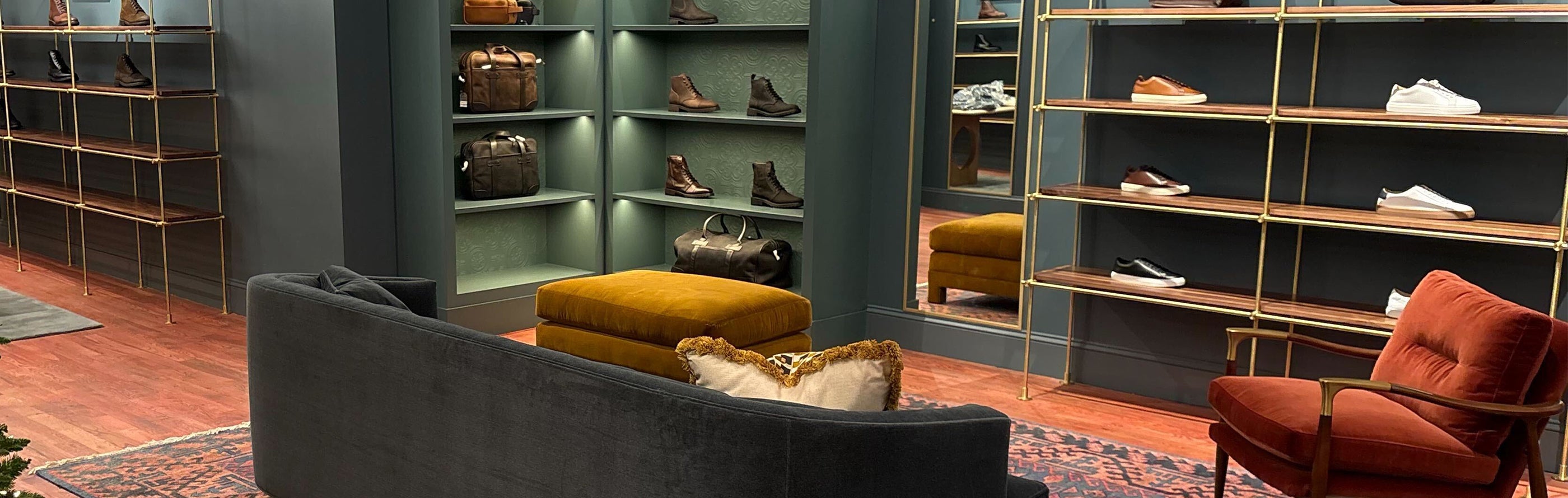
The decision was also disciplined rather than romantic. Favorable rent helped the economics. The store could reach tourists and passersby who would never seek out an office showroom, while serving as a testing ground for products. By that point, Thursday said it was selling in every US state and 75 countries. The formal shop was local in address and global in context, a street-level laboratory for an internet business.
There is a pleasing reversal here. Direct-to-consumer brands originally used the web to avoid the costs and compromises of wholesale. Thursday's low-markup model depended on that directness. But direct did not have to mean disembodied. A company could bypass the department store while building a room of its own. The store was not a retreat from the internet. It was the internet business learning what the screen had omitted.
The room also shortened the distance between observation and response. Online, a fit problem arrives after a box has crossed a city or a country. In a shop, the hesitation happens in public: a toe pinches, a heel lifts, a customer reaches for the neighboring size. The conversation can change while the product is still on the foot. For someone responsible for customer care, this is unusually vivid information. The question and the object occupy the same square yard.
That matters because Thursday's proposition required customers to believe two things at once. The boots were meant to look considered and withstand ordinary wear, while the price was kept below much of the established Goodyear-welted market. A physical store could make both claims tangible. Stitching could be inspected. Soles could be flexed. The customer did not have to take every adjective on faith. Haile's argument for retail therefore supported more than distribution. It created a place where the product could finish making its own case.
The company catches up with the customer
Years later, the odd little scene at Flatiron remains legible. A 2025 video tour of the headquarters showroom recounts that customers would discover the office location, knock on the door and expect to buy shoes. Thursday had not initially intended to turn headquarters into a shop. Intention, however, is only one author of a business. Customers hold a pencil too.
Thursday's current locations page lists two New York stores, in Flatiron and SoHo, plus Wicker Park in Chicago, Garden State Plaza in Paramus, New Jersey, and Hayes Valley in San Francisco. The California shop, opened as the fifth location, marked the company's first West Coast outpost. Haile publicly shared news of the San Francisco plan with her professional network. The footprint is still modest enough to count without removing one's shoes, but it makes the original pattern hard to miss.
Haile joins Thursday's early team shortly after the October launch.
An informal Flatiron retail space turns office visits into a working showroom.
Haile pushes for and designs the first formal SoHo shop.
Chicago, Paramus and a new SoHo flagship extend the retail footprint.
San Francisco becomes Thursday's fifth store and first in California.
It is tempting to make the story more ornate than it is. Fashion encourages ornament, and startup histories are forever burnishing themselves into legend. Haile's contribution is sharper without any gilding. She stood near the recurring customer problem, understood that it described an opportunity and argued for the company to act. Then she helped design the place where that action would become visible.
This is operator's work. It connects the humble and the consequential. A shopper asks about fit; a company changes its footprint. An improvised showroom makes money; a lease begins to look less like vanity and more like tested demand. White paint, hidden inventory and a chair become parts of a commercial system. The strategy does not descend from a mountaintop. It arrives one uncertain customer at a time.
“People come in here and want to try product on, feel it and touch it.”Alicia Martinez Haile, on the Flatiron showroom
The listening advantage
Haile's record beyond Thursday adds a small but consistent detail. Her professional profile lists volunteer work in animal welfare: driving for Muddy Paws Rescue since late 2023 and volunteering with GallopNYC since early 2024. It also lists Queens College and two earlier independent websites, Delilah Soleil and Binder Bags. These facts do not need to be stretched into a personality test. They locate a career that has included projects, service and the practical care of living creatures as well as customers.
The useful lesson is not that every e-commerce company needs a shop. Rent remains rent, and a charming room can lose money with considerable charm. The lesson is to notice behavior that customers repeat despite friction. Thursday's shoppers undertook the trouble of finding an upstairs office because the product raised questions a website could not answer. Their inconvenience was the research. The six-figure showroom revenue was the confirmation.
Alicia Haile heard the knock while it was still easy to mistake for noise. She helped turn it into a doorway. Nearly eight years after the first formal SoHo opening, Thursday's stores still offer the same basic proposition: come in, try a size, feel the leather and say hello. The poetry of retail is usually overstated. Here it can be kept to one plain image - a customer on one side of a door, and an operator sensible enough to open it.
Continue exploring