A friend in Los Angeles gave Todd Leebow a shortcut for reading scripts: start with the last page. If the ending held up, the rest might deserve his attention. Years later, back in Ohio, he put the advice on a restaurant. The Last Page opened at Pinecrest in February 2021, with Leebow and Gary Shamis as founding partners. An abandoned career plan had left behind a rather good name.
Leebow had gone west to pursue film production. The family business was steel, and he had other ideas. He had studied business and entrepreneurship at the University of Miami, then tried a field in which assembling people around an idea was the job itself. Cleveland eventually drew him back. The interest in producing things traveled with him.
Today, he is president and CEO of Majestic Steel USA and a co-founder of Felux. His other ventures reach into restaurants, property and clothing. A steel warehouse and a dining room make unusual neighbors on a résumé. Follow his route between them, though, and a recurring concern appears: how something gets made, how people experience it, and what happens between those two events.
The inventory came before the order
Dennis Leebow founded Majestic in Cleveland in 1979. Earlier generations of the family had worked in steel through Baldwin Steel in Jersey City. Todd grew up with exposure to the product, the plant and the customers. Steel was already part of his education long before he chose to make it his occupation.
His father’s business involved a consequential wager: carry inventory before a customer bought it. Stocking finished material meant buyers could get steel when they needed it. The distributor carried the expense and exposure that came with keeping it available. Convenience at one end of the transaction required somebody to accept uncertainty at the other.
That arrangement helps explain Todd’s later preoccupation with the customer’s total cost. A quoted price cannot tell the whole story of a purchase. A delayed delivery, unusable material or time spent sorting out a problem belongs in the calculation, too. The family’s product was steel; its service involved making the buyer’s working day more predictable.
When Todd joined in 2007, his work centered on supply chains and innovation. The return brought him close to the mechanics of the business, where inventory and information meet. It also put a former film producer inside an established industrial company with plenty of room to ask why familiar tasks were done in familiar ways.
A family name still needs a hearing
The succession arrived in 2012. Leebow had worked across the operation, including sales, finance and the plant, but taking the top job introduced another assignment: getting people to accept the changes he wanted to make. A successful company comes with evidence that its habits work. For a successor, that evidence can make every proposed alteration sound faintly impertinent.
His account of the transition emphasizes listening, calculated risks and respect that has to be earned. He wanted a leadership group with people from the family and outside it, with experience from steel and other industries. The aim was a mix of perspectives rather than a family conversation with additional chairs.
That concern with people also appears in Majestic’s workplace ambitions. An industrial company competes for employees who have choices well beyond its own industry. Recruiting therefore asks a company to explain why the work matters, what a person might learn and whether there is room to contribute. The product alone cannot do all the persuading.
Majestic received a Family Business Achievement Award in 2020. Leebow’s description of its culture connected individual productivity with creativity and participation in the community. That is a revealing pairing for a business built around physical stock. The inventory needs somewhere to sit; the people need somewhere to go.
The steel business enters the inbox
Felux emerged from this interest in improving industrial transactions. An early profile describes Leebow founding it in 2018 with former Majestic executives Chris Day and John Camenisch. The venture took the buying and selling of metal as a software problem, giving an old commercial activity a different set of tools.
Its marketplace pitch gathered sourcing, procurement, freight and financing into a single digital experience. For a buyer, those activities already belonged to one purchase, even when the work was scattered among calls, emails and separate arrangements. Putting them together offered a way to reduce the administrative distance between wanting material and receiving it.
By its June 2022 funding announcement, Felux reported facilitating $454 million in transactions during 2021, compared with $64.9 million in 2020. It announced a $19 million Series A led by EquipmentShare. Those figures describe the venture at that stage: transaction volume passing through the platform and investment in the company. They measure different things.
Metal moving through the platform
The present Felux website describes a more specific offering: software that gathers requests for quotation, quotes, purchase orders and bills of lading from sales email. It promises a view of incoming demand, including inquiries that never received a quote. The unanswered request becomes information a business can use.
That is a practical extension of an inventory question. An order record shows what a company sold. Requests that went unanswered can reveal interest the company never converted into a sale. For someone deciding what to stock, the difference matters. Felux’s offering has changed, while the connection between better information and buying decisions remains easy to recognize.
A flag, a desk, a different audience
Leebow’s interest in steel also runs beyond transactions. When Majestic rebuilt its headquarters in 2009, it used its own products, local contractors and American artists to make the material visible. Exposed structural elements and commissioned work gave visitors reasons to notice what industrial buildings usually ask them to overlook.
Stephen Yusko was among the artists involved. Staff artist Raymond Bugelski worked on the Majestic Flags. In January 2017, a steel flag was part of the conversation around Sotheby’s Americana Week. The material had found a setting where people would look at it rather than calculate how much they needed.
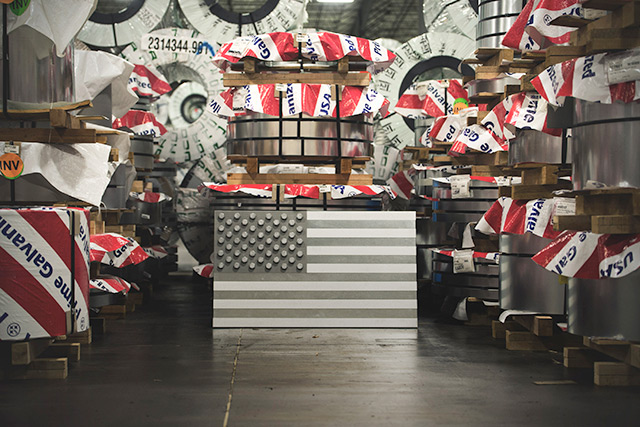
His habit of looking at other materials and asking, “Can steel replace this?” has the appeal of a simple creative constraint. It starts with something he knows well, then changes the setting. An artist’s commission and a building component can share a supplier while inviting quite different kinds of attention.
The exercise also gives the business a vocabulary beyond specifications. Steel can be purchased for performance, encountered as design and recognized as part of a local manufacturing tradition. Leebow has tried to make those encounters overlap. A reception desk can do a modest amount of sales work without ever asking for the order.
Cleveland, with a table for more
The Last Page carried the production instinct into hospitality. Its name preserved the Los Angeles advice, while the business itself put Leebow alongside partners whose work happens in kitchens and dining rooms. The ending of the script had become the beginning of an evening out.
In 2026, he was involved in another Ohio restaurant, 1818 American Grille in Bath. During its development, he described wanting a place people could use for different occasions, from a casual meal at the bar to a longer dinner. The name refers to Bath’s founding year. This time the local history came printed on the sign.
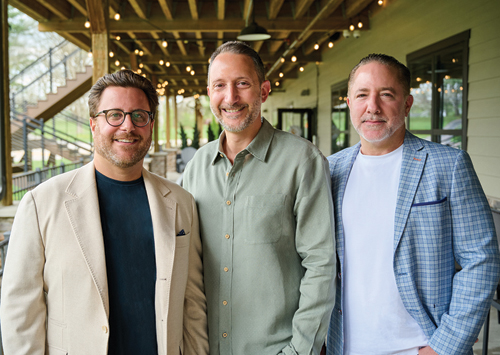
By October, the restaurant’s full opening had been reported, following the earlier opening of its downstairs Grille Room. Chef-partner Brad Race worked with partners Gary Shamis and Leebow. The main dining room, raw bar and covered patio gave the project several ways to accommodate a visit. For Leebow, it was another operating business rooted in Northeast Ohio.
Clothing supplied another variation. SOZO’s 2022 Pinecrest store put a cut-and-sew operation in view, allowing the making of garments to become part of the shopping experience. The idea made production visible in a setting where customers usually meet a finished item on a hanger. It brought the workshop a little closer to the sale.
His public arguments about domestic manufacturing sit alongside these ventures. In a November 2025 conversation with Rachel Tripp, he advocated for domestic steel production and discussed tariffs and trade. Those are his policy positions. They also place his commercial interests within a broader ambition to keep industrial work and investment in the United States.
The producer keeps a list
The range of businesses can obscure a smaller, more ordinary detail: Leebow has described relying on lists and the Notes app on his iPhone. A career involving multiple companies still needs somewhere to put tomorrow’s tasks. The technology doing that particular job comes installed on the phone.
He has also described his process for ideas in production terms: allow room for brainstorming, develop a framework, make a plan and execute it. His film background informs that sequence. The projects have different materials and different audiences, but someone still has to move the idea toward a finished result.
“Stop, collaborate and listen.”
Todd Leebow’s choice of favorite quote
There is room for a little levity in this industrial life. His company biography names the Tasmanian Devil as his favorite cartoon character and Mitchell’s pistachio as his preferred ice cream. The favorite quotation is a neat instruction for someone whose work requires other people: pause, gather the company and pay attention.
The career he originally imagined would have given him scripts to read. The one he built gave him a family company to understand, software to help establish, artists to work with and restaurants to open. The last page remains a useful place to begin. Eventually, though, a producer has to go back and work through everything that comes before it.