The truck has arrived. The cartons are counted. Somewhere else, an invoice is waiting to be paid. For most people, the interesting part of logistics has already happened. CT Logistics has built its business around what happens next: checking whether the price on that invoice bears a defensible relationship to the journey that actually occurred.
- Checks freight charges before payment and hunts overcharges afterward.
- Sells the software it developed for its own auditing work.
- Uses shipping records to inform carrier selection, contracts and costs.
It is a wonderfully unglamorous specialty. A freight bill can contain the wrong rate, the wrong classification, an inappropriate extra charge, or a request to pay something already paid. Each error looks small in isolation. Give it enough invoices, and an administrative nuisance becomes a business problem. CT’s proposition starts with a practical suspicion: delivery confirms the goods arrived; it does not confirm the arithmetic.
The invoice has a second life
CT receives invoices from carriers, checks them against shipment details and customer requirements, then pays audited bills using funds supplied by the customer. Paper, PDF and electronic submissions all appear in its service description. The differences matter. A business that accepts data in several forms still has to make those forms agree.
FreitRater, CT’s proprietary software, examines classifications, contractual rates, weight, taxes, previous payments and accessorial charges. It can allocate costs to general-ledger accounts down to individual product codes. The invoice becomes more than a demand for money. Properly recorded, it is evidence about a company’s shipping habits.
That is where CT sits in the market: between transportation operations and financial control. Manufacturers, distributors, retailers and logistics providers can use its services. CT describes customers ranging from small firms to Fortune 100 corporations. Graco’s published 2025 routing guide directs certain freight bills to CT, a useful glimpse of the work in ordinary commercial life.
Before it was software, it was a habit
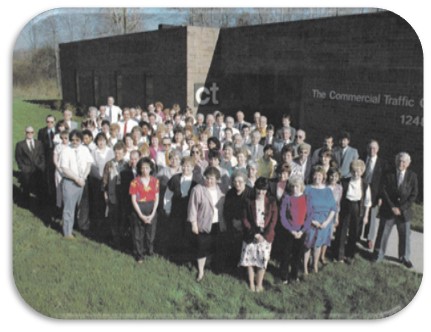
The Commercial Traffic Company began in Cleveland in 1923 with five founding partners, including its first president, H. R. Snyder. The original assignment was auditing freight bills. Decades later, an internal tool changed the way that assignment could be delivered.

In 1986, Dale Lunar, CT’s executive director of IT, wrote the first version of FreitRater and installed it inside the company. CT formed a software division in 1990; its first package sale followed in 1991. This sequence is revealing. The product grew out of a recurring operational task, with practitioners already available to judge whether it worked.
Today, customers can buy FreitRater or use it through software-as-a-service and business-process-as-a-service arrangements. CT can perform the work or supply the machinery. The same foundation also supports CTLion, which compares routes across multiple legs, modes and carriers, and a web-based transportation management system for planning and executing shipments.
“Process Right On Time Once”
CT’s PRONTO quality policy
PRONTO is an unexpectedly tidy little motto for a business devoted to messy documents. CT has been ISO certified since 1999. It also assigns customer-specific teams, with managers, processors and auditors trained on each client’s requirements. Software carries rules; people establish which rules belong to which customer.
The mistakes that made customers move
CT’s published customer stories describe the point at which routine administration became intolerable. An unnamed global apparel company faced billing errors and slow processing. CT reports that a historical audit, carrier EDI connections and customized software reduced processing time from fourteen days to seven, while reducing annual overpayments by $1.5 million.
Another case describes a medical-device company whose regional provider struggled with global complexity. CT used a phased migration, ran parallel systems and preserved historical records. The reported improvement was a 15% reduction in duplicate payments and billing errors. These accounts make the customer’s reason for switching concrete: the old process stopped providing dependable answers.
The transferable lesson is procedural. Examine the past before replacing the system. Connect carriers electronically. Keep an audit trail through the transition. Build reports around decisions people actually make. A fashionable dashboard will not repair a missing contract or an incorrectly recorded shipment.
A buying club with a routing guide
TranSaver approaches a different problem. Small shippers often lack the negotiating volume of larger businesses. CT pools participating shippers’ freight and negotiates carrier pricing for the group. The program charges a monthly participation fee and offers a free comparison using a selection of the prospective member’s freight bills.
The practical detail is the routing guide. CT says it must be used alongside carriers’ point lists to confirm that the precise destination is served. A discount is useful only when the service fits the shipment. Likewise, its TMS returns both carrier rates and service times, allowing users to weigh price against urgency.
CT’s post-audit service has a different bargain: no upfront cost, with recovered refunds or credits divided between CT and the client. This ties compensation to recoveries. For a buyer, the calculation still includes the agreed split, internal effort and any ongoing fees. Comparing a recovery with the original invoice total would miss the economics.
The next shipment is the point
CT’s Qlik-powered analytics lets users investigate outliers and drill into freight-spend details. Its distinction is the combination: invoice checking, payment, transportation tools and people who understand the records. Buyers can also turn to providers such as Cass or CTSI-Global, or assemble their own internal process.
The benefit depends on what those records reveal and whether anyone acts on them. A company with few billing errors, little negotiating room or unsuitable carrier coverage may find less to gain. CT’s enduring idea is more modest, and more useful, than a promise of effortless savings: learn what the last journey cost before choosing the next one.