A shipment can arrive perfectly and still have been a mistake. In one of nVision Global’s customer cases, employees were choosing airfreight for goods that could have travelled by rail or ocean. The bills were processed, the data appeared, and management finally saw the expense. By then, the decision had already taken off.
The fix was to move control into booking. Impact TMS restricted users to contracted transportation providers and displayed different transport modes alongside negotiated and spot rates. The company’s account of the project reports more than €30 million in avoided expedited freight costs. Its headline gives the dollar equivalent as more than $34 million in less than 24 months. Treat that as a reported customer outcome, rather than a forecast for the next buyer.
- Auditing checks whether the bill matches the agreement.
- Transport software helps decide which shipment to book.
- Clean invoice data connects those two jobs.
- The practical lesson: place a control where the costly choice happens.
01 / The invoice is a witness
nVision Global occupies an easily overlooked corner of commerce. It helps shippers manage the decisions and paperwork surrounding transportation: freight invoice audit and payment, shipment planning, claims, and analytics. Think of the distance between a purchasing decision and its appearance in the accounts. A surprisingly large business can hide there.
The company traces its origins to a local claims-processing operation founded in 1992. That beginning helps explain its current shape. A claim requires someone to establish what was promised, what happened, and what can be recovered. Freight audit applies a related habit to invoices. Software lets those questions travel across a much larger operation.
A freight invoice is more informative than its total. It contains clues about the service, carrier, route, and extra charges. nVision’s audit and payment service validates invoices against contractual terms, catches duplicate payments, and supports exception handling. For the shipper, the immediate benefit is paying correctly. The longer-lived benefit is a record that can explain the next negotiation.
↳ Invoice evidence feeds the next booking decision.
02 / Eight currencies walk into a database
The customers who need this most have plenty of ways to make a small problem repeat. Multiple divisions. Multiple carriers. Multiple currencies. A local spreadsheet may be perfectly competent at its local task while remaining nearly useless to someone trying to understand the whole company.
Teradyne offers a concrete historical example. Its customer case dates the engagement to 2005 and lists freight bills in Mexican pesos, Japanese yen, Malaysian ringgits, Chinese renminbi, Korean won, euros, pounds sterling, and US dollars. The objective was one global database of transportation spending across divisions, with enough detail to understand volumes and providers.
The point of consolidation was practical: fewer administrative burdens, a clearer picture of suppliers, and better information for purchasing transport. A total tells finance how much was spent. A usable breakdown gives procurement something to act on. nVision sits between those audiences, translating the same shipment into operational and financial terms.
03 / The dashboard’s secret ingredient
There is a seductive idea that visibility comes from putting a graph on a screen. nVision’s analytics offering reveals the less photogenic requirement: the underlying descriptions have to agree. One carrier’s name for an extra charge must be comparable with another’s. Otherwise the chart offers precision without meaning.
The freight-spend analytics product normalizes and enriches charges, offers configurable reports, and lets users drill down to invoice images. The company advertises more than 1,000 standard KPIs. That number is less useful than the drill-down: a manager ought to be able to travel from an aggregate to the transaction that produced it.
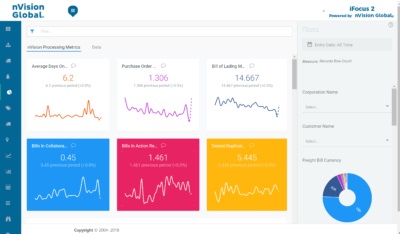
Consider a carrier review. If surcharges have consistent names and shipments have reliable attributes, the conversation can move from “your bills seem high” to a particular service, route, or fee. That is a better starting position for both parties. A dashboard earns its keep when someone can ask a better question because of it.
04 / Buying the rules, and the people
Impact TMS extends that logic upstream. Its published features include rating, routing, tendering, tracking, spot quotes, reverse auctions, and configurable approvals. Shippers, suppliers, and transportation providers can work through a shared application. The appeal is a controlled workflow from planning to execution, with reporting attached.
For a business buyer, this is a combination of SaaS and managed logistics services. A standalone accounts-payable process handles the bill; a transport system shapes the shipment; an audit service checks the charges. Combining them can reduce the work of reconnecting the evidence later. Configuration matters because companies have different approval authorities, carrier arrangements, and internal systems.
Allen Company, the outdoor-products manufacturer, selected Impact TMS and freight audit and payment in November 2021. The announcement covered truckload, less-than-truckload, and parcel deliveries. Operations executive Perry Lundberg put the selection in human terms:
“We needed the right TMS and, just as importantly, the right TMS Team”Perry Lundberg · Allen Company · 2021
His explanation emphasized software configured for the company’s requirements and collaboration with the team. That is a revealing buying criterion. A feature list describes possible behavior. Implementation determines the behavior a customer will actually get.
05 / The second journey of damaged goods
Some shipments produce another job altogether. Goods go missing, arrive damaged, or fail to receive the service purchased. Payment accuracy cannot resolve every one of those events. Someone has to assemble the claim and pursue it.
nVision offers claims software and services for loss, damage, service failure, and overcharges. Its published materials report nearly 8,000 claims, an 87% recovery rate, and more than $7 million recovered over a stated two-year period. Those are the company’s figures for that period, with no promise that an individual claim will be collectible.
This is where the company’s claims-processing origin becomes more than an anniversary detail. Knowing which records to retain and how to pursue an exception is part of the product. A damaged carton may be visibly simple. Its financial resolution can be a small research project.
06 / AI meets the unusual invoice
The current nSure AI offering addresses the incoming documents themselves. It describes classification, extraction, validation, enrichment, and exception flagging before information enters rating, audit, allocation, and approval processes. Its concise premise deserves the space normally reserved for grander promises:
“An audit is only as reliable as the data behind it.”nVision Global · nSure AI
That makes document interpretation a consequential step. A fast workflow built on a misunderstood charge can distribute the misunderstanding efficiently. In its March 2026 commentary, nVision argues for human oversight of exceptions, contracts, and changing requirements alongside automation. The company’s own explanation gives buyers a useful test: ask how an unusual invoice is investigated, rather than stopping at how quickly an ordinary one moves.
07 / A global total needs a local explanation
In September 2026, nVision published a guide to local financial realities inside global programs. Currencies, taxes, legal entities, documentation, and banking practices can change the execution of a payment. Consistent reporting therefore depends on preserving local context.
Its differentiation is this combination of freight-specific software, regional service, and financial detail. Alternatives in the established freight-audit market include Cass, Trax, and CT Logistics, alongside other specialists listed in the historical Gartner market guide. Buyers should compare the countries, modes, exception workflows, and systems they actually need. A global label alone answers very little.

nVision also makes continuity part of its sales argument. It describes continuous private ownership since inception. Its workforce account reports employees with more than 25 years of service. In work full of exceptions, accumulated knowledge has an obvious use: somebody remembers why the rule exists.
08 / Put the lesson before the booking
The opening case supplies a copyable idea. Start with invoice evidence, identify a recurring expensive choice, and place the relevant approval or comparison at booking. Then check subsequent bills to see whether behavior changed. That sequence can inform a process redesign even before a company chooses software.
It requires accurate contracts, dependable shipment data, and service rules that reflect the actual delivery need. Urgent freight can be justified; a lower rate can buy the wrong service. The useful question is whether the person booking can see the alternatives and has a reason to choose carefully. The next invoice will be along shortly to check.