The first thing to go wrong was the typing. In 1995, the American Academy of Ophthalmology launched a network to track cataract surgery outcomes. It gathered information on 17,000 patients. Then the project died: entering records by hand asked too much of the people meant to contribute them. The doctors had a second job waiting inside their first one.
That earlier failure helps explain FIGmd. The healthcare technology company made a business of extracting clinical information from systems where it already existed. A registry could grow without requiring every participating practice to become a miniature data-entry bureau. The proposition was modest enough to be believable, and consequential enough to matter.
- FIGmd connects existing clinical systems to registries, measurement tools and reporting programs.
- Medical societies and healthcare organizations buy the infrastructure; clinicians use the resulting tools.
- Software comes with mapping, validation, onboarding and support.
- The useful lesson: remove duplicate work, then investigate the work that remains.
The extra job nobody ordered
The eventual ophthalmology registry, IRIS, launched in March 2014. By July 2017 it held 148 million visits involving 37.3 million patients. A 2017 Academy editorial credited easy participation, automatic extraction and an initial absence of physician fees among the reasons for adoption. Those are IRIS results, not a claim that FIGmd alone produced them. Still, the contrast with the abandoned manual-entry project is instructive. A database cannot learn from records nobody has time to supply.
FIGmd sits in that awkward space between a medical record and a useful comparison. The record tells a practice what happened to a patient. A registry lets participants examine patterns across many patients and practices. Getting from one to the other requires connections, definitions and checks. The chart at the end is the part everyone can see; most of the product is the journey to it.
When the customer buys a stake
Sanket Baralay founded FIGmd in 2010. Its early relationship with the American College of Cardiology became more than a supplier contract. In June 2011, the ACC announced an equity investment in the company. At that point, FIGmd said its technology had integrated information from more than 170 practices into the PINNACLE Registry.
The investment had a stated purpose: support registry growth and help FIGmd reach other professional societies. That arrangement reveals the company’s market position. A society brings clinical expertise and a community of physicians. FIGmd supplies the machinery for gathering and organizing their records. The customer knew the problem well enough to become an investor in the means of solving it.

That history also explains why FIGmd sells to institutions rather than patients. Its customers include medical societies, practices, health systems and payers. The company’s account of its work extends to research organizations and life sciences. Its expertise is the relationship between healthcare definitions, source records and the operational requirements of collecting them.
The same patient, counted once
For an accountable care organization, the difficulty grows with the number of practices involved. PerformancePathway, FIGmd’s cloud software and service offering, combines information from different EHRs, normalizes it, removes duplicate patients, validates measures and supports quality submissions. An updated release was announced in September 2022.
Deduplication sounds like housekeeping until one patient visits two practices. In a simplified example, two source records can represent one person. A measure calculated over records rather than the intended patient population can answer the wrong question. PerformancePathway’s enterprise dashboard is designed to bring multiple ACOs into view while accounting for patients seen across practices only once.
- 01Existing recordsDifferent practices. Different systems.
- 02Connect + normalizeBring unlike fields into a usable structure.
- 03Deduplicate + validateCheck the population and the measures.
- 04Measure + reportMake the dashboard earn its keep.
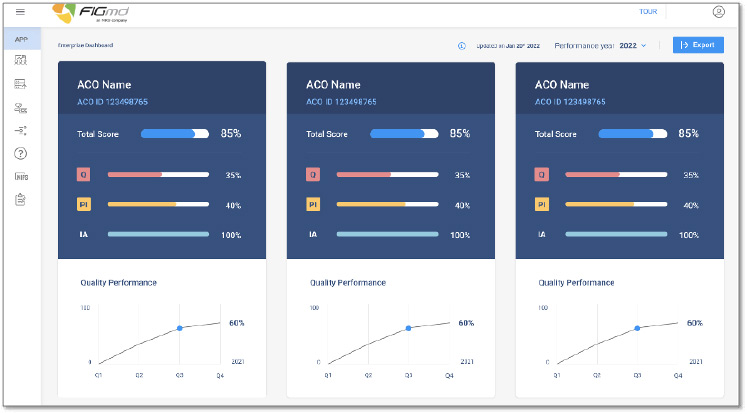
In market terms, this places FIGmd across several purchasing decisions: registry infrastructure, data integration and quality reporting. Alternatives include reporting within an EHR, building an internal pipeline, or choosing another registry technology provider. Its stated advantage is connecting heterogeneous systems and handling the service work around them. The right comparison depends on how many systems, practices and reporting obligations the buyer must manage.
The screen had its own problems
Automatic collection did not remove every obstacle. A public FIGmd design case study describes complaints about its MIPS reporting interface. Users faced a crowded screen, measures irrelevant to their work, poorly labelled settings and selections lost while moving between screens. Submitting or resubmitting could require repeated navigation. Bureaucracy had acquired buttons.
The design team surveyed and interviewed established users, but also people who had registered and never completed reporting. It tested the existing platform with newcomers and grouped the findings into problem areas. The revealing choice was to study the missing submission. Someone can accept a product’s promise and still abandon the task.
Those complaints changed the design brief: a reporting tool needed to make the next action clear. The case study documents research and redesign work; it does not establish a measured improvement in completion rates. The lesson remains useful. Watch the path between intention and submission. Every screen on that path spends some of the user’s patience.
The bill has more than one line
FIGmd’s business combines cloud software with implementation and ongoing services. Its Pegasus pricing disclosure says registry customers determine participant pricing. That makes the registry sponsor an important part of the commercial arrangement: the physician’s fee is not necessarily a universal FIGmd list price.
PRIME, the primary care registry established by the American Board of Family Medicine, offers a concrete example. Its pricing page lists an annual subscription of $515 per clinician for EHR-integrated dashboard access, whether or not the clinician uses it for CMS reporting. ABFM Diplomates receive their first reporting year free; subsequent subsidies are evaluated annually.
PRIME’s published dashboard subscription. Eligible first-year participation is subsidized. Some EHR vendors impose a separate connection fee.
A practice also has to check EHR compatibility. PRIME’s enrollment guidance says some systems cannot provide accessible or adequate quality data, and some EHR vendors charge separately for a connection. It recommends appointing a primary administrative contact for setup and maintenance. A plausible purchase decision therefore includes the fee, the connection and somebody’s working time.
A score needs a custodian
PRIME’s July 2023 welcome kit gives a less glamorous view of operating the service. The FIGmd/MRO representative helps connect the EHR and introduces the dashboard. The kit describes refreshes roughly every 30 days and asks users to review performance regularly against expectations. It also offers refresher training and help for new administrators.
That is the practical limit of extraction: moving a field does not settle whether the field means what a measure requires. Practices still need to validate what appears and investigate surprises. A clinical quality tool works best when someone owns that review. The system can assemble a view of care; people must decide whether it is a faithful view and what to do with it.
Pegasus Quality Platform version 2.0 has an ONC certification dated January 24, 2022. Its published disclosure covers specified criteria and describes electronic information export and multifactor authentication. Certification supports a defined technical claim. It does not confer a government endorsement or guarantee that every connected practice has impeccable records.
“the clinical, quality and claims data acquisition process”SANKET BARALAY · ON THE MISSION, 2021
Why the record-exchange company bought in
MRO acquired FIGmd in June 2021. The announcement described a fit between FIGmd’s acquisition and interoperability technology and MRO’s secure clinical information exchange business. Baralay described a mission of making data acquisition simpler and turning it into useful intelligence. The founder and employees were to join MRO at closing.
In June 2025, MRO acquired Q-Centrix, adding an enterprise clinical data management platform. The combined organization reported serving more than 2,000 hospitals and health systems. That is a parent-level figure, not FIGmd’s customer count. The sequence suggests a broader strategy of handling clinical information from extraction through exchange and use.
Registry relationships can change along the way. A 2022 Compulink notice named Verana Health as the IRIS technology partner and explained that a deferred interface would leave clients using FIGmd’s connection temporarily. Integration history does not make a supplier permanent. The usefulness of the connection must survive changes in vendors and systems.
Copy the sequence, not the dashboard
FIGmd’s experience offers a practical sequence for anyone building software around specialist work. Start with information the customer already produces. Make its collection less burdensome. Check that the resulting measure describes the intended population. Then study where the person using it gets stuck.
The order matters. A handsome dashboard built over unreliable inputs is an attractive way to be mistaken. A technically sound pipeline behind a confusing interface may never get used. FIGmd’s story contains both problems, which makes it more useful than an uninterrupted victory lap.
The product earns its place when a practice can understand a result, trust enough of its construction to investigate it, and finish the required task. That is a demanding standard for something often described as data plumbing. It is also the standard the person with patients waiting has every right to demand.
Follow the work
Explore FIGmd, PerformancePathway, PRIME’s plans and MRO.
Company channels: LinkedIn (archived activity), X, Facebook and YouTube.
Watch the HIMSS21 interview with FIGmd’s Raj Rajagopal. Read the PerformancePathway release announcement or browse MRO’s company history.