A member of Congress says something useful during an overseas trip. An Air Force officer enters it on her phone. Colleagues at the Pentagon receive the information within minutes. In Quorum’s account of that customer, the journey from Africa to Washington has become shorter than the journey from a meeting to somebody’s notebook used to be.
That is a revealing way to understand Quorum. The company sells software for government affairs, a profession whose raw materials include legislation, relationships and a formidable quantity of things people said last Tuesday. Its proposition is that these materials belong together. A bill tracker can tell you what changed. A shared relationship record can tell you whom to call, what your colleague already asked, and whether anyone followed up.
- Quorum joins policy monitoring, relationship records, advocacy and PAC work.
- Its July 2026 announcement says more than 2,000 organizations use the platform.
- The useful lesson: record the conversation, triage the information, then spend expert time where it matters.
The meeting that survives its participants
Washington is often described as a town of connections. Connections are flattering. Records are less glamorous. Yet the distance between knowing someone and knowing what your organization last discussed with them can be surprisingly large.
Uber’s federal affairs team ran into precisely this problem. In a customer account published by Quorum, the team had opportunities to engage policymakers but was not consistently capturing conversations or retrieving earlier positions on issues. It adopted shared interaction logs: a colleague preparing to approach an office could consult what another colleague had already discussed. Alerts supplied a second function, flagging mentions of Uber in officials’ public communications. A contact database supported regular newsletters to Hill staff.
The Air Force faced a different version of the same difficulty. Action Officers rotate through positions, sometimes arriving with little legislative experience. Incoming staff had to acquire knowledge their predecessors already possessed. Quorum’s case study describes a shared information cycle, with meeting notes entering the platform and becoming material for leadership briefings. Its mobile app also let traveling officers record information before returning to government computers at the Pentagon.
These accounts are published by the vendor, so they demonstrate reported workflows rather than an independent estimate of savings. Still, the problem they expose is familiar well beyond lobbying: an organization can employ informed people and remain remarkably forgetful.
A congressional question becomes a workflow
Quorum began with a narrower ambition. Alex Wirth and Jonathan Marks, Harvard classmates, wanted to make congressional behavior easier to analyze. Who worked together? Who crossed party lines? Who was active on a particular issue? In a 2015 interview, Marks described the initial idea as quantitative help for legislative professionals making decisions about members of Congress.
The company incorporated in April 2014 and launched its initial product in January 2015. By the time of that interview, the product had already expanded into tracking, targeting, outreach and project management. The interesting development was the widening of the question: after you learn something about Congress, what work must happen next?

Wirth’s tenth-anniversary account recalls weekly flights from Cambridge to Washington to show prospective customers the software and collect feedback. The business grew through that exchange between an analytical idea and the ordinary chores surrounding it. A memorable 2016 Washingtonian profile found the early team operating from a Craftsman house in Friendship Heights. Political analytics, dinner parties, laundry: entrepreneurship retained its domestic arrangements.
Today the product menu spans federal and state policy, local governments and school boards, EU and international affairs, stakeholder engagement, grassroots campaigns and political action committees. Quorum also sells data and professional services. It occupies the specialized enterprise software market for teams that must understand government and organize a response.
- 01 / NoticeA bill, amendment or public statement
- 02 / ConnectThe official, the issue, the last meeting
- 03 / ActA briefing, outreach or supporter campaign
- 04 / RememberNotes and results for the next colleague
Put the cheaper read first
Texas REALTORS® supplies a useful example of what can change someone’s mind. Its Quorum case study describes an older tracking system that was difficult to use and isolated from relationship management. Sixteen attorneys spent time on initial bill analysis, including bills that would later be deprioritized. The expensive attention arrived before the organization had decided which documents deserved it.
Tray Bates, its vice president of governmental affairs, tested Quorum alongside the existing system for two legislative sessions. AI-generated initial summaries became the reason to complete the transition. His team could use a summary to judge relevance, then direct legal scrutiny toward bills that warranted it. The case study also describes relationship tracking and shared bill-review sheets across a team of more than twenty people.
“I said no—we need something to track our relationships too.”Tray Bates, Texas REALTORS®, in Quorum’s customer account
The copyable idea is a sequence: screen first, examine closely second. That is an editorial inference from the workflow, rather than a claim that legal judgment can be automated. A summary is useful when it helps a qualified person decide where to look. It becomes dangerous when it acquires the authority of the document it abbreviates.
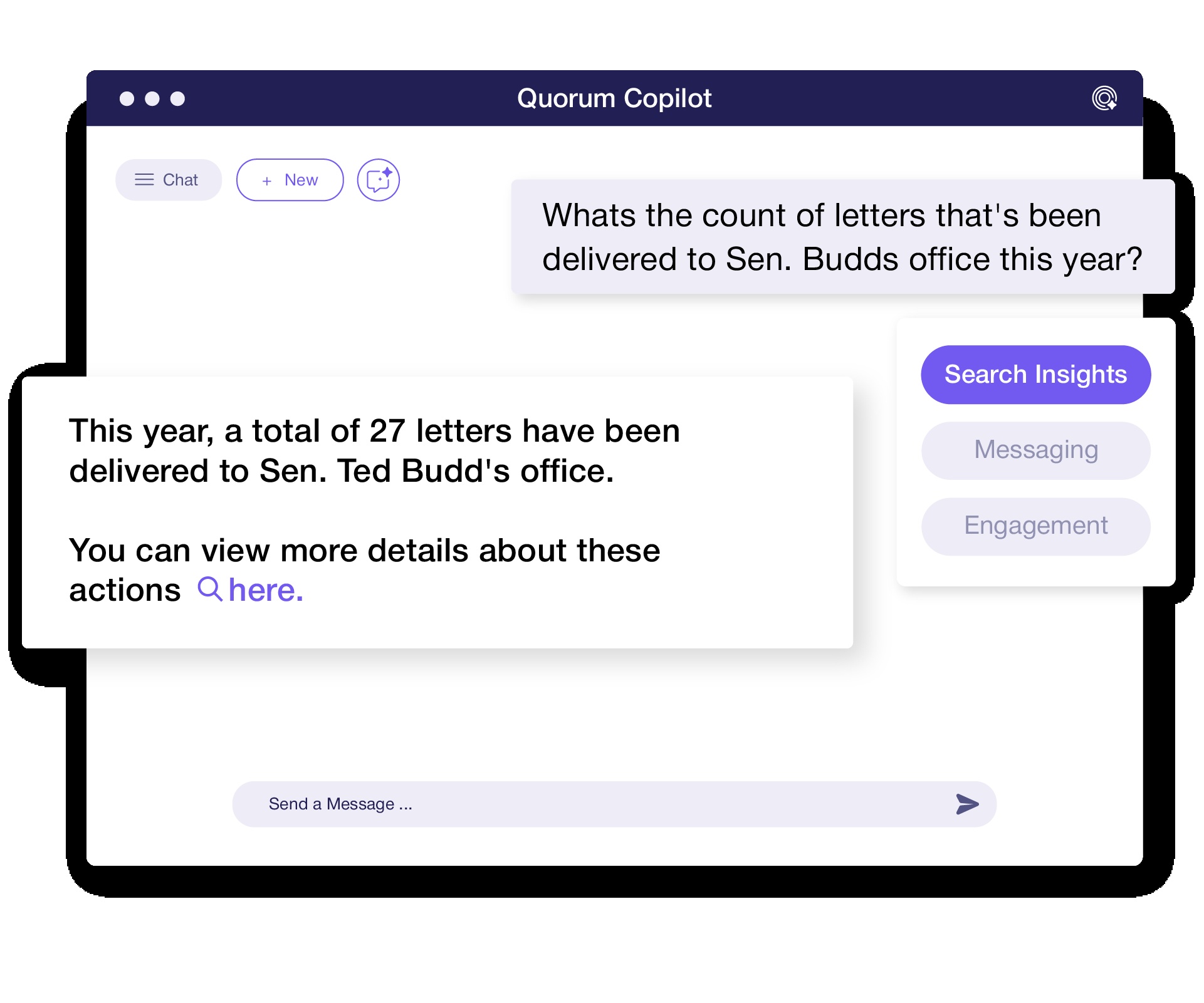
Quincy, Quorum’s AI assistant, brings that sorting and drafting work into the platform. The May 2025 expansion connected AI capabilities across Federal, State, PAC and Grassroots customers. A product illustration shows the assistant answering a question about letters delivered to a senator’s office. The value of such a question lies in access to the underlying campaign records, alongside policy information.
Buying the action after the alert
Quorum’s expansion also involved acquisitions. It acquired CisionPAC in December 2021, adding PAC management expertise. In September 2022 it bought Capitol Canary, previously Phone2Action, joining its policy products with an established digital advocacy business. Capitol Canary had also acquired KnowWho and GovPredict, bringing contact data and government intelligence into the family.
The 2022 announcement reported more than 2,000 combined clients and coverage of more than half the Fortune 100. Those figures belong to that announcement, rather than a fresh census. They explain the commercial ambition: serve the organization monitoring a proposal and the colleagues mobilizing people around it.
Customers range from corporations to trade associations, advocacy nonprofits and public agencies. Their desired outcomes can differ sharply. A shared tool does not imply a shared politics. It does imply overlapping administrative needs: reliable information, usable contacts, coordinated work and a record of activity.
Alternatives include Bloomberg Government and FiscalNote/CQ for policy intelligence, plus specialist advocacy platforms and ordinary CRMs for parts of the job. Quorum’s pitch is the connection between these activities. A buyer should test that connection with an actual issue; a broad product catalogue alone does not establish that one platform fits every team.
The price is a proposal; the work is adoption
Quorum sells product plans through a sales-led process, with add-ons and professional services. Its pricing page directs buyers to request pricing. The purchase therefore starts with a scope: jurisdictions, workflows, users and the work the team wants to combine. Washingtonian’s 2016 reporting described some clients paying six figures annually. That historical observation is not a current starting price.
Startup economics were different. Marks credited cloud resources supplied through Harvard’s Innovation Lab relationship with AWS for letting the early team build without large upfront server expenses. In August 2020, Quorum announced a minority growth equity investment from Serent Capital to accelerate expansion. In July 2026, it announced a strategic investment from Enlightenment Capital aimed at its roadmap and agentic AI. Terms of the latter transaction were undisclosed.
For a customer, adoption has a cost beyond the contract. Someone must define priorities, maintain access and make logging interactions part of the job. A practical demo would follow one real bill through discovery, interpretation, outreach and reporting. Then change the scenario: a colleague leaves, an amendment lands, a contact changes offices. The software should help the next person reconstruct the situation.
A memory still needs a keeper
Quorum’s July 2026 agent Q&A offers useful limits. Agents shared a common data layer; direct agent-to-agent communication was described as roadmap work. The initial Campaign Builder release covered a single-message letter campaign. Policy Comms monitored an organization’s own published communications. These are specific capabilities, with specific boundaries.
The company also advises checking AI answers against their underlying information. That matters because the conditions for useful automation are quite ordinary: relevant coverage, clear priorities, accurate records and people willing to review consequential output. If meetings remain unlogged, the shared memory has holes. If summaries become the final legal read, the faster workflow has skipped its essential step.
Quorum’s stated culture emphasizes respectful disagreement and discussion of mistakes. Customers need a comparable habit: make corrections visible, leave usable notes, and distinguish an activity from an outcome. A sent letter is a recorded action; a policy victory requires a larger explanation.
The company’s most persuasive proposition is easy to recognize after a handoff goes badly. The next person should be able to pick up the work without asking everyone to remember it all over again. In a town that prizes who you know, there is room for a business that helps colleagues know what you knew.
Try the workflow yourself
Explore Quorum, its interactive product tours, customer stories and policy blog. Watch the ten-year company video or read the July 2026 investment announcement.