A 50 percent shipping discount is an excellent conversation starter. It is a less reliable description of what a company will pay. Minimum charges, fuel surcharges, dimensional weight and volume thresholds can have their own opinions. TransImpact has built a business examining the difference between the number that pleases a purchasing manager and the number that arrives on the invoice.
- It checks the bill: parcel audits, refund recovery and carrier negotiation.
- It checks the warehouse: demand forecasts, inventory planning and S&OP.
- Its useful habit: connect costs to individual shipments, products and decisions.
Consider the ordinary indignity of free shipping. A customer receives a pleasing checkout message. Somewhere else, a business absorbs the carrier charge. If that charge changes, the product can keep selling while its profit quietly deteriorates. Sales sees the order. Finance sees an expense. Logistics sees the package. Each department can be correct and still leave the company with an incomplete picture.
TransImpact sells ways to put those pictures together. Its parcel tools inspect invoices and contracts; its planning tools examine what a business should stock. The appeal is wonderfully practical: find the money obscured by disconnected records, then give someone enough detail to do something about it.
A large discount. A smaller saving.
Imagine a $100 bill: $50 in eligible transport charges and $50 in charges that stay unchanged. Move the discount to see what happens.
The people who knew the other side of the table
Keith Byrd and Travis Burt founded Transportation Impact in 2008 after working at UPS. That background matters because carrier pricing is an institutional process as well as a mathematical one. A concession must make sense to the people approving it. Knowing the approval machinery can be as useful as finding an attractive rate in a spreadsheet.
The current negotiation service begins with shipping data. TransImpact models the shipment profile, develops a strategy and prepares carrier communications for the client to send. It examines the proposals, helps implement the agreement and subsequently checks invoices. The company describes a four-to-six-week engagement. The promise has a test attached: did the negotiated terms actually change the bill?
The commercial arrangement follows that test. The initial analysis is free; negotiation fees depend on delivered savings validated on invoices. This creates a different buying conversation from paying for advice regardless of its outcome. It also makes the definition of savings, the baseline and the monitoring period important parts of the contract a prospective customer should understand.

This is a familiar category with serious alternatives: Shipware, Sifted, Reveel, Intelligent Audit and Green Mountain all give buyers reasons to compare. TransImpact’s particular attraction is the breadth of its offering: managed negotiation and parcel analytics sit alongside inventory forecasting. For a business trying to understand both stock and shipping, that combination deserves a look.
The broader offering emerged over time. The Jordan Company became an equity partner in March 2020. Transportation Impact changed its name to TransImpact in 2021, when its corporate timeline also records the acquisitions of business-intelligence company Vizion360 and MCG Logistics. In January 2022, it acquired Avercast, adding forecasting and inventory optimization. The expansion moved the business upstream, toward the decisions that fill a warehouse before a carrier collects anything.
The warehouse needed subtraction
Evriholder Products provides a particularly instructive example. The housewares business was launching more than 500 products annually, according to TransImpact’s case study, and its catalog had approached 9,000 SKUs. A growing catalog sounds like commercial ambition. It can also become a very elaborate way to store things that nobody wants.
The case identifies legacy planning tools as the bottleneck. Product complexity had increased faster than the team’s ability to forecast demand and manage inventory. After adopting TransImpact’s demand planning, Evriholder identified and removed 7,500 underperforming SKUs. The published account reports $14 million less excess inventory at brick-and-mortar stores without compromising availability or service levels.
“Sometimes you need to lower the water to see where the rocks are.”
Eileen Li, Chief Operating Officer, Evriholder Products
There is an unusually revealing number beside the large dollar figure. Forecast accuracy rose from 40 percent to 70 percent. That is a 30-percentage-point gain. Calling it merely a “30 percent improvement,” as marketing shorthand sometimes does, conceals the distinction. Relative to the original 40 percent, the increase is 75 percent. Careful arithmetic is rather the point of this business.
A forecast with fewer surprises
The lesson worth copying is the sequence. Establish which products are moving. Identify those tying up resources. Change the assortment and the buying decisions. Software makes the evidence easier to see; the inventory reduction still requires someone to act on it. A dashboard cannot discontinue a product by looking disappointed.
Kawasaki’s problem had a different texture. Its U.S. demand planning covered nearly 13,000 active SKUs and supported a network of more than 1,100 dealerships. TransImpact’s case describes manual spreadsheets, limited scalability and earlier planning providers that the business had outgrown. Automated analysis helped planners spend less time assembling information and more time examining part characteristics and demand patterns. The reported results include better turnover and lower carrying costs, rather than a published numerical forecast-accuracy gain.
Give the savings a day job
TransImpact’s product names are unusually literal. Parcel Spend Intelligence audits charges, tracks carrier performance and supports refund recovery. Parcel Margin Analysis joins sales orders, cost of goods, shipping expenses and shipping revenue so a business can examine profit by order, customer or SKU. Parcel Cost Variance compares expected charges with actual bills. Freight Audit & Pay extends invoice checking across transportation modes, including truck, ocean and air.
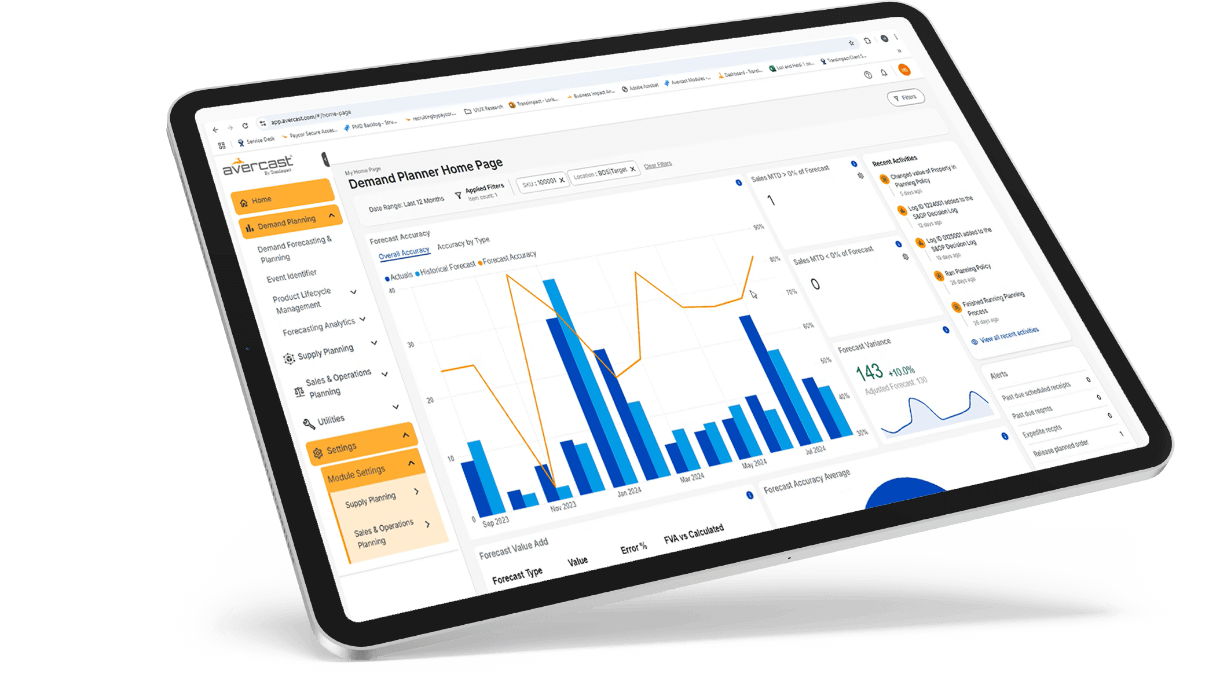
On the inventory side, Avercast-powered demand planning forecasts requirements. Supply planning turns those forecasts into replenishment decisions with constraints such as minimum order quantities and container sizes. Sales and operations planning brings sales, supply and finance into the same discussion. The intended users are the people responsible for purchasing, procurement, logistics, planning and financial control across retailers, manufacturers and distributors.
The software has its own economics. Parcel Spend Intelligence uses subscriptions and currently advertises a 60-day free trial on real shipping data, during which customers keep recovered refunds. Parcel Cost Variance is an optional add-on with an integration fee and a subscription increase. Buyers need to account for the work of connecting systems, especially when a quoted shipping charge and a final invoice live in different places.
Filters Fast offers a useful operating routine. Its published case describes a dedicated team member checking dashboards daily, then monthly reporting and annual planning meetings. What changed was the cadence: the retailer could examine service shifts and surcharges throughout the year instead of waiting for another contract negotiation. Readers can copy that assignment of responsibility before buying any new platform.
There are practical limits. Sparse demand history, inconsistent inventory records or inaccessible manifest data leave less for these tools to analyze. A small shipper with simple billing may have little need for the full suite. A forecast is useful only if purchasing can respond; a suggested shipping change needs to respect the customer’s delivery promise. These are buying conditions, not minor implementation details.
Bolt, the AI assistant within Parcel Spend Intelligence, gives users a conversational route into contracts, billing rules and shipment history. The interesting question is what follows an answer: a supported dispute, a corrected address, a revised service choice. TransImpact’s 2026 Shipstore partnership addresses another part of that handoff, connecting rate strategy with multi-carrier shipping rules and execution.
Twenty hours away from the invoice
For a company so interested in counting, its community program is appropriately specific. IMPACT1 commits 1 percent of employee time, 1 percent of profits and 1 percent in-kind services. Employees receive 20 paid volunteer hours a year. An employee-led committee decides donations. The program grew from an idea Berkley Stafford brought home after hearing Tony Robbins at the 2016 Inc. 5000 conference.

It is a small but telling expression of the same preference running through the products: give a broad intention a measurable commitment and an owner. The shipping contract, the unwanted SKU and the volunteer afternoon all become easier to discuss once somebody can say what happened. TransImpact’s most transferable habit is that insistence on detail. Read the invoice. Look at the slow stock. Decide who will act.